


GSIKE FixWall 15.0: 314Ah 16.08kWh Floor LiFePO4 Cabinet, France
Estimate delivery times: 2-7 Business days (European Union, United States).
Return within 30 days of purchase. Duties & taxes are non-refundable.
GSIKE FixWall 15.0: 314Ah 16.08kWh Floor LiFePO4 Cabinet, France
Description
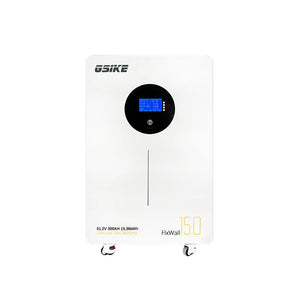
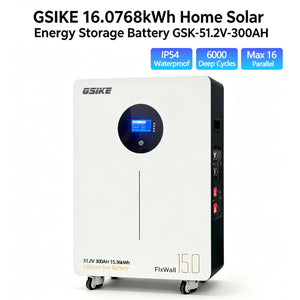
GSIKE FixWall 15.0 — 51.2V 300Ah (314Ah) 16.08kWh Floor LiFePO4 Cabinet With 200A BMS for France
A rolling 51.2V 314Ah LiFePO4 cabinet holding 16.08kWh, priced at €1,569.99 against a struck €2,250.00 reference. The unit is a battery-only DC node with no built-in AC socket, installed behind a separate 230V or 230/400V hybrid inverter for backup and solar self-consumption in French homes, gîtes and rural premises.
Product Overview
This heavy 48V-class cabinet on casters sits in a garage, cellar, plant room, country property, gîte or business outbuilding and feeds a compatible hybrid inverter. It stores DC energy only and does not make AC itself; the circuits in the property are supplied by whichever inverter the installation uses.

The cabinet costs €1,569.99, down from €2,250.00; one variant, in stock. Free delivery covers the 15 listed EU markets, with order handling of 1–3 days and onward transit of 2–7 days; a 30-day return and three-year warranty apply, and import duties and taxes are non-refundable. Listing: GSIKE 314Ah cabinet on gesike.com.
Battery and Electrical Specifications
Figures below follow the verified 300Ah cabinet record: prismatic 3.2V LFP cells from Penghui (Great Power), in a 16S1P build under a smart 200A BMS.
| Specification | Detail |
|---|---|
| Chemistry and assembly | Prismatic 3.2V LiFePO4 cells, 16S1P; cell brand Penghui (Great Power) |
| Nominal voltage | 51.2V (48V-class bus) |
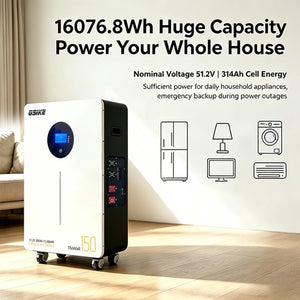
| Real capacity and energy | 314Ah / 16,076.8Wh = 16.08kWh; the printed 300Ah / 15.36kWh mark is the nominal marketing label |
| BMS current | 200A charge and 200A discharge, DC ceiling about 10.2kW (10,240W at 51.2V); this is not a 15kW continuous rating |
| Working voltage | 43.2V – 58.4V; discharge cut-off near 43.2V |
| Charge voltage | 58.4V bulk/absorption, standard CC/CV profile for 16S LFP |
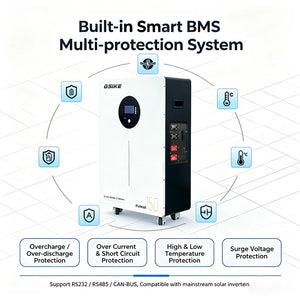
| Built-in smart BMS | Protection against over-charge, over-discharge, over-current, short-circuit, high and low temperature, surge voltage |
| Communication | RS232, RS485 (Pylontech protocol), CAN-BUS for pairing with a compatible 48V hybrid inverter |
| Inverter compatibility | Suitable devices: Deye, Growatt, Sungrow, Sofar, Sol-Ark, EG4; compatibility is not certified for every model, verify before purchase |
| Cycle life | 6000 cycles at 80% DoD, 25°C; design life roughly ten years; beyond 10,000 cycles at 50% DoD |
| Usable reserve | About 12.9kWh at 80% DoD; roughly 11.5–12kWh usable AC through an inverter of around 95% efficiency |
| AC output | None; battery-only DC node; phase count depends on the connected inverter |
| Monitoring | Round LCD and on/off switch; no WiFi or Bluetooth, no mobile app |


Expansion, Cabinet Build and Environment
Several cabinets can stand side by side on the 51.2V bus; casters let the unit be rolled into position, and the IP54 case is intended for dry indoor rooms or a closed sheltered position in a French home or premises.
| Specification | Detail |
|---|---|
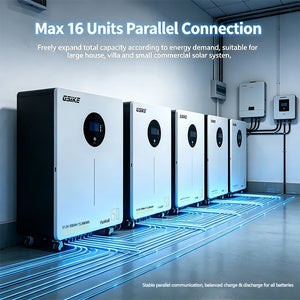
| Expansion scheme | Parallel only, up to 16 cabinets on the 51.2V bus with unique address 1–16; series connection not allowed |
| Mixing rule | Do not mix brands or capacities in the same parallel bank |
| Form factor | Floor-standing cabinet on casters, rollable; round LCD, on/off switch, terminal blocks |
| Ingress rating | IP54, dust-tight and splash-proof; not waterproof; indoor or dry sheltered use only |
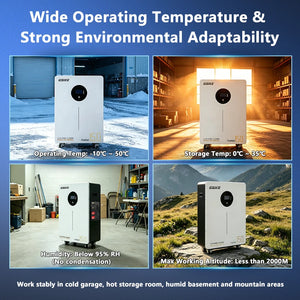
| Operating temperature | −10°C to 50°C |
| Storage temperature | 0°C to 35°C; humidity below 95% RH without condensation; altitude below 2000m |
| Low-temperature charging | No self-heating; do not charge below 0°C |
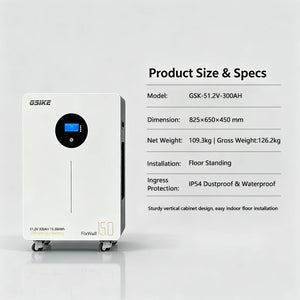
| Net weight | 109.3kg |
| Gross weight | 126.2kg on pallet |
| Dimensions | 825 H × 650 W × 450 D mm |


Home and Solar Context in France
One cabinet holds a reserve that keeps essential household circuits going through an evening interruption and, when set for self-consumption, moves solar energy toward the afternoon and evening load. How far that reserve stretches depends on what the household draws, inverter efficiency, depth of discharge and how many cabinets share the bus.
| Context Point | Detail |
|---|---|
| Whole-home reserve | Roughly 12.9kWh is available at 80% DoD before inverter losses; essential circuits should be planned against that figure rather than the full 16.08kWh nominal |
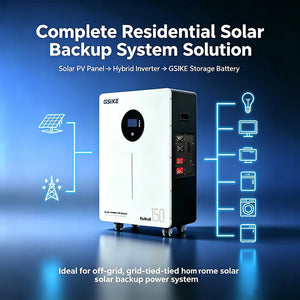
| Inverter pairing | It works with a matching single-phase 230V or three-phase 230/400V inverter; phase count and backup switching are the inverter's responsibility |
| PV self-consumption | The rooftop or ground-mounted array charges the cabinet through the hybrid inverter or MPPT regulator; autonomy days are planned around daily yield and the evening draw |
| Placement | The cabinet stands on its casters; across France's temperate climate it belongs in a ventilated, dry indoor or sheltered position, so check floor load-bearing, ventilation and the delivery route before the pallet arrives |


In the Packaging
| Item | Detail |
|---|---|
| FixWall 15.0 51.2V 314Ah cabinet with casters | Yes |
| Terminal blocks and connection fittings | As specified; check the cables on the product listing before purchase |
| User manual | Included |
| Hybrid inverter, solar panels or mounting rails | Not included; chosen separately for the French installation |
Pros & Cons
Objective Strengths
- Large reserve: the 314Ah rating stores 16.08kWh for whole-home backup, evening self-consumption and multi-day autonomy in a French home or holding.
- Strong BMS: 200A charge and discharge, six protection levels and cell balancing keep sustained household and workshop loads stable.
- Linked comms: RS232, Pylontech-protocol RS485 and CAN-BUS keep charge limits aligned with the matched 48V inverter.
- Scalable: another 15 cabinets can be added in parallel on the 51.2V bus as demand grows.
- Long service: 6000 cycles at 80% DoD and 25°C, a design horizon near ten years, three-year warranty.
- Roll-on format: casters move the cabinet into a garage, cellar or plant room with no bracket fixing to a vertical surface.
Objective Weaknesses
- DC node: no AC socket on the cabinet; household circuits need a separate 48V hybrid inverter.
- DC ceiling: 200A is a DC ceiling near 10.2kW, not a 15kW continuous nominal rating; keep loads inside that limit.
- No app: the round LCD alone shows status; there is no WiFi, Bluetooth or phone control.
- Parallel only: series strings are impossible, and cabinets from other brands or capacities must never share a bank.
- No heater: no low-temperature self-heating is fitted, and charging cells below 0°C is forbidden.
- Heavy build: net 109.3kg (gross 126.2kg on pallet) calls for a solid floor, two-person movement and delivery space.
Practical Applications
High-capacity fixed storage where the 48V DC node feeds a matching inverter: home backup, cellar and plant room, farm holding, gîte and light-commercial premises.

Home Technical Room
The cabinet stands in a ventilated, heated technical room, wired to the hybrid inverter so essential circuits stay ready for an interruption.

Parallel Reserve Bank
Further cabinets join the bus in parallel, lifting total stored energy for a larger home or a space needing a longer reserve.

Farm and Small Business
The unit supports a farm holding, compact workshop, small shop or café, keeping tools, fridges and circuits steady on reserve.

Garage or Outbuilding Placement
Casters move the cabinet into a garage or outbuilding for installation and upkeep; it stands free on its own base.
Frequently Asked Questions
What are the voltage, Ah and energy rating of the GSIKE FixWall 15.0?
The cabinet runs on the 51.2V nominal bus of the 48V class, carries a 314Ah rating and stores 16,076.8Wh, or 16.08kWh, from 3.2V LiFePO4 cells in a 16S1P build. The 300Ah / 15.36kWh figure printed on the unit is the nominal marketing label rather than the measured cell rating.
How high a continuous DC power does the 314Ah cabinet's BMS allow?
The smart BMS caps both charge and discharge at 200A, a DC ceiling near 10.2kW (10,240W at 51.2V). That is not a 15kW continuous rating, and whatever AC reaches household loads comes from the separate inverter wired to the cabinet.
Does the cabinet supply French household appliances on its own?
No. There is no built-in AC socket, so the unit is a battery-only DC node. The single-phase 230V or three-phase 230/400V supply for household circuits comes from the system's separate hybrid inverter, not the cabinet.
Which inverter models are able to read the BMS over the three-phase installation?
Data runs over RS232, a Pylontech-protocol RS485 line and CAN-BUS. The cabinet targets 48V Pylontech-compatible inverters such as Deye, Growatt, Sungrow, Sofar, Sol-Ark or EG4; compatibility is not certified for every model, so verify the protocol before buying.
What number of cabinets may share a single 51.2V parallel bus?
Up to 16 cabinets may join the 51.2V bus in parallel, each set to a unique address 1 to 16. Series connection is impossible; other brands or capacities must never be built into the same bank.
Which cycle rating, design life and warranty come with the cabinet?
The rating is 6000 cycles at 80% depth of discharge and 25°C, a design horizon near ten years, and beyond 10,000 cycles at 50% DoD. The unit carries a three-year warranty on the EU market.
After depth-of-discharge and inverter losses, how much usable energy is left?
At 80% DoD the stored reserve is roughly 12.9kWh before inverter losses; after a roughly 95%-efficient inverter, about 11.5–12kWh of usable AC reaches the household.
Which indoor placement, weight and case dimensions does the cabinet have?
The cabinet moves on casters and stands free rather than being fixed to a vertical surface. Net weight is 109.3kg, gross 126.2kg on the pallet, and the case measures 825 H × 650 W × 450 D mm; the round LCD, on/off switch and terminal blocks sit behind an IP54 rating for indoor or dry sheltered use.
Which fault protections does the cabinet's smart BMS guard against?
The controller protects against over-charge, over-discharge, over-current, short-circuit, high and low temperature, and surge-voltage events, keeping the internal cells balanced against one another.
Under which ambient and storage temperature limits may the cabinet run, and what is the sub-zero charging rule?
Allowed ambient use spans −10°C to 50°C, with storage between 0°C and 35°C. No self-heating element is fitted, and charging the cabinet below 0°C is not allowed.
Related GSIKE Guides for France
How repeated outages and shifting the evening load change the value of the 16kWh cabinet in a French home.
Compare the cabinet with established European and Asian 16kWh options on capacity, communication, format and warranty.
Plan stored energy for multi-day autonomy around daily consumption and solar yield at a country house, gîte, farm or remote plot.
Cover matching a three-phase inverter, cabinet address settings, wiring checks and pallet delivery for a home install.
LiFePO4 battery 51.2V 300Ah, 314Ah 16kWh home battery, whole-house backup battery for France, 48V 314Ah 16.08kWh LFP cabinet, GSIKE FixWall 15.0, 16kWh LiFePO4 battery for a solar system, floor cabinet with 200A BMS, 16kWh battery for self-consumption, GSIKE 16kWh floor storage for backup, RS485 Pylontech-protocol and CAN battery, high-capacity 48V bank for family home, gîte, farm and light business

