




Gsike 12.8V 300Ah LiFePO4 Pack 3840Wh, 100A BMS | Solar RV Boat
Estimate delivery times: 2-7 Business days (European Union, United States).
Return within 30 days of purchase. Duties & taxes are non-refundable.
Gsike 12.8V 300Ah LiFePO4 Pack 3840Wh, 100A BMS | Solar RV Boat
Description
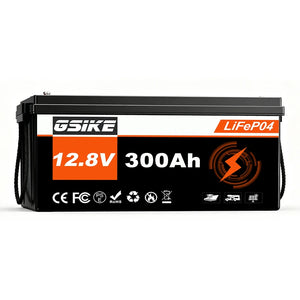
Gsike 12.8V 300Ah LiFePO4 Battery Pack (3840 Wh Nameplate, 100A BMS) for Solar RV Boat Backup
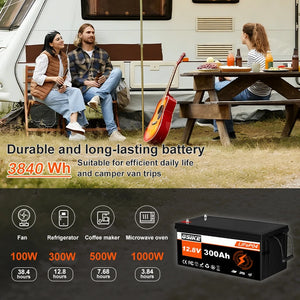
Built on a 12V bus, this Gsike iron-phosphate unit pairs a 300 Ah / 3840 Wh nameplate tier with a 314 Ah / 4019.2 Wh engineering cell grade. A 100A BMS, 6000 rated cycles and a sealed IP65 ABS housing make it a candidate for solar arrays, campervans, motorhomes, small craft and light off-grid standby duty.
Overview and price

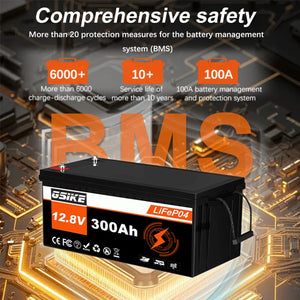
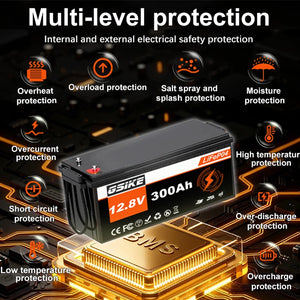
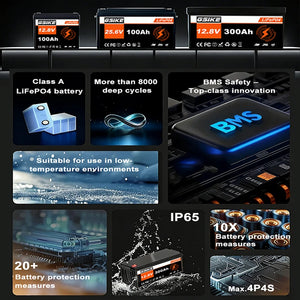
This Gsike unit is, at heart, a deep-cycle LFP reservoir for a 12V bus. Its 100A BMS monitors over-charge, over-discharge, over-current, over-temperature and short circuit, while the usable capacity stays high. Think of it as a DC tank rather than a portable station or inverter: charging sources and loads connect through separate external gear.
Full specification

| Feature | Specification |
|---|---|
| Chemistry / assembly | LiFePO4 (LFP), 12.8 V nominal, 4 cells in series (4S) |
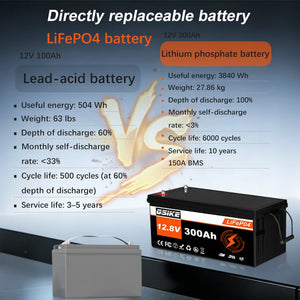
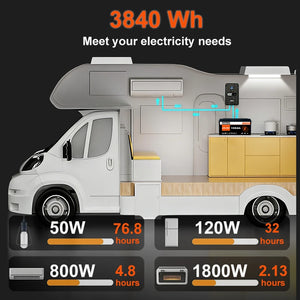
| Capacity / energy (nameplate) | 300 Ah / 3840 Wh (300 Ah x 12.8 V) |
| Capacity / energy (engineering) | 314 Ah / 4019.2 Wh (314 Ah x 12.8 V) |
| Continuous current | 100 A charge, 100 A discharge |
| DC continuous power | 1280 W (12.8 V x 100 A) |
| Pulse / peak | 400 A for 1 second (startup surge, not continuous) |
| BMS | 100A BMS: over-charge, over-discharge, over-current, over-temperature, short-circuit protection; discharge cut-off at 10 V |
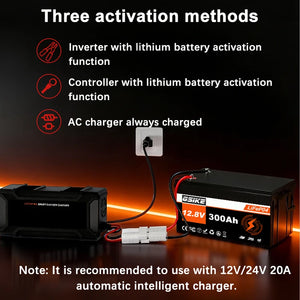
| Charge profile | CC/CV, 14.4 V +/-0.2 V; recommended charge current 40 A; BMS allows up to 100 A continuous charge |
| Cycle life | 6000 cycles at 80% DoD; about 5000+ at 100% DoD; roughly 10-year design life |
| Expansion | 4P4S = 16 units = 64.3 kWh (4S = 51.2 V, 4P = 1256 Ah) |
| Internal resistance | <=20 mOhm |
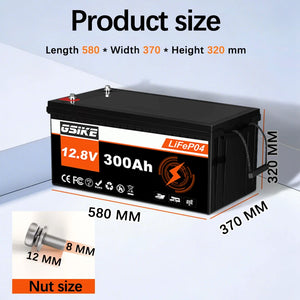
| Terminals | M8 bolt terminal (8 mm bolt / 12 mm nut) |
| Housing / rating | ABS housing, IP65; CE, RoHS, UN38.3 |
| Weight / dimensions | 26 kg net, 27 kg gross; 540 x 283 x 275 mm (L x W x H) |
| Self-discharge | Less than 3% per month |
Build and environmental conditions
| Area | Specification |
|---|---|
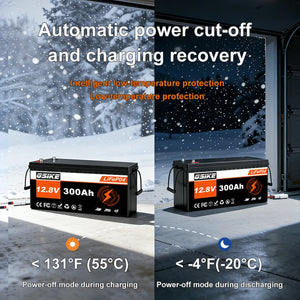
| Charge temperature | 0 C to 50 C; no self-heating element; do not charge below 0 C |
| Discharge temperature | -20 C to 60 C |
| Storage temperature | -10 C to 50 C; store at about 50% state of charge |
| Built-in charger | None; a separate 14.4V LiFePO4 charger or MPPT controller is required |
| Built-in inverter | None; a separate 12V inverter is needed for 230V appliances |
| Display / communication | No documented display; no documented CAN/RS485/RS232 port |
| Monitoring | Wi-Fi, app and Bluetooth are not documented on the spec sheet |
| Voltage class | 12V class: 12V inverter, 14.4V LiFePO4 charger/MPPT; inverter efficiency about 90-95% |
Shipping, returns and warranty by market
| Policy | Detail |
|---|---|
| Shipping cost | 0 EUR to the 15 listed EU countries: GB, DE, FR, IT, ES, NL, BE, AT, SE, DK, FI, IE, PT, PL, CZ |
| Handling / transit | Handling 1-3 days; transit 2-7 days |
| Returns | 30-day return by mail in original condition and packaging; duties and taxes are non-refundable |
| Warranty | 3-year warranty; roughly ten-year design life |
| Other markets | For destinations outside the 15 listed countries, including Ukraine, the listed shipping and return terms do not apply; delivery, import and customs must be confirmed with the seller |
Pros and cons (objective)
Pros
- High usable capacity: 300 Ah / 3840 Wh nameplate tier, 314 Ah / 4019.2 Wh engineering grade
- 6000 cycles at 80% DoD; low-maintenance LiFePO4 construction, free of lead-acid servicing
- 100A BMS carrying multiple protection circuits; 400A one-second startup pulse
- IP65 ABS housing, M8 terminals, CE/RoHS/UN38.3 marks; room to expand toward 64.3 kWh
Cons
- Built-in charger, inverter and AC outlet are absent; external 12V gear is needed
- No screen, documented data bus, app or Wi-Fi monitoring is listed
- Steady output held to 1280 W DC; the 400 A rating lasts one second and nothing more
- 26 kg net over a 540 x 283 x 275 mm case: compact footprint, real weight; lift with two people
Practical applications

Campervan and motorhome
Fridge, water pump, lights and chargers run for several days off hook-up on the 300 Ah bank. Being 12V class, it mates with a 12V inverter plus a 14.4V LiFePO4 charger or MPPT controller.

Boat and trolling motor
Onboard gadgets and the electric trolling motor draw steady, sag-free current from the pack. The wiring remains 12V, and the IP65 housing fits a dry, ventilated cabin on deck.

Home backup and solar storage
A small off-grid or hybrid system uses it to hold midday solar for evening use. Its 100A continuous current supports heavier appliances; outages are crossed via the battery plus an external inverter.

Off-grid cabin and camping
Weekend runs and longer remote stays ride through cloudy spells on this reserve. Parallel expansion lets the bank grow later as needs rise.
Common questions about the Gsike 12.8V 300Ah LiFePO4 battery
Which capacity rating should I read: 300 Ah or 314 Ah?
One bank, two reference points. Sales tier: 300 Ah, which works out to roughly 3840 Wh at 12.8 V. Real cell grade: 314 Ah, which works out to 4019.2 Wh at 12.8 V. The 314 Ah number reflects the cells actually installed; 300 Ah labels the marketed tier, so the dual marking is intentional, not faulty.
What system voltage class is this pack made for?
This unit sits in the 12V family: 12.8 V nominal, four cells in series (4S). Its circuit needs an external 12V inverter plus a 14.4V LiFePO4 charger or MPPT controller. Any 24V / 25.6V gear uses a separate cell layout and must not connect to this bank.
How much current can it draw continuously, and what is the peak?
Charge and discharge each top out at 100 A, with a steady DC limit of 1280 W (12.8 V x 100 A). The 400 A rating covers a one-second startup pulse only—compressor kick and similar motor inrush—not ongoing draw. Anything that keeps pulling over 100 A or 1280 W calls for parallel packs or a redesigned system.
How is the battery charged?
Charge uses CC/CV with a 14.4 V +/-0.2 V end voltage. Suggested current is 40 A; the BMS permits up to 100 A continuous charge. A standard lead-acid unit parked at a 13.5-13.8 V float level, with no LiFePO4 curve, cannot complete the charge and should not be used. Discharge shuts down near 10 V.
How long are the cells expected to last?
Rated lifespan: 6000 cycles measured at 80% DoD; a full 100% drain is expected to reach roughly 5000 cycles or more. Design life is cited near ten years. Realized service varies with temperature, depth of cycling, charge current and maintenance habits.
What terminals and enclosure does the unit use?
Terminals are M8 bolts (8 mm bolt, 12 mm nut) matched to ring lugs sized for the cable current. The ABS case carries an IP65 ingress grade; markings include CE, RoHS and UN38.3. Net weight 26 kg, gross 27 kg; case footprint 540 x 283 x 275 mm (L x W x H).
Is there a screen, app, Wi-Fi or data port on this model?
This listing shows no LCD screen, no CAN/RS485/RS232 port, and no documented Wi-Fi, app or Bluetooth module. The unit is a bare DC node—no built-in charger, inverter or mains outlet. 230V devices must connect through an external 12V inverter.
Can several units be tied together for a bigger bank?
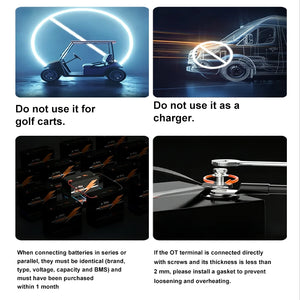
Maximum stated build: 16 units in 4P4S, about 64.3 kWh (4S = 51.2 V, 4P = 1256 Ah). Build-up stages: 1P1S 12.8V/314Ah/~4.0 kWh; 2P1S 12.8V/628Ah/~8.0 kWh; 4P1S 12.8V/1256Ah/~16.1 kWh; 4P4S 51.2V/1256Ah/64.3 kWh. Only matched packs—similar production date and state of charge—may be combined; fresh and heavily worn cells must never share a bank.
How do shipping, returns and warranty work for a buyer in Ukraine?
Free 0 EUR carriage and the stated 30-day mail return cover just the 15 listed destination markets; inside that list, handling runs 1-3 days and transit 2-7 days. Warranty is 3 years under seller terms. Ukraine falls outside that destination set, so delivery, import duties and customs charges need confirmation with the seller before purchase; this page makes no Ukraine delivery guarantee.
What is the selling price of the Gsike 12.8V 300Ah battery?
Listed price: 369.99 EUR; compare-at 470.00 EUR as of October 12, 2026. This page shows EUR amounts only. Reaching your address depends on carriage and import arrangements; current terms are published on the product listing.
Gsike 12.8V 300Ah LiFePO4 battery, 3840 Wh storage, 100A BMS, 12V RV battery, solar storage 12V, boat battery, 6000 cycles

