


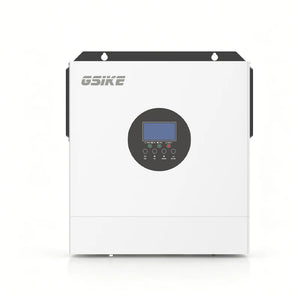
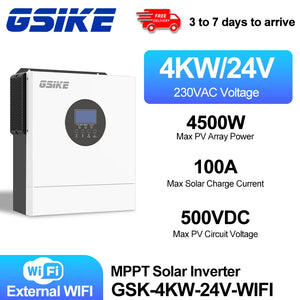
GSIKE Power 4.2KW Solar Inverter 24V 220V Off Grid Inverter 120A MPPT Solar Controller With WIFI
Estimate delivery times: 2-7 Business days (European Union, United States).
Return within 30 days of purchase. Duties & taxes are non-refundable.
GSIKE Power 4.2KW Solar Inverter 24V 220V Off Grid Inverter 120A MPPT Solar Controller With WIFI
Description
GSIKE 4.2kW 24V Off-Grid Hybrid Solar Inverter — 120A MPPT, 8000VA Surge, 94% Efficient, Battery-Free, Free EU Shipping
The GSIKE 4.2kW 24V off-grid hybrid inverter delivers 4200 W of continuous pure-sine 230V AC with an 8000 VA surge, a single 120A MPPT solar charger for a 60–500 Vdc PV array of up to about 6200 W, 94% peak efficiency, about 10 ms UPS switchover and genuine battery-free operation, and it is in stock across Europe at EUR 189.99 with free delivery to 15 countries and a 30-day return window.
4200 W continuous 8000 VA surge 120A single MPPT ~6200 W PV 94% efficient No battery needed WiFi optional

| Parameter | Value |
|---|---|
| Continuous AC power | 4200 W / 4.2 kVA, dual AC output (main + secondary circuit) |
| Surge power | 8000 VA (2.0× continuous, for motor startup) |
| MPPT charger | Single 120 A MPPT solar charge controller (not dual MPPT) |
| PV input | 60–500 Vdc, maximum PV array up to about 6200 W |
| AC (mains) charge | 80 A |
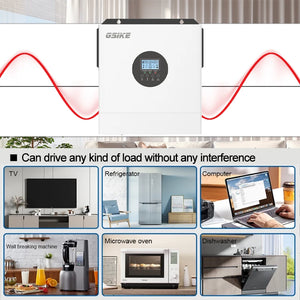
| Waveform / power factor | Pure sine wave, PF 0.6–1.0; works without a battery |
| Battery / AC output | 24 V DC · 220–230 V AC (±5%), 50/60 Hz auto |
| Parallel capacity | None — single unit only, cannot be paralleled or stacked |
| UPS transfer | About 10 ms (PC loads) / 20 ms (appliance loads) |
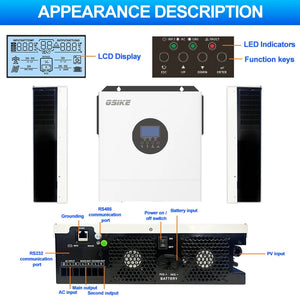
| Monitoring & ports | WiFi (optional), RS232 (DB9), RS485 (RJ45), dry-contact / ATS, LCD |
| Price / stock | EUR 189.99 · In stock, new condition |
| Delivery / returns | Free shipping to 15 European countries, 2–7 days · 30-day returns |
Full technical specifications
AC output & conversion
| Item | Specification |
|---|---|
| Continuous power | 4200 W / 4.2 kVA, dual AC output (main + secondary, both in the ~4000–4200 W class) |
| Surge power | 8000 VA for 5 seconds (2.0× continuous, for motor and compressor inrush) |
| Output waveform | Pure sine wave, power factor 0.6–1.0 |
| Nominal AC output | 220–230 V AC ±5%, 50/60 Hz auto-sensing |
| Overload rating | 5 s at ≥140%, 10 s at 100–140% |
| UPS transfer time | About 10 ms for PC loads, 20 ms for appliance loads, on grid outage |
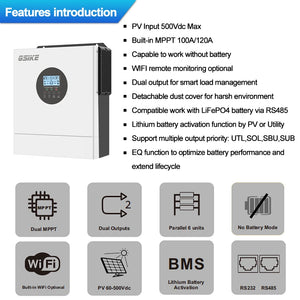
| Output priority modes | UTL / SOL / SBU / SUB selectable on the LCD |
PV input & charging (single MPPT)
| Item | Specification |
|---|---|
| MPPT trackers | One single MPPT channel, 120 A solar charge current |
| PV input voltage range | 60–500 Vdc |
| Maximum PV array | Up to about 6200 W (title / sellpoint figure) |
| Theoretical solar charge power | 120 A × 24 V = 2880 W (about 3240 W at 27 V float) |
| AC (mains) charge current | 80 A |
| Battery charge profile | CC/CV; supports lead-acid and LiFePO4; lithium activated from PV or mains |
System, mechanical & protection
| Item | Specification |
|---|---|
| Battery voltage | 24 V DC; float charge 27 V, overcharge protection at 33 V |
| Battery-free operation | Supported — runs on PV or mains alone; no overnight power after sunset |
| Parallel operation | No — single unit only, cannot be paralleled with another GSIKE unit |
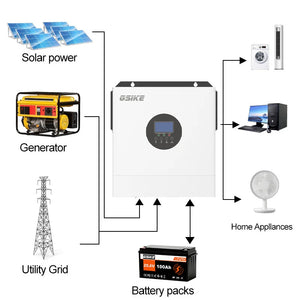
| Communication | WiFi (optional module), RS232 (DB9), RS485 (RJ45) for LiFePO4, dry-contact for generator / ATS |
| Casing / ingress | Removable dust cover, IP21 |
| Operating temperature | −10 °C to +50 °C |
| AC input range | 230 V AC nominal (170–280 V for PC loads, 90–280 V for appliance loads), 50/60 Hz |
| Dimensions (W × D × H) | 368 × 312 × 105.5 mm |
| Net weight | 6.7 kg |
| Protection | Overload, short-circuit, over-temperature, battery over/under-voltage |
Pros & cons (verified, not marketing)
Pros
- 4200 W continuous with an 8000 VA (2.0×) surge — enough to start a fridge, a water pump or a small compressor alongside house loads.
- Single 120 A MPPT accepts a 60–500 Vdc PV array of up to about 6200 W, so a modest 3 kWp build sits comfortably inside the limit.
- 94% peak efficiency and about 10 ms UPS switchover, with a clean pure-sine 230 V output for sensitive electronics.
- Genuine battery-free operation and UTL / SOL / SBU / SUB priority modes; RS485 auto-recognises Pylon-style LiFePO4 batteries.
- Compact and light: 368 × 312 × 105.5 mm, 6.7 kg, IP21 — mounts in a cupboard, garage or utility corner.
- EUR 189.99 is the cheapest verified branded / EU-warehouse 4.2 kW / 24 V / 120 A unit — about 19.7% cheaper than the EASUN 4.2K at EUR 229.00 and 37.2% cheaper than the SANDISOLAR at EUR 292.98.
- Free shipping to 15 European countries in 2–7 days, with a 30-day return window.
Cons
- No parallel / stacking — this is a single-unit inverter with a hard ceiling around 4 kW per box; if you need more you must step up to a larger 48 V model, not add a second unit.
- 24 V is not for larger systems — builds of 6.2–11 kW need 48 V. At 24 V the full-load battery current is about 4200 / (24 × 0.92) = 190 A, forcing thick 35–70 mm² cables; this is why 24 V realistically tops out near 4 kW.
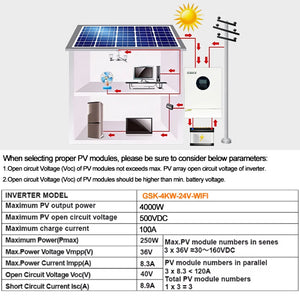
- Title vs manual discrepancy — the box title says 120 A / ~6200 W PV while the shared manual's 4 kW column says 100 A / 4000 W; verify the actual controller on your unit.
- English-only support chat; no local-language phone line per country, and no VAT invoice guarantee for business buyers.
- WiFi is an optional module; the base unit relies on the LCD and wired RS232 / RS485.
- No night power in battery-free mode — once the sun is down there is no output without a PV feed or a connected battery bank.
Where the 4.2 kW 24 V inverter fits — real European use cases
Modest off-grid cottage
A four-to-five-panel rooftop array on a small cottage powers lights, a fridge and charging points without an oversized system.
Tiny home & cabin
A compact, light 6.7 kg unit fits the limited space of a tiny home or holiday cabin while running essentials from PV.
Garden office & summer house
Bring 230 V power to a garden room for a laptop, router, lighting and a kettle without a grid connection.
Caravan & travel
Portable PV plus a small 24 V inverter runs a caravan's outdoor kitchen, lights and media on a quiet coastal pitch.
Rural smallholding
Wall-mount the unit outside a modest farmhouse to run a water pump, fencing and a few livestock loads.
Garage workshop
The 8000 VA surge starts a bench drill or grinder, while the battery keeps the workbench lit after dark.
24 V LiFePO4 battery corner
Two compact 24 V LiFePO4 packs on a shelf communicate over RS485; the 120 A stage charges a 400–600 Ah bank gently.
Modest household loads
Fridge, kettle and warm LED kitchen lighting run quietly on pure-sine power — the everyday loads this 4 kW unit is sized for.
Shipping & returns
| Policy point | Detail |
|---|---|
| Price | EUR 189.99 · In stock, new condition |
| Free delivery to | Europe |
| Handling / transit | Handling 1–3 days + transit 2–7 days, shipping rate EUR 0 |
| Returns | 30-day return window, by post, in original condition and packaging |
| Return cost | Buyer pays return shipping; original shipping refunded; import duties and taxes are non-refundable |
Frequently asked questions
What is the continuous and surge power of the GSIKE 4.2kW 24V inverter?
The GSIKE 4.2kW delivers 4200 W / 4.2 kVA of continuous pure-sine 230V AC across a dual output (a main plus a secondary circuit), and an 8000 VA surge for about 5 seconds — a 2.0× rating sized to start a refrigerator, a well pump or a small compressor that draw several times their running current at startup.
Can the GSIKE 4.2kW inverter really run without a battery?
Yes. This 24V hybrid inverter is specified to run on PV or mains with no battery bank connected, and lithium packs can be activated from PV or the grid. The honest trade-off is that battery-free mode gives no overnight power after sunset, so a 24V LiFePO4 battery bank is still required for evening or night-time off-grid loads.
What does the single 120A MPPT accept as a PV array?
There is one single MPPT channel rated at 120 A, accepting a 60–500 Vdc PV array up to about 6200 W. The theoretical solar charge power is 120 A × 24 V = 2880 W (about 3240 W at the 27 V float). A sensible 3 kWp build (for example 6 × 550 W panels) sits comfortably inside that limit.
Why is this 24V unit not suitable for a 6 kW or larger home system?
At 24 V the full-load battery current is about 4200 / (24 × 0.92) = 190 A, which forces very thick 35–70 mm² cables and heavy volt-drop losses. Systems of 6.2–11 kW are therefore built on 48 V, where the current is halved. This 24V inverter is the right choice only up to about 4 kW per unit.
Can I parallel two GSIKE 4.2kW units to get 8 kW?
No. This model does not support parallel or stacked operation — it is a single-unit inverter only, which is its main drawback next to larger GSIKE 48V models. If your load exceeds about 4 kW continuous, choose a higher-rated 48V inverter rather than adding a second 4.2kW box.
What is the 120A versus 100A spec discrepancy about?
The product title and sell points state a 120 A MPPT with about 6200 W maximum PV and 60–500 Vdc, while the shared user manual's 4 kW column lists 100 A, 4000 W maximum PV and 30–500 V (the 120 A figure belongs to the 6.2 kW / 48 V column). This page uses the marketed 120 A figures; the merchant should confirm the exact controller on the physical unit before launch. It is a single MPPT either way, not a dual-MPPT unit.
How much does the GSIKE 4.2kW 24V inverter cost and what is included?
The price is EUR 189.99 and the unit is listed as in stock and new (SKU G4200EU24V). The inverter includes the built-in single MPPT charge controller and the LCD; the WiFi monitoring module is optional rather than fitted as standard. No RRP or strike-through price is verified, so no discount percentage is claimed.
Which European countries do you ship to and how long does delivery take?
Shipping is free to 15 European countries: GB, DE, FR, IT, ES, NL, BE, AT, SE, DK, FI, IE, PT, PL and CZ. Handling takes 1–3 days and transit 2–7 days after dispatch, so most customers receive the unit within roughly 3–10 working days of ordering. Prices stay in EUR for all markets.
What battery size do I need for a small cabin on this 24V inverter?
For about 7 kWh of daily use over two autonomy nights you need 14 kWh usable, or 17.5 kWh nominal at 80% depth of discharge — about 729 Ah at 24 V (684 Ah at the 25.6 V LiFePO4 nominal), for example four 24V 200 Ah packs. The 120 A stage charges a 400–600 Ah bank at a gentle 0.2–0.3 C rate.
Does it support WiFi monitoring, RS485 lithium communication and output priority modes?
Yes. An optional WiFi module gives remote phone monitoring, and RS232 / RS485 handle local communication and Pylon-style LiFePO4 auto-recognition. A dry-contact connection supports generator or ATS transfer. The LCD sets the UTL / SOL / SBU / SUB output priority modes, and the unit switches in about 10 ms on a grid outage.
Guides & comparisons
Go deeper before you buy:
4.2kw hybrid inverter 24v,4000w off grid solar inverter 24v,24v 230v inverter 120a mppt,4000w solar inverter without battery,4.2kw solar inverter 24v 220v wifi,24v hybrid inverter 8000va surge,4200va 24v pure sine wave inverter 6200w pv,4.2kw hybrid inverter 24v price,4kw 24v hybrid inverter under 200 eur,4.2kw 24v inverter in stock eu warehouse,gsike 4.2kw 24v inverter price,24v hybrid inverter 120a mppt 60-500vdc wifi
4.2kw hybrid inverter 24v price, buy 4kw 24v off grid inverter europe, 4kw 24v hybrid inverter under 200 eur, 4.2kw 24v inverter in stock eu warehouse, 8000va surge inverter 24v motor pump startup, 4kw 24v off grid inverter free shipping europe, 4.2kw 24v inverter 30 day returns warranty, gsike 4.2kw 24v inverter price, 4000w 24v hybrid inverter deal october 2026, 4.2kw solar inverter eu delivery 2-7 days, 24v hybrid inverter 120a mppt 60-500vdc wifi, 4kw 24v inverter vat invoice business europe
how to size a 4kw 24v off grid solar system, how many ah battery for 4kw 24v inverter, wh vs ah24vbattery off grid sizing, what size 24v cable for 4kw inverter, mppt charge controller explained 120a, can 4kw 24v inverter run a fridge or water pump, can hybrid inverter work without battery 24v, utl sol sbu sub output priority modes explained, how to setup wifi monitoring 4.2kw inverter, ac charger 80a vs solar mppt 120a which charges faster, 12v vs 24v vs 48v inverter when to choose 24v
gsike 4.2kw vs easun 4.2k 24v 120a, easun vs mpp solar pip4024 24v which is better, best 4kw 24v hybrid inverter europe 2026, mpp solar pip4024 Iv424 vs chinese 4.2kw 24v, sandisolar vs anenji vs daxtromn 4.2kw 24v, gsike vs datouboss 4kw 24v inverter, axpert vm ii 4kw twin 24v vs gsike, 4kw vs 6.2kw inverter doi need more power 24v vs 48v, powland vs gsike 4kw 24v 100a inverter, 4kw 24v 120a mppt which to buy europe, 4kw 24v hybrid inverter reviews, anern aninerel 4.2kw 24v vs asike

