




Gsike 12.8V 300Ah LiFePO4 Battery, 3840Wh, 100A BMS | Solar RV Boat ES
Estimate delivery times: 2-7 Business days (European Union, United States).
Return within 30 days of purchase. Duties & taxes are non-refundable.
Gsike 12.8V 300Ah LiFePO4 Battery, 3840Wh, 100A BMS | Solar RV Boat ES
Description
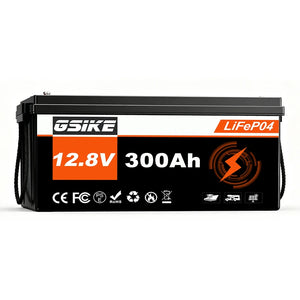
Gsike 12.8V 300Ah LiFePO4 Battery: 3840 Wh Deep-Cycle Pack for Solar, Campervan, Boat and Backup in Spain
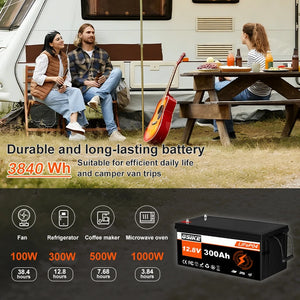
Which system size does this Gsike 12.8V 300Ah pack serve, and what sits inside? It is an iron-phosphate deep-cycle DC store built around a 12V bus: the nameplate lists 300 Ah, about 3840 Wh, while the engineering cell rating reads 314 Ah / 4019.2 Wh. A 100A BMS guards the cells, the rating reaches 6000 cycles at 80% depth of discharge, and the ABS housing carries an IP65 ingress grade. Spanish buyers will find it aimed at solar arrays, campervans, motorhomes, boats and off-grid standby, with orders here falling under the listed EU carriage terms.
Overview and price

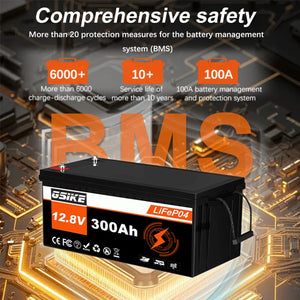
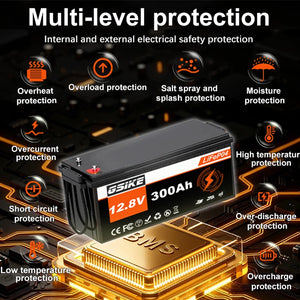
Who should consider this pack? It is a deep-cycle iron-phosphate store built around a 12V system, pairing generous usable capacity with a 100A BMS that watches for over-charge, over-discharge, over-current, over-temperature and short circuit. What it is not: neither a portable power station nor an inverter. Loads and charging sources connect to it through an external inverter or solar controller.
Full specification

| Feature | Specification |
|---|---|
| Chemistry / assembly | LiFePO4 (LFP), 12.8 V nominal, 4 cells in series (4S) |
| Capacity / energy (nameplate) | 300 Ah / 3840 Wh (300 Ah x 12.8 V) |
| Capacity / energy (engineering) | 314 Ah / 4019.2 Wh (314 Ah x 12.8 V) |
| Continuous current | 100 A charge, 100 A discharge |
| DC continuous power | 1280 W (12.8 V x 100 A) |
| Pulse / peak | 400 A for 1 second (startup surge, not continuous) |
| BMS | 100A BMS: over-charge, over-discharge, over-current, over-temperature, short-circuit protection; discharge cut-off at 10 V |
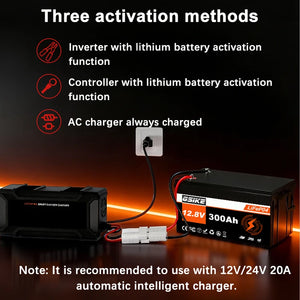
| Charge profile | CC/CV, 14.4 V +/-0.2 V; recommended charge current 40 A; BMS allows up to 100 A continuous charge |
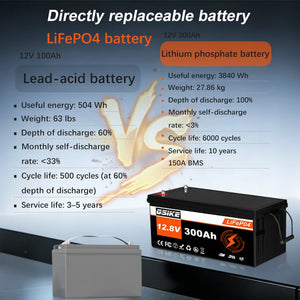
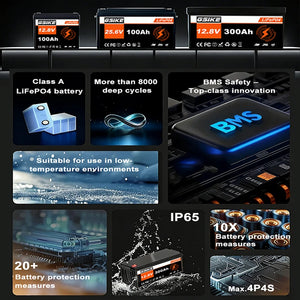
| Cycle life | 6000 cycles at 80% DoD; about 5000+ at 100% DoD; roughly 10-year design life |
| Expansion | 4P4S = 16 units = 64.3 kWh (4S = 51.2 V, 4P = 1256 Ah) |
| Internal resistance | <=20 mOhm |
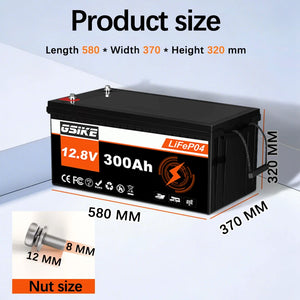
| Terminals | M8 bolt terminal (8 mm bolt / 12 mm nut) |
| Housing / rating | ABS housing, IP65; CE, RoHS, UN38.3 |
| Weight / dimensions | 26 kg net, 27 kg gross; 540 x 283 x 275 mm (L x W x H) |
| Self-discharge | Less than 3% per month |
Build and environmental conditions
| Area | Specification |
|---|---|
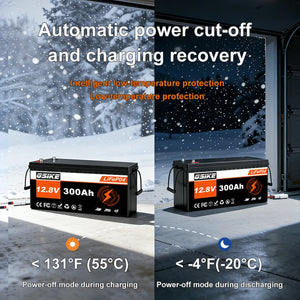
| Charge temperature | 0 C to 50 C; no self-heating element; do not charge below 0 C |
| Discharge temperature | -20 C to 60 C |
| Storage temperature | -10 C to 50 C; store at about 50% state of charge |
| Built-in charger | None; a separate 14.4V LiFePO4 charger or MPPT controller is required |
| Built-in inverter | None; a separate 12V inverter is needed for 230V appliances |
| Display / communication | No documented display; no documented CAN/RS485/RS232 port |
| Monitoring | Wi-Fi, app and Bluetooth are not documented on the spec sheet |
| Voltage class | 12V class: 12V inverter, 14.4V LiFePO4 charger/MPPT; inverter efficiency about 90-95% |
Shipping, returns and warranty by market
| Policy | Detail |
|---|---|
| Shipping cost | 0 EUR to the 15 listed EU markets: GB, DE, FR, IT, ES, NL, BE, AT, SE, DK, FI, IE, PT, PL, CZ |
| Handling / transit | Handling 1-3 days; transit 2-7 days |
| Spain position | ES appears in the listed 15 markets, so the listed free carriage and return terms apply to Spanish orders, subject to seller confirmation |
| Returns | 30-day return by mail in original condition and packaging; duties and taxes are non-refundable |
| Warranty | 3-year warranty; roughly ten-year design life |
| Other markets | For destinations outside the 15 listed countries, the listed shipping and return terms do not apply; delivery, import and customs must be confirmed with the seller |
Pros and cons (objective)
Pros
- How much energy does it hold? 300 Ah / 3840 Wh on the nameplate, with a 314 Ah / 4019.2 Wh engineering figure behind it
- How durable are the cells? 6000 cycles at 80% DoD, in a low-maintenance LiFePO4 build that needs none of the lead-acid upkeep
- How is the pack protected? A 100A BMS covers several protection functions, and the 400A one-second startup surge absorbs motor inrush
- How expandable and certified is it? IP65 ABS case, M8 terminals, CE/RoHS/UN38.3 approvals, and scaling up to 64.3 kWh in a matched bank
Cons
- What onboard electronics are missing? No built-in charger, inverter or AC outlet; external 12V components have to be sourced
- How is state of charge monitored? There is no display, no documented communication bus and no documented app/Wi-Fi monitoring
- What limits continuous draw? Power is capped at 1280 W DC; the 400 A number counts as a one-second surge only
- How heavy is it to handle? 26 kg net in a 540 x 283 x 275 mm case: compact, but heavy enough that two-person mounting is advised
Practical applications

Campervan and motorhome
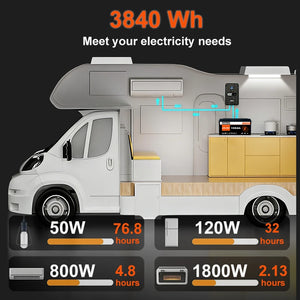
Which onboard loads does it carry overnight? The 300 Ah store keeps the fridge, water pump, lighting and chargers running for several days without shore power. Being a 12V-class pack, it works with a 12V inverter and a 14.4V LiFePO4 charger or MPPT controller.

Boat and trolling motor
What about onboard appliances and the trolling motor? The battery holds a steady discharge without voltage sag for those loads. On board, the wiring stays 12V, and the IP65 housing belongs to a dry, aired cabin rather than an exposed spot.

Home backup and solar storage
How does it support an off-grid or hybrid home? It stores daytime solar energy for the evening in a small setup. The 100A continuous current can carry heavier appliances; outages are bridged via the pack and an external inverter.

Off-grid cabin and camping
What about weekend trips and longer stays? The store buffers cloudy days in off-grid use. Being expandable in parallel, the bank can grow later as demand increases.
Frequently asked questions about the Gsike 12.8V 300Ah LiFePO4 battery
Which capacity figure applies: 300 Ah or 314 Ah?
Which number should you plan around? The storefront tier names 300 Ah, which works out to roughly 3840 Wh when you multiply 300 Ah by 12.8 V. At cell level, the engineering measurement reaches 314 Ah, or 4019.2 Wh (314 Ah x 12.8 V). The same model carries both labels on purpose: 314 Ah reflects the actual cell measurement, and 300 Ah is the tier shown on the listing.
Which voltage class does the pack belong to?
Which other devices share its bus? On a four-cell-in-series (4S) layout rated 12.8 V nominal, the pack belongs to the 12V class. Its partners are an external 12V inverter plus a 14.4V LiFePO4 charger or MPPT solar controller. A 24V or 25.6V unit comes from another cell arrangement and must never be wired onto this bank.
What are the continuous current and the startup surge?
How hard can it work at one instant? Charge and discharge each stay within 100 A continuously, putting the DC continuous ceiling at 1280 W (12.8 V x 100 A). The 400 A rating is a one-second startup surge rather than a sustained limit. Anything that holds above 100 A or 1280 W on an ongoing basis needs several parallel units or a larger designed system.
How should this battery be charged?
How should the cells be topped up? Charging runs CC/CV to a 14.4 V +/-0.2 V end voltage. Forty amps is the recommended charge current, while the BMS permits up to 100 A continuous charge. A lead-acid charger held to a 13.5-13.8 V float with no LiFePO4 profile cannot finish the cycle and should be kept off this pack. Discharge cut-off lands near 10 V.
How many cycles can the cells deliver?
What service life can you expect? The cells are quoted for 6000 cycles at 80% depth of discharge; a full 100% drain brings the expectation to around 5000 cycles or more, alongside a roughly ten-year design life. How long they actually last depends on temperature, cycling depth, charge current and general maintenance.
What terminals and housing does the unit use?
What do you connect to, and what encloses the cells? Bolt-on M8 terminals (8 mm bolt, 12 mm nut) accept ring terminals matched to the cable current. The case is ABS with an IP65 ingress rating, certified to CE, RoHS and UN38.3. Physical figures: 26 kg net, 27 kg gross, in a 540 x 283 x 275 mm (L x W x H) case.
Is there a display, Wi-Fi, app or communication port?
Can state of charge be read from the pack itself? No LCD display, no CAN, RS485 or RS232 port, and no documented Wi-Fi, app or Bluetooth module appears on this model. The unit is a pure DC node: no onboard charger, no onboard inverter, no mains AC outlet. 230V appliances require an external 12V inverter.
Can several units be combined into a bank?
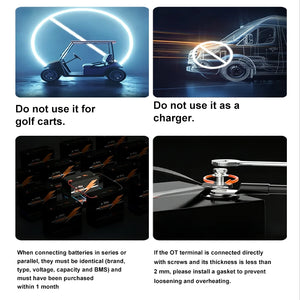
How large can a matching bank grow? The top 4P4S stage, sixteen units, reaches about 64.3 kWh (4S = 51.2 V, 4P = 1256 Ah). The stages in between run: 1P1S 12.8V/314Ah/about 4.0 kWh; 2P1S 12.8V/628Ah/about 8.0 kWh; 4P1S 12.8V/1256Ah/about 16.1 kWh; 4P4S 51.2V/1256Ah/64.3 kWh. Bring together only matched units of similar production date and charge level; new cells must never be paired with heavily worn ones.
What shipping, returns and warranty apply to a Spanish buyer?
What do Spanish buyers pay for carriage, returns and warranty? ES sits among the 15 listed EU destination markets, so the listed free 0 EUR carriage, 1-3 day handling and 2-7 day transit apply to Spanish orders subject to seller confirmation. Under the seller policy, goods come back by mail within 30 days in their original state, while the unit is covered by a 3-year warranty. For any destination outside those 15 markets, delivery and import arrangements must be checked with the seller first.
What does the Gsike 12.8V 300Ah battery cost?
What is the listed price? The pack is listed at 369.99 EUR, with a compare-at figure of 470.00 EUR as of October 12, 2026. This page shows EUR only. Current offer terms and any location-specific charges appear on the product page when you place the order.
Gsike 12.8V 300Ah LiFePO4 battery, 3840 Wh storage, 100A BMS, 12V RV battery, solar storage 12V, boat battery, 6000 cycles

