




GSIKE 12.8V 100AH Lithium Energy Storage Battery for Solar Power System
Estimate delivery times: 2-7 Business days (European Union, United States).
Return within 30 days of purchase. Duties & taxes are non-refundable.
GSIKE 12.8V 100AH Lithium Energy Storage Battery for Solar Power System
Description
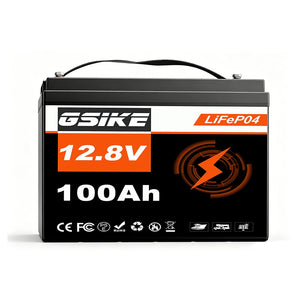
GSIKE 12.8V 100Ah LiFePO4 Battery — 1280Wh, 100A BMS, 6000 Deep Cycles, IP65, for RV, Solar & Trolling Motor, Free EU Shipping
The GSIKE 12.8V 100Ah LiFePO4 battery stores 1280Wh of deep-cycle power in a 9.8kg ABS case — a 100A BMS, 6000 cycles at 80% depth of discharge, a 14.4V CC/CV charge profile and IP65 protection give it roughly twice the usable energy of a 12V 100Ah lead-acid battery at about one third of the weight, expandable up to a 16-unit / 20.48kWh bank and sold across Europe at €159.99 with free delivery and a 30-day return window.
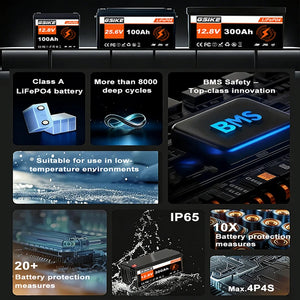
1280 Wh 100 Ah 100A BMS 6000 cycles 400A pulse / 1s 14.4V CC/CV IP65 M8 terminals up to 20.48 kWh bank

| Parameter | Value (manual model GSK-12.8V-100AH) |
|---|---|
| Chemistry / nominal voltage | LiFePO4 (LFP), 12.8 V nominal (4 cells in series) |
| Rated capacity / energy | 100 Ah / 1280 Wh (12.8V × 100Ah) |
| Continuous current | 100 A charge / 100 A discharge (max continuous power 1280 W) |
| Pulse / peak | 400 A for 1 second only (inrush / startup; not a continuous figure) |
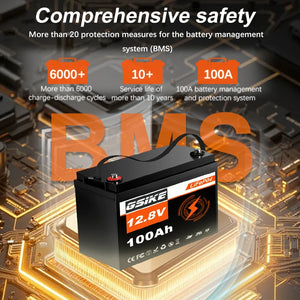
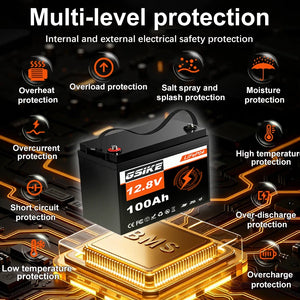
| BMS | 100 A BMS — over-charge, over-discharge, over-current, over-temperature and short-circuit protection |
| Cycle life | 6000 cycles at 80% DoD (about 5000+ at full 100% DoD) |
| Expansion | 4P4S = 16 units = 20.48 kWh (4S = 51.2 V, 4P = 400 Ah) |
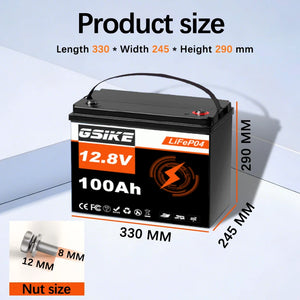
| Terminals | M8 bolt terminals (8 mm bolt / 12 mm nut) |
| Housing / ingress | ABS housing, IP65; CE, RoHS, UN38.3 certified |
| Weight / size | Net 9.8 kg (gross 10.35 kg); 315 × 215 × 280 mm (L×W×H) |
| Self-discharge | Less than 3% per month |
| Warranty / design life | 3-year warranty; ~10-year design life |
| Price / stock | €159.99 EUR · In stock, new condition, valid from 2026-07-06 (no EUR regular price, so no strike-through) |
| Delivery / returns | Free shipping to 15 European countries (1–3 days handling + 2–7 days transit) · 30-day returns |
LiFePO4 vs lead-acid / AGM (like-for-like 12V 100Ah)
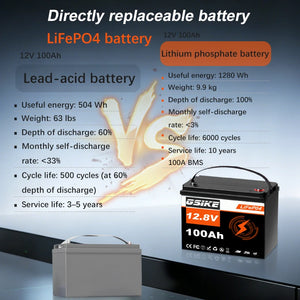
Same nominal 12V and 100Ah, very different usable energy. Because LiFePO4 safely delivers close to its full capacity while flooded lead-acid is typically limited to about 42% depth of discharge, one GSIKE 12.8V 100Ah replaces two 12V 100Ah lead-acid batteries wired in parallel (same 12V — never in series, which would make 24V).
| Metric | GSIKE 12.8V 100Ah LiFePO4 | Typical 12V 100Ah lead-acid / AGM |
|---|---|---|
| Nominal energy | 1280 Wh | ~1280 Wh nameplate |
| Usable energy (DoD) | ~1216–1280 Wh (~95–100% usable) | ~504 Wh (limited to ~42% DoD for longevity) |
| Cycle life | 6000 cycles @80% DoD | ~500 cycles |
| Weight | 9.8 kg net | ~28.6 kg |
| Real energy density | 130.6 Wh/kg (1280 ÷ 9.8) | ~44 Wh/kg |
| Maintenance | None (no watering, no equalisation) | Watering / venting / equalisation |
| Replacement ratio | 1 GSIKE = 2 × 12V 100Ah lead-acid IN PARALLEL for the same usable Ah at 12V | |
Charge settings & operating temperatures
| Item | Specification |
|---|---|
| Charge method | CC/CV (constant current, constant voltage) |
| Charge voltage | 14.4 V ±0.2 V (the physical unit label prints 14.6V = 14.4 + 0.2, consistent) |
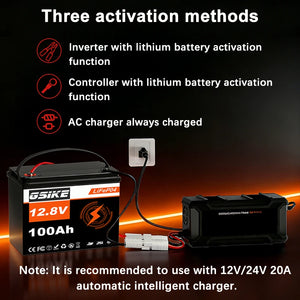
| Recommended charge current | 20 A (0.2C); the BMS allows up to 100 A continuous charge |
| Discharge cut-off | 10 V end-of-discharge cut-off (per the unit label) |
| Internal resistance | ≤20 mΩ |
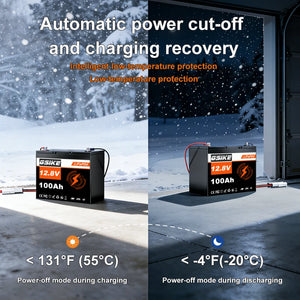
| Charge temperature | 0 °C to 50 °C (the BMS stops charging around 55 °C; do not charge below 0 °C) |
| Discharge temperature | −20 °C to 60 °C |
| Storage temperature | −10 °C to 50 °C; store at ~50% charge, self-discharge <3%/month |
Expansion — 4P4S up to 20.48 kWh
The battery supports parallel and series building. 4P4S means four units in parallel × four in series: 16 units total = 20.48 kWh. 4S raises the voltage to 51.2 V; 4P raises the capacity to 400 Ah (51.2 V × 400 Ah = 20,480 Wh).
| Configuration | Voltage | Capacity | Energy | Units |
|---|---|---|---|---|
| 1P1S (single) | 12.8 V | 100 Ah | 1.28 kWh | 1 |
| 2P1S | 12.8 V | 200 Ah | 2.56 kWh | 2 |
| 2P2S | 25.6 V | 200 Ah | 5.12 kWh | 4 |
| 4P2S | 25.6 V | 400 Ah | 10.24 kWh | 8 |
| 4P4S (max) | 51.2 V | 400 Ah | 20.48 kWh | 16 |
Expected runtime by load (1280 Wh ÷ load)
Ideal DC runtimes at 12.8 V, before derating. When running through a 12V inverter, apply roughly 90–95% inverter efficiency and a usable depth of discharge for real-world figures.
| Load | Example use | Runtime (1280 Wh) |
|---|---|---|
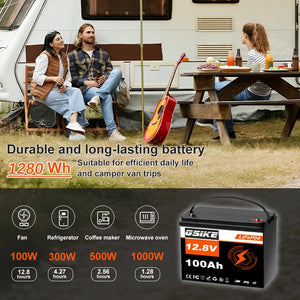
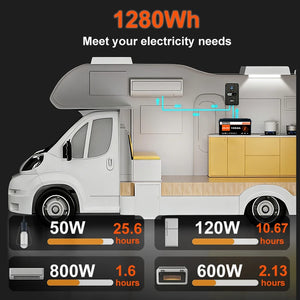
| 50 W | LED lights + phone charging | 25.6 h |
| 100 W | Laptop + lights + fan | 12.8 h |
| 120 W | Router + lights + small fan | 10.67 h |
| 300 W | Compressor fridge | 4.27 h |
| 500 W | Fridge + TV + fan | 2.56 h |
| 600 W | Fridge + TV + lights + charger | 2.13 h |
| 800 W | Fridge + microwave (intermittent) | 1.6 h |
| 1000 W | Higher DC / inverter load | 1.28 h |
Pros & cons
Pros
- 1280 Wh at ~100% usable DoD with a 100A BMS and 6000 cycles @80% DoD — one unit replaces two 12V 100Ah lead-acid batteries in parallel and lasts roughly 10× longer.
- Light and compact: 9.8 kg net in a 315×215×280 mm IP65 ABS case — easy to lift into a motorhome locker, boat locker or shed shelf.
- 100A continuous charge/discharge with a 400A one-second pulse handles fridge and trolling-motor inrush without voltage sag.
- Expandable to 20.48 kWh (4P4S, 16 units, 51.2 V / 400 Ah) so a single starter unit can grow into a whole off-grid bank.
- €159.99 undercuts every verified branded EU-store 12V 100Ah leisure battery — LiTime H190 (€275.99), Power Queen (€239.99), ECO-WORTHY (€229.99) and the Renogy range (€362.99–678.99) — with free EU shipping and 30-day returns.
- Real buyer rating 4.9 / 5 from 8 reviews, praising the weight saving, weekend fridge runtime and the 100A trolling-motor output.
Cons
- Needs a lithium 14.4V charger. A legacy lead-acid charger (float 13.5–13.8V, no CC/CV LiFePO4 mode) will not fully charge it — use a LiFePO4 / lithium-capable charger or solar controller set to 14.4V ±0.2V.
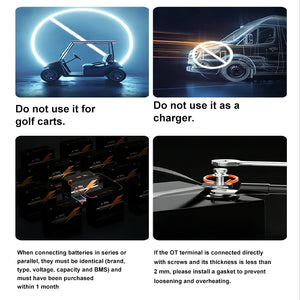
- Match units for series/parallel. Bank building requires identical units at a similar state of health (within ~1 month of production / charge history); never mix new and worn cells in one bank.
- Not for golf carts. This is a 12V leisure / deep-cycle battery — it is not rated for the high continuous draw of a golf-cart drive system.
- It is not a charger and not an inverter. No built-in charger, no mains outlet — you supply both the charge source and a separate 12V inverter for 230V appliances.
- Do not charge below 0°C. Charge window is 0–50°C; unlike some self-heating rivals, it has no low-temperature charging function (discharge works down to −20°C).
- 3-year warranty vs ~10-year design life. The rated warranty is 3 years even though the design life is ~10 years at light use; rivals like the Renogy Core are also rated 150A continuous vs this unit's 100A.
Where this battery fits — real European use cases
RV / motorhome
Strapped into a motorhome under-seat locker, it runs the fridge, lights and chargers for days — the ~9.8 kg weight saving also helps fuel economy.
Trolling motor / boat
The constant 100A discharge gives an electric trolling motor full thrust without sag — buyers report a full day of fishing on one charge.
Weekend camping
On a camp table beside a portable fridge, it powers fridge, lights and phones for a whole weekend before needing a charge.
Solar off-grid shed
Mounted on a shed shelf, it stores energy from a small solar array and cycles daily — the IP65 case shrugs off damp workshop air.
Home backup
Kept in a utility closet, it carries lights, the router and a few essential appliances through an evening outage, and grows into a larger 20.48 kWh bank later.
Caravan / camper van
On a caravan bench shelf it supplies lighting, the charger and the small kitchen loads for a static pitch — no maintenance, no venting.
Forest retreat
A remote cabin relies on it for warm light, a kettle and a phone after the panels stop generating at dusk.
Workshop / garage
On a workbench it runs bench lighting, a 12V pump and a charger off-grid — the 10V cut-off protects the cells from deep drains.
Shipping & returns
| Policy point | Detail |
|---|---|
| Price | €159.99 EUR · In stock, new condition |
| Free delivery to | Europe |
| Handling / transit | Handling 1–3 days + transit 2–7 days, shipping rate EUR 0 |
| Returns | 30-day return window from delivery, by post, in original condition and packaging |
| Return cost | Return shipping is handled by the merchant; original import duties and taxes are non-refundable |
Frequently asked questions
Can I replace two 12V 100Ah lead-acid batteries with this one GSIKE unit?
Yes, for the same usable 12V capacity. One GSIKE 12.8V 100Ah delivers ~1216–1280 usable Wh at ~95–100% depth of discharge, whereas a 12V 100Ah flooded lead-acid is limited to about 42% DoD — roughly 504 usable Wh. So one GSIKE replaces two 12V 100Ah lead-acid batteries wired in parallel (same 12V). Do not wire them in series, which would produce 24V and is a different system.
What charger do I need — will my old lead-acid charger work?
You need a lithium / LiFePO4-capable charger or solar controller set to CC/CV at 14.4V ±0.2V, with a recommended charge current of 20A (0.2C; the BMS allows up to 100A). A legacy lead-acid charger that only floats at 13.5–13.8V without a LiFePO4 charge profile will not fully charge this battery. The battery itself is not a charger — it only stores and releases power.
Can I charge it in winter or below freezing?
No — the charge window is 0°C to 50°C and the BMS stops charging around 55°C. Do not charge below 0°C. Discharge works down to −20°C, and storage should be between −10°C and 50°C at roughly 50% charge. Unlike some self-heating competitors, this unit has no low-temperature charging function, so warm the space before charging in cold weather.
How long will it run my fridge, lights and laptop?
Based on 1280 Wh divided by the load: a 50W LED/phone load runs ~25.6h, a 100W laptop-and-lights load ~12.8h, a 120W router-and-fan load ~10.67h, a 300W compressor fridge ~4.27h, a 500W fridge+TV+fan load ~2.56h, a 600W load ~2.13h, an 800W load ~1.6h and a 1000W load ~1.28h. When running through a 12V inverter, derate by about 90–95% inverter efficiency and leave headroom on depth of discharge.
Can I wire several batteries together — series or parallel, and how many?
Yes. The maximum configuration is 4P4S: four in parallel times four in series = 16 units, giving 51.2V and 400Ah for 20.48 kWh. When building a bank, use units that are identical in model and matched within about one month of production / charge history; do not mix new and heavily-used units, and keep the whole bank on the 14.4V charge profile with the 10V cut-off.
Is this battery itself a charger or an inverter?
No. It is an energy-storage battery — it stores 12-volt DC power and releases it. It has no built-in charger and no built-in inverter, so it has no mains AC outlet. To charge it you need a 14.4V LiFePO4 charger or solar controller; to run 230V appliances you connect a separate 12V inverter. The 400A rating is a one-second pulse for startup inrush, not a continuous output.
Will this battery work for a golf cart?
No. This is a 12V leisure / deep-cycle battery rated for RV, camper, caravan, boat/trolling-motor, camping, off-grid solar and home-backback use. It is not designed for the high continuous drive-current profile of a golf cart. Choose a purpose-built traction battery for that application.
What does the 100A BMS actually protect against?
The built-in 100A BMS guards against over-charge, over-discharge, over-current, over-temperature and short-circuit events, with the discharge cutting off around 10V. It allows 100A continuous charge and 100A continuous discharge, and a 400A pulse for one second to absorb motor or fridge startup inrush without sagging. Self-discharge stays under 3% per month.
What terminals and cables does it use?
It uses M8 bolt terminals (8 mm bolt, 12 mm nut). Fit ring (lug) terminals sized for your cable current and keep runs short to limit voltage drop — especially at 12V, where high currents make cable thickness matter. For a 16-unit 51.2V / 400Ah bank, follow the matched-battery wiring guide and the 14.4V charge profile.
What about the warranty, shipping and returns?
The price is €159.99 EUR, in stock and new. Shipping is free to 15 European countries (GB, DE, FR, IT, ES, NL, BE, AT, SE, DK, FI, IE, PT, PL, CZ) with 1–3 days handling plus 2–7 days transit, and returns run for 30 days by post. The warranty is 3 years against a ~10-year design life, so the covered period is shorter than the expected service life at light use — factor that into your total-cost-of-ownership plan.
Guides & comparisons
Go deeper before you buy:
12v 100ah lifepo4 battery,12.8v 100ah lithium battery,1280wh lifepo4 battery,12v 100ah deep cycle battery,12v 100ah lithium leisure battery,12v 100ah battery for rv camper,12v 100ah trolling motor lithium battery,buy 12v 100ah lifepo4 battery europe,12v 100ah lifepo4 battery under 160 eur,12v 100ah lifepo4 battery eu warehouse,gsike 12.8v 100ah battery price,ip65 12v 100ah lifepo4 battery
buy 12v 100ah lifepo4 battery europe, 12v 100ah lifepo4 battery under 160 eur, 12v 100ah lifepo4 battery eu warehouse, lithium leisure battery 100ah uk europe, 12v 100ah lifepo4 free shipping europe, gsike 12.8v 100ah battery price, 12v 100ah lifepo4 30 day returns warranty, 12v 100ah lifepo4 battery price comparison europe, 12v100ahlifepo4instockeuropedelivery2-7days, 12v 100ah solar battery for off grid cabin, 12v 100ah lifepo4 battery deal october 2026, ip65 12v 100ah lifepo4 battery
lifepo4 vs lead acid 12v 100ah, lifepo4 vs agm battery for rv, 12v 100ah battery how many kwh, how much usable capacity 100ah lifepo4 dod, lifepo4cycle life 6000 cycles explained, 12vbatteriesseriesvsparallel, what size battery for a 12v inverter, 14.4v charge voltage for lifepo4, what does a 100a bms do on alifepo4 battery, 12v lithium battery weight vs lead acid, how long will a 12v 100ah battery run a fridge, how many lead acid batteries does one lifepo4 replace
best 12v 100ah lifepo4 battery europe 2026, gsike vs litime 12v 100ah lifepo4, gsike vs renogy 12v 100ah lifepo4, redodo 12v 100ah lifepo4 vs gsike, power queen 12v 100ah lifepo4 review, eco-worthy 12v 100ah lifepo4 vs gsike, easun 12v 100ah lifepo4 battery, anenji 12.8v 100ah lifepo4 vs gsike, datouboss 12v 100ah lifepo4 battery review, 12v 100ah lifepo4 under 150 eur europe, litime 12v 100ah vs renogy core 100ah, cheap 12v 100ah lifepo4 battery europe

