


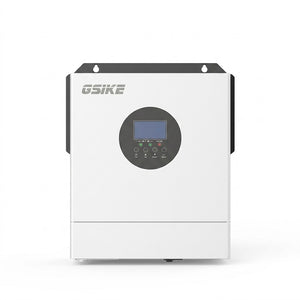
GSIKE Power 2.5KW Solar Inverter 12V 220V Off Grid Inverter 120A MPPT Solar Controller With WIFI
Estimate delivery times: 2-7 Business days (European Union, United States).
Return within 30 days of purchase. Duties & taxes are non-refundable.
GSIKE Power 2.5KW Solar Inverter 12V 220V Off Grid Inverter 120A MPPT Solar Controller With WIFI
Description
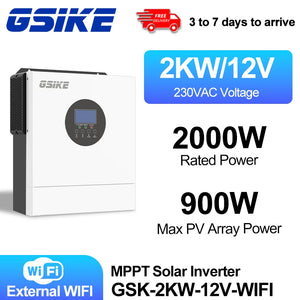
GSIKE 2.5KW 12V Off-Grid Hybrid Solar Inverter — 2000W Continuous, 3000VA Surge, 60A MPPT, 900W PV, Dual AC Output, Battery-Free, Free EU Shipping
The GSIKE "2.5KW" 12V off-grid hybrid inverter is, in engineering terms, a 2000W / 2kVA continuous pure-sine 230V unit with a 3000VA (1.5×) surge, a single 60A MPPT solar charger for a PV array of up to 900W, two real AC output terminals, genuine battery-free operation and optional external WiFi — sold across Europe at €149.99 with free delivery to 15 countries and a 30-day return window.
2000 W continuous 3000 VA surge single 60A MPPT 900 W max PV dual AC output 12 V battery No battery needed WiFi optional

| Parameter | Value (engineering manual GSK-2KW-12V-WIFI) |
|---|---|
| Continuous AC power | 2000 W / 2 kVA pure sine, 220/230 VAC, 50/60 Hz — the "2.5KW" listing name, not the continuous rating |
| Surge power | 3000 VA (1.5× continuous), for motor and fridge startup |
| MPPT charger | Single MPPT; max solar charge current 60 A (PV input 50 A) — not a dual-MPPT unit |
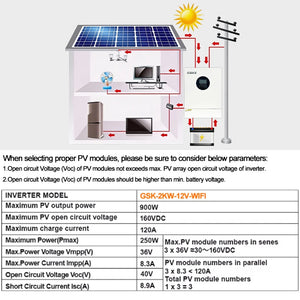
| PV input | MPPT working range 30–160 VDC; max open-circuit voltage 160 VDC; maximum PV array 900 W (practical ~750 W = 3×250W) |
| Charging currents | Solar MPPT 60 A / AC mains charge 80 A / PV+AC combined max 120 A (the title's "120A" is this combined total, not a 120A solar charge) |
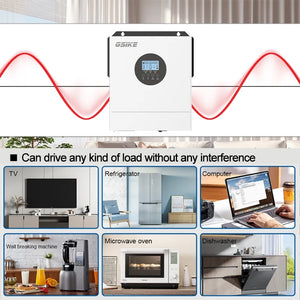
| Waveform / power factor | Pure sine wave, PF 0.6–1.0; works without a battery |
| Battery / AC output | 12 V DC (float 13.5 V, overcharge protection 14.1 V) · 230 V AC (±5%), 50/60 Hz auto |
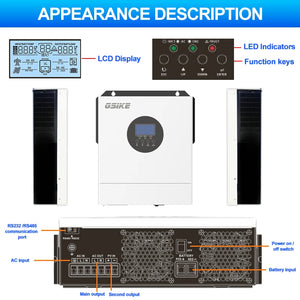
| AC outputs | Two terminals — Main output + Second output, shared 2000 W total (this is "Dual Output", not dual MPPT) |
| Parallel capacity | None — single unit only, cannot be paralleled or stacked |
| UPS transfer | About 10 ms (PC loads) / 20 ms (appliance loads) on grid outage |
| Efficiency | PV→inverter 96%, battery→inverter 93% |
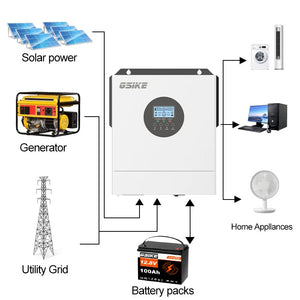
| Monitoring & ports | WiFi (external / optional module), RS232, RS485 for LiFePO4, dry-contact generator / ATS, LCD |
| Price / stock | €149.99 EUR · In stock, new condition, SKU G2500EU12V, valid from 2026-05-28 |
| Delivery / returns | Free shipping to 15 European countries (1–3 days handling + 2–7 days transit) · 30-day returns |
Full technical specifications
AC output & conversion
| Item | Specification |
|---|---|
| Continuous power | 2000 W / 2 kVA (the unit the manual GSK-2KW-12V-WIFI rates; the listing is named 2.5KW) |
| Surge power | 3000 VA for a few seconds (1.5× continuous, for motor, fridge and pump inrush) |
| Peak efficiency | PV→inverter 96%, battery→inverter 93% |
| Output waveform | Pure sine wave, power factor 0.6–1.0, crest factor 3:1 |
| Nominal AC output | 220–230 V AC ±5%, 50/60 Hz auto-sensing |
| AC input range | 230 V AC nominal (170–280 V for PC loads, 90–280 V for appliance loads), 50/60 Hz auto |
| Overload rating | 5 s at ≥140% load; 10 s at 100–140% load |
| UPS transfer time | About 10 ms for PC loads, 20 ms for appliance loads, on grid outage |
| AC outputs | Two terminals — Main output + Second output, shared 2000 W total |
| Output priority modes | UTL / SOL / SBU / SUB selectable on the LCD |
PV input & charging (single MPPT)
| Item | Specification |
|---|---|
| MPPT trackers | One single MPPT channel; max solar charge current 60 A (max PV input current 50 A) |
| PV input voltage range | MPPT working range 30–160 VDC; maximum open-circuit voltage 160 VDC |
| Maximum PV array | Up to 900 W; official example is 3×250W modules (3×36 V Vmpp ≈ 108 V, 120 V Voc < 160 V) |
| Why ~750W is the sweet spot | Raw 900 W / 12 V ≈ 75 A, but the solar charge stage caps at 60 A — practical usable PV is ~750 W (3×250W) |
| AC (mains) charge current | 80 A; maximum combined PV+AC charge 120 A |
| Battery charge profile | CC/CV; float 13.5 V, overcharge protection 14.1 V; supports lead-acid, gel and LiFePO4; LiFePO4 activation by PV (RS485) |
System, mechanical & protection
| Item | Specification |
|---|---|
| Battery voltage | 12 V DC; float charge 13.5 V, overcharge protection at 14.1 V |
| Full-load DC current | 2000 W / 12 V = 166.7 A ideal; at 93% efficiency ≈ 179 A — this is why the 12V battery cables must be very thick and short |
| Battery-free operation | Supported — runs on PV or mains alone; no night power after sunset without a battery |
| Parallel operation | No — single unit only, cannot be paralleled with another unit |
| Communication | WiFi (external / optional module), RS232, RS485 for LiFePO4, dry-contact for generator / ATS, LCD |
| Casing / ingress | Detachable dust cover only; no IP rating is stated by the manual — use indoors / in a sheltered space |
| Operating temperature | −10 °C to +50 °C (storage −15 to +60 °C); humidity 5–95% non-condensing |
| Dimensions | 358 × 295 × 105.5 mm (package 465×380×175 mm) |
| Net weight | 6.0 kg |
| Protection | Overload, short-circuit, over-temperature, battery over-voltage / under-voltage |
Pros & cons (verified, not marketing)
Pros
- 2000 W continuous pure-sine 230V AC with a 3000 VA (1.5×) surge — enough to start and run a refrigerator, TV, laptop, lights, a small pump and kitchen essentials in a camper, cabin or garden office.
- Single 60 A MPPT accepts up to 900 W of PV (MPPT 30–160 V, 160 V Voc ceiling); the official 3×250W example (~750 W) matches the 60 A charge cap.
- Dual AC output terminals (Main + Second, shared 2000 W) let you split critical loads from the rest, with ~10 ms PC / 20 ms appliance transfer on a grid outage.
- Genuine battery-free operation on PV or mains, with UTL / SOL / SBU / SUB priority modes and PV-only LiFePO4 activation.
- €149.99 puts this in the sub-€160 band and near the front of the verified EU-warehouse 12V 2kW hybrids — essentially tied with EASUN's 2.2kW 12V (€151.73) and under DATOUBOSS 1800W (€159.99), PowMr (~€165), Daxtromn (~€175) and ANENJI (~€184).
- Compact 6.0 kg / 358×295×105.5 mm chassis; 96% PV→inverter efficiency; free shipping to 15 European countries in 2–7 days, 30-day returns.
- Real buyer rating 4.8 / 5 from 10 reviews, most praising stable pure-sine output and quiet running.
Cons
- 2000 W engineering ceiling, not 2.5 KW — the storefront name says 2.5KW but the manual rates 2000 W / 2 kVA continuous; plan loads for 2000 W, not 2500 W.
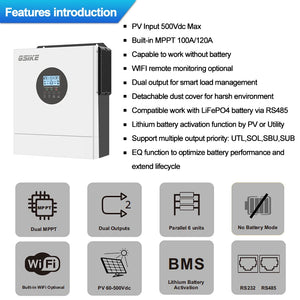
- No parallel / stacking — single unit only; you cannot stack two to reach 4 kW. The "Parallel 6 units" icon is a 48V large-model template error.
- Single MPPT (one 60 A channel); "Dual Output" is the two AC terminals, not two solar trackers.
- 12V means very high current — full load pulls ~167–179 A, so the battery cables must be very thick (about 50–70 mm²) and kept short (1 m class); longer runs force even heavier copper.
- 12V is not a whole-house voltage — for larger homes step up to a 24V/48V model, where the same power halves the current and the cable size.
- Max PV only 900 W (practical ~750 W) and solar charge capped at 60 A — this is a small-array, short-run class, not a big-roof system.
- English-only support; no local-language warranty line; WiFi is an external / optional module, not fitted as standard.
- No night power in battery-free mode once the sun is down, and no IP rating — use indoors / in a sheltered space with the detachable dust cover.
Where the 12V 2000W inverter fits — real European use cases
Family camper van
A compact inverter on the bench wall runs the fridge, charger and lights at a quiet rural European campsite — the classic 12V short-run install.
Provence caravan
A static caravan with a small roof array powers its own lighting, TV and small kitchen loads without a full grid connection.
Swedish log cabin
A small forest cabin uses a few panels and one wall inverter for lights, a small fridge and phone — essentials only, inside the 900 W PV cap.
Dutch garden office
A home-working summerhouse runs a laptop, router, lamp and small fan from PV and a 12V battery — short, thick battery cables inside one building.
Spanish tool shed
A workshop shed powers bench lighting, a small charger and a pump off-grid — the dual second output can feed the pump separately.
Austrian tiny home
A tiny house on wheels uses a few roof panels for cooking, refrigeration and entertainment — a single-room, off-grid lifestyle load.
Apartment backup
A small utility closet keeps a fridge, router and lights on a 12V battery during short outages; the ~10 ms transfer supports PC loads.
Van roof array
A four-panel van roof array (~900 W) feeds the inverter below the eaves — right at the maximum PV ceiling, with 3 panels the sweet spot.
Shipping & returns
| Policy point | Detail |
|---|---|
| Price | €149.99 EUR · In stock, new condition |
| Free delivery to | Europe |
| Handling / transit | Handling 1–3 days + transit 2–7 days, shipping rate EUR 0 |
| Returns | 30-day return window, by post, in original condition and packaging |
| Return cost | Buyer pays return shipping; original shipping is refunded; import duties and taxes are non-refundable |
Frequently asked questions
Is this inverter really 2.5KW — or is it 2000W?
The listing is named "2.5KW", but the linked engineering manual for model GSK-2KW-12V-WIFI — confirmed by the main spec image and the official PV table — rates continuous output at 2000W / 2kVA with a 3000VA (1.5×) surge. "2.5KW" is the storefront tier name. Size your loads for 2000W continuous, not 2500W.
What does the title's "120A" mean — is that a 120A solar charge?
No. The solar MPPT charge is 60A (50A PV input), the AC mains charger is 80A, and the maximum combined PV+AC charge is 120A. The "120A" in the title is that combined total, not a 120A solar charge. Never size your array around a 120A solar figure.
Can I parallel two GSIKE 12V units to get 4kW?
No. The manual lists Parallel Capability = NO — this is a single-unit inverter with a hard ceiling around 2000W. The infographic's "Parallel 6 units" icon is a 48V large-model template error. If you need more than about 2000W continuous, choose a larger 24V or 48V model rather than stacking this one.
Is this a dual-MPPT inverter — and what does "Dual Output" mean?
It is a single MPPT. "Dual Output" means two real AC terminals — a Main output and a Second output, both shared within the 2000W total — so you can separate critical loads. It is not two MPPT trackers, and this page never claims dual MPPT.
What size PV array does it accept — why only 900W?
There is one single MPPT working from 30 to 160 VDC with a 160V maximum open-circuit voltage, and the maximum PV array is 900W. Because the solar charge stage caps at 60A, the practical sweet spot is ~750W — the official example is three 250W panels in series (about 108V, 120V Voc under the 160V ceiling). The generic bullet's 500V / 100–120A figures are discarded template errors.
What 12V battery and cables does it need?
This is a 12V-only inverter (float 13.5V, overcharge protection 14.1V). At full 2000W it draws about 167A ideal (179A at 93% efficiency), so plan very thick, short battery cables — roughly 50–70 mm² for a 1% drop over just 1m — and keep the battery close to the inverter. A 12.8V 100Ah LiFePO4 gives ~1280Wh (~1024Wh usable at 80% depth of discharge), about half an hour at full 2000W; plan ~167Ah for one hour at 2000W.
Can it run without a battery?
Yes — it is specified to run on PV or mains with no battery connected, and LiFePO4 packs are activated from PV. The honest trade-off is that battery-free mode gives no power once the sun is down, so a 12V LiFePO4 bank is still required for evening or night loads.
Will it run my fridge, TV and laptop?
Yes. Buyers report a fridge, lights and laptop running steadily on pure-sine output, and the 3000VA surge can start a small fridge or pump. Stay within 2000W continuous total — this is a camper, cabin, garden-office and backup-essentials class, not a whole-house system.
How much is it, and what about shipping, returns and an IP rating?
The price is €149.99 EUR, in stock and new (SKU G2500EU12V). Shipping is free to 15 European countries (GB, DE, FR, IT, ES, NL, BE, AT, SE, DK, FI, IE, PT, PL, CZ) with 1–3 days handling plus 2–7 days transit, and a 30-day return window by post. The manual states no IP rating — only a detachable dust cover — so use it indoors or in a sheltered space; support is English-only and WiFi is an optional external module.
Does it have WiFi, LiFePO4 communication and output modes?
WiFi monitoring is an optional external module (reviewers find the remote status check useful). RS485 supports LiFePO4 communication and RS232 is also provided; a dry-contact connection supports a generator or ATS. The LCD sets the UTL / SOL / SBU / SUB output-priority modes, and the unit switches in about 10ms for PC loads (20ms for appliances) on a grid outage.
Guides & comparisons
Go deeper before you buy:
2.5kw 12v hybrid inverter,2000w 12v solar inverter,12v 60a mppt solar inverter,12v inverter 900w pv max,12v dual output inverter 2000w,12v inverter without battery,2kw 12v 230v pure sine wave inverter wifi,2.5kw 12v hybrid inverter price,2000w 12v hybrid inverter under 160 eur,12v 2kw inverter in stock eu warehouse,gsike 2.5kw 12v inverter price,12v hybrid inverter 60a mppt 160vdc wifi
2.5kw 12v hybrid inverter price, buy 2kw 12v off grid inverter europe, 2000w 12v hybrid inverter under 160 eur, 12v 2kw inverter in stock eu warehouse, 3000va surge 12v inverter motor pump startup, 2kw 12v off grid inverter free shipping europe, 12v hybrid inverter 30 day returns warranty, gsike 2.5kw 12v inverter price, 2000w 12v hybrid inverter deal october 2026, 12v solar inverter eu delivery 2-7 days, 12v hybrid inverter 60a mppt 160vdc wifi, 12v inverter vat invoice business europe
how to size a 2kw 12v off grid solar system, how many ah battery for 2000w 12v inverter, 12.8v 100ah lifepo4 how long will it run a 2000w inverter, what size 12v cable for 2000w inverter, 60a mppt charge controller for 12v explained, can a 2kw 12v inverter run a fridge tv and laptop, can hybrid inverter work without battery 12v, utl sol sbu sub output priority modes explained, how to setup external wifi monitoring 12v inverter, 900w pv array for 12v 2kw inverter 3 x 250w panels, 12v vs 24v inverter for 2kw do i need 24v, lithium battery activation by pv on 12v inverter
gsike 2.5kw 12v vs easun 2.2kw 12v hybrid inverter, easun vs datouboss 18o0w 12v inverter which is better, best 2kw 12v hybrid inverter europe 2026, anenji 2.5kw 12v vs gsike inverter, daxtromn 2.2kva 12v vs gsike 2.5kw inverter, powmr 2.2k 12v hybrid inverter vs gsike, 12v 2kw hybrid inverter under 150 eur europe, bare inverter vs hybrid inverter with mppt 12v, mpp solar pip2424 2400va vs 12v 2kw chinese inverter, sandisolar 20o0w 12v hybrid inverter review, 2000w 12v hybrid inverter reviews, 12v vs 24v 2kw inverter for camper van which to buy

