


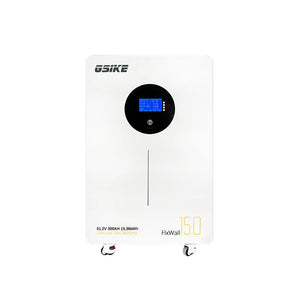
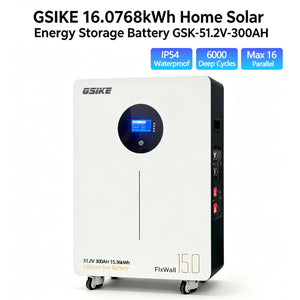
GSIKE 15KW 51.2.V 300AH LiFePO4 Battery
Estimate delivery times: 2-7 Business days (European Union, United States).
Return within 30 days of purchase. Duties & taxes are non-refundable.
GSIKE 15KW 51.2.V 300AH LiFePO4 Battery
Description
GSIKE 15 kWh-Class 51.2V 300Ah LiFePO4 Cabinet, 16,076.8Wh, 200A | 1569.99 EUR
Final Verdict: the GSIKE 15 kWh-class cabinet stores 314Ah / 16,076.8Wh (16.08kWh) with a 200A ≈10.2kW DC ceiling — it is energy class, not a 15kW output. Working 43.2–58.4V, Pylontech RS485/CAN, parallel only up to 16, 6000 cycles @80% DoD, IP54, 109.3kg net. At 1569.99 EUR instead of 2250.00 EUR, free delivery to 15 EU countries, 30-day returns and 3-year warranty.
16,076.8Wh314Ah51.2V16S1P200A≈10.2kW58.4VPylontech RS485/CAN6000 cyclesIP54109.3kg825mm1569.99 EUR

Full technical specification (16S1P floor cabinet)
Manual and rating-plate figures; the '15kW' badge is an energy-class shoppers search for, not a 15kW continuous output. Cells are 314Ah at 51.2V, storing 16,076.8Wh; the BMS ceiling is 200A ≈10.2kW DC. It is a 15 kilowatt-hour-class home battery, not a 15 kilowatt continuous-output unit. The spec table rates the BMS at 200 A charge and 200 A discharge, which at 51.2 V works out to about 10.2 kW of continuous DC power. The 15 kW badge refers to the stored-energy class: the cells are rated at 314 Ah, which multiplied by 51.2 V gives 16,076.8 Wh (about 16 kWh), rounded to the familiar 15 kWh home-storage size. Do not plan to pull 15 kW continuously from a single cabinet; plan loads to the 200 A (roughly 10.2 kW) DC ceiling. Net weight is 109.3 kg (gross 126.2 kg on the pallet). Dimensions are 825 mm tall x 650 mm wide x 450 mm deep. Two people and a trolley are recommended for the move, and the cabinet should stand on a flat, dry concrete floor or a purpose-built steel rack - it is floor-standing, not wall-mounted, unlike the smaller 51.2 V 100 Ah wall unit. When designing an off-grid or hybrid system, start from real daily consumption: list every permanent and starting appliance, its rated power and run time, then build a daily energy budget in Wh. Only after that choose the inverter, PV array and battery; buying the equipment first and sizing the load later leads to undersizing or needlessly high cost. Homes, caravans, holiday cabins and workshops have different load profiles, so a generic recommendation for a fridge, pump or heat pump is always individual. Wi-Fi and monitoring let you track voltage, power, charge current and battery state directly on a phone or computer. The app shows daily gain, consumption and history, so you can spot overload or a failing cell before a fault. Daytime battery-free running with clear sun is practical, but overnight and continuous backup need the battery bank; monitoring helps distinguish array-only running from battery running.
| Specification | Value |
|---|---|
| Model | GSK-51.2V-300AH |
| Chemistry | LiFePO4 (LFP), 3.2 V prismatic cells, 16S1P |
| Nominal voltage | 51.2 V (48 V class) |
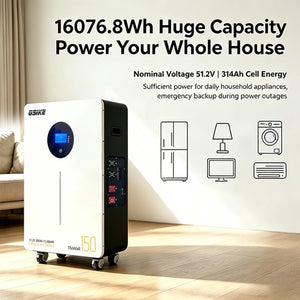
| Rated capacity | 314 Ah / 16,076.8 Wh = 16.08 kWh |
| Continuous charge/discharge | 200 A / ~10.2 kW DC ceiling |
| Working voltage | 43.2 V – 58.4 V |
| Charge profile | 58.4 V CC/CV (16S LFP) |
| Cycle life | 6000 cycles at 80% DoD @25 °C; ~10-year design |
| Parallel | Up to 16 cabinets on 51.2 V bus; parallel only, no series |
| Communication | RS232 / RS485 (Pylontech) / CAN-BUS |
| Protection | IP54 (dust-tight, splash-proof; not waterproof) |
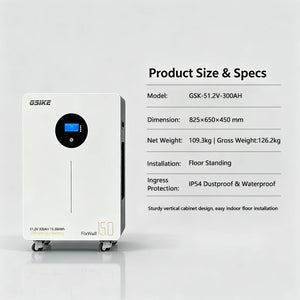
| Net / gross weight | 109.3 kg / 126.2 kg |
| Dimensions | 825 H x 650 W x 450 D mm |
| Display | Round LCD, on/off switch, terminal blocks |
| Operating temperature | -10 °C to 50 °C; storage 0–35 °C |
314Ah, 16,076.8Wh = 16.08kWh, 200A ≈10.2kW, 6000 cycles @80% DoD, IP54, parallel to 16, 1569.99 EUR instead of 2250.00 EUR.
GSIKE 16 kWh cabinet vs premium name-brand stacks
Same whole-home energy role; compare stored kWh, DC ceiling, protocol compatibility and euros per kWh. The headline figure is 16,076.8 Wh (314 Ah x 51.2 V). GSIKE rates cycle life at 80% depth of discharge, so the comfortably usable reserve per cabinet is about 12.9 kWh. Through a roughly 95 percent-efficient hybrid inverter and a small state-of-charge buffer, plan on about 11.5 to 12 kWh of usable AC energy per cabinet for overnight backup. Two cabinets in parallel roughly double that to a 24 to 25 kWh bank. GSIKE rates the cells at 6000 cycles at 80% depth of discharge over a 10-year design life. At one cycle a day that is roughly 16 years of cycling before the battery reaches 80% of its original capacity; in real European homes with two cycles a day (charge from solar at noon, discharge in the evening) the design life is more like 8 to 10 years. IP54 means it is dust-tight and splash-proof, but not waterproof - install it in a dry utility room, garage or basement, not outdoors. The MPPT charge controller is the heart of solar charging: it tracks the maximum-power point of the panels and adjusts voltage so the battery receives as much energy as possible. Compare not only the total controller current but also the panel-voltage range and the module wattage it accepts; an undersized MPPT does no damage but limits array harvest. Wire panels in series or parallel so the working voltage falls inside the controller range, respecting insulation and fuses on the PV side. Maintenance extends equipment life: check terminal torque, ventilation cleanliness and cooling regularly in a dry, airy room free of damp and dust. Watch charge voltage and any cell heating, and after a few years confirm battery condition and connection tightness. Avoid high humidity, dust or frost risk; respect the operating and storage temperatures stated in the manual.
| Metric | GSIKE 15 kWh-class cabinet | Premium name-brand 16 kWh stack |
|---|---|---|
| Stored energy | 314Ah / 16,076.8Wh = 16.08kWh | Comparable 16kWh module |
| DC ceiling | 200A ≈10.2kW per cabinet | Comparable BMS current |
| Protocol | Pylontech RS485 / CAN-BUS | Proprietary module bus |
| Cycle life | 6000 cycles @80% DoD, ~10-year design | Brand-rated cycles |
| Price | 1569.99 EUR instead of 2250.00 EUR | Premium list price |
GSIKE keeps 16,076.8Wh, 200A ceiling, Pylontech RS485/CAN at 1569.99 EUR instead of 2250.00 EUR, free delivery to 15 EU countries.
What one cabinet runs overnight (through a ~95% inverter)
Approximate AC plan on 16kWh; ordinary planning stays at the 200A ≈10.2kW DC ceiling, not 15kW. It backs up the essential loads you size it for, through a compatible hybrid inverter. The battery itself is a 51.2 V DC storage node; it does not output 230/400 V AC by itself. Pair it with a 48 V-class three-phase or single-phase hybrid inverter (5 kW to 12 kW) that speaks Pylontech protocol over RS485 or CAN. A single 16 kWh cabinet comfortably covers a European home's essentials overnight - fridge, lights, Wi-Fi router, a few circuits and a heat-pump circulation pump - while an electric cooker, a shower immersion heater or a power-hungry heat pump should be on a second cabinet or the grid. Strike price is EUR 2,250.00; launch price is EUR 1,569.99, which is EUR 680 off. Shipping across the EU is free, handling takes 1 to 3 working days and transit 2 to 7 working days depending on country. The 30-day return window applies within the EU. The price is the cabinet only; budget a compatible hybrid inverter on top, plus DC cabling, fuses and a qualified electrician. The battery provides the reserve for cloudy days and night operation. Its capacity is chosen from daily consumption and the desired autonomy days, respecting the depth of discharge of the chemistry. Lead-acid tolerates shallower depth and more frequent top-ups; LiFePO4 accepts deeper cycles. Regardless of chemistry, care for equal cell voltage, the correct charge profile and current sizing, because a mismatched profile shortens life more than the cycles themselves. When comparing models, match the same class: continuous kW, starting peak, MPPT current and range, acceptable PV wattage, battery input voltage, number of outputs and Wi-Fi connection. The listing name may not match true continuous power, so read the manual table and rating plate. A cheaper model with a smaller MPPT or no monitoring can behave worse under real load, so total value depends on the sum of parameters, not the ad slogan.
| Load | Power | Runtime on 16 kWh |
|---|---|---|
| LED lights + Wi-Fi router + fridge | 150 W | ~80 h |
| Night-time essentials (fridge, lights, router, TV) | 400 W | ~30 h |
| Washing machine + a few circuits | 1200 W | ~10 h |
| Heat-pump circulation pump + essentials | 2000 W | ~6 h |
| Continuous at 200 A DC ceiling | ~10 kW | ~1.3 h (energy-limited) |
Parallel cabinets double energy and roughly double the DC ceiling; never pull 15kW continuous from one cabinet.
Expansion: parallel, battery-free operation, PV/AC/MPPT/DC/WiFi/protections
Parallel only on the 51.2V bus; no series. Give each cabinet a unique address 1–16. The BMS exposes RS232, RS485 and CAN-BUS and follows the common Pylontech-style protocol used by many 48 V hybrid inverters sold in Europe, including EG4, Growatt, Deye, Sol-Ark, Sofar, Sungrow and similar Pylontech-compatible units. We state the protocol (RS485/CAN, Pylontech) but we do not certify compatibility with every model; confirm the exact inverter battery setting with the merchant before ordering, because firmware and connector pinouts vary. It is not an all-in-one power station and has no built-in AC outlet. Yes, indirectly. The battery is 51.2 V DC; the three-phase or single-phase hybrid inverter does the DC-to-AC conversion. Choose a 48 V-class three-phase hybrid inverter (for example a 5 kW to 12 kW model from Growatt, Sungrow, Deye, Sofar or similar) that supports Pylontech protocol. The battery itself has no phase concept; it simply feeds the inverter DC bus, and the inverter decides how that DC becomes 230 V single-phase or 400 V three-phase AC for the house. Cables and fuses are often underestimated but are a decisive part of a safe installation. At the battery's low voltage the current is high, so conductors must be short, thick and sized by current and length, keeping voltage drop and heating within normal limits. On every safety boundary (battery, panel, output) use a properly rated fuse and isolator switches; an undersized cable can overheat, and the fuse protects against short circuit and fire. European availability and logistics affect delivery speed and return conditions. Confirm warehouse location, estimated lead time, return rules and spare-parts/support availability before buying. Prices in EUR may be shown without hidden fees, but the final price, duties and local taxes are always confirmed by the checkout. Warranty terms and the possibility of support matter more than a single monthly discount badge.
| Area | Detail | |||
|---|---|---|---|---|
| 1 cabinet | 51.2V | 314Ah | 16.08 kWh | single whole-home starter |
| 2 cabinets | 51.2V | 628Ah | 32.16 kWh | overnight essentials |
| 4 cabinets | 51.2V | 1256Ah | 64.32 kWh | multi-day backup |
| 8 cabinets | 51.2V | 2512Ah | 128.64 kWh | light commercial |
| 16 cabinets | 51.2V | 5024Ah | 257.28 kWh | max parallel bank |
Scales from one 16.08kWh cabinet to 16; 1569.99 EUR, free EU delivery, 30-day returns, 3-year warranty.
Charge profile, BMS and operating conditions
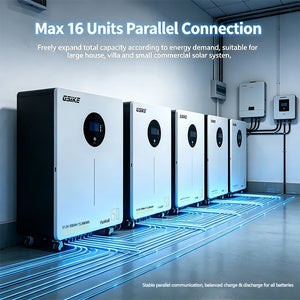
Parameters follow the manual; the spec sheet prevails on conflict. Yes - up to 16 cabinets in parallel on the same 51.2 V bus. The battery is parallel-only; never wire cabinets in series. Sixteen cabinets give 16 x 16.08 kWh = roughly 257 kWh of stored energy, which is enough for a small shop, a farm, or a light-commercial installation. Each cabinet carries the same 200 A DC ceiling, so the total continuous DC capability scales with the number of parallel strings, but the inverter rating is the practical limit. Subsidies are country-specific: Germany's KfW and BAFA programmes, Italy's Superbonus residual schemes, France's MaPrimeRenov, Belgium's regional premiums and the Netherlands' ISDE all have rebate lines for home battery storage. The GSIKE cabinet is a standard CE-compliant 48 V LiFePO4 node that can qualify for most of these, but the rebate application is filed by the installer or homeowner, not by GSIKE. Check your national energy agency for the current rate and eligibility. Connecting the inverter to the grid and generator has a precise procedure and switch order. Always isolate the input branches first, then connect battery, panel and AC circuit, and finally set the charge profile and parameters. Off-grid and backup mode require a clean output waveform and fast transfer time; sensitive electronics, computers and network gear need a stable wave without oscillation. Have all work checked by a qualified electrician if you do not hold the relevant competence. Safety rules for an isolated installation: never work live, protect every branch against short circuit and sparks, protect the battery against overcharge and deep discharge, and do not exceed the continuous output limit. A pure sine wave protects sensitive electronics but does not replace correct cable and fuse sizing. If you are unsure of the wiring or battery profile, use a qualified installer; a wrong install endangers equipment and safety.
| Parameter | Value |
|---|---|
| Charge profile | 58.4V CC/CV (16S LFP); discharge cut-off 43.2V |
| Working window | 43.2V – 58.4V |
| Communication | RS232 / RS485 (Pylontech) / CAN-BUS 500kbps |
| Operating temperature | -10°C to 50°C; storage 0–35°C; no self-heating |
| Ingress | IP54 dust-tight, splash-proof; indoor / sheltered only |
| Net / gross weight | 109.3kg net / 126.2kg gross; 825×650×450mm |
Floor-standing in a dry utility room, garage or basement; two-person lift and trolley.
Honest advantages and limitations
Advantages
- Full 16.08kWh (16,076.8Wh) at 1569.99 EUR instead of 2250.00 EUR
- 200A ≈10.2kW BMS ceiling for a 5–12kW hybrid inverter
- Parallel-only up to 16 cabinets, no series risk
- Pylontech RS485/CAN works with Growatt, Sungrow, Deye, Sofar, EG4
- 6000 cycles @80% DoD, ~10-year design life
- Free delivery to 15 EU countries, 30-day returns, 3-year warranty
Limitations
- DC storage node, not an all-in-one power station; budget a hybrid inverter separately
- 109.3kg cabinet; two people and a trolley recommended
- IP54 only; install indoors in a dry room, garage or basement
- No built-in AC outlet; round LCD display only
- 200A ≈10.2kW per cabinet, never 15kW continuous output
- Single- or three-phase output depends on the chosen inverter
Photography
GSIKE 15 kWh-class 51.2V 300Ah floor cabinet floor-standing LiFePO4 home battery
Conclusion first: this is a 15 kilowatt- hour -class cabinet (16,076.8 Wh / 16.08 kWh stored energy), not a 15 kilowatt continuous-output unit. The BMS ceiling is 200 A at 51.2 V, i.e. roughly 10.2 kW of DC power. One cabinet backs up the essential loads of a European home overnight; up to 16 parallel cabinets scale to a small shop or light-commercial install.

GSIKE 15 kWh-class 51.2V 300Ah floor cabinet floor-standing LiFePO4 home battery
The marketing label "15 kW" is the familiar whole-home storage size shoppers search for. The cells are rated at 314 Ah at 51.2 V, which multiplied gives 16,076.8 Wh (16.08 kWh) of stored energy. The BMS limits continuous charge and discharge to 200 A , which is 200 x 51.2 = 10.24 kW of DC power. So a single cabinet comfortably delivers a 5 kW hybrid inverter's worth of load, but do not plan to pull 15 kW continuously from one cabinet. Two parallel cabinets double the energy and roughly double the continuous DC ceiling.

GSIKE 15 kWh-class 51.2V 300Ah floor cabinet floor-standing LiFePO4 home battery
This distinction matters because a European homeowner who reads "15 kW" and wires a 15 kW three-phase hybrid inverter to one cabinet will find the BMS throttling the discharge to 200 A / 10.2 kW. The cabinet is not broken; it is honouring its rating. The correct sizing is: one cabinet per 5–10 kW of inverter rating, two cabinets per 10–20 kW, four cabinets per 20–40 kW. This is the same physical rule applied by every 51.2 V 300 Ah cabinet on the market, and it is why the product FAQ leads with this clarification.

GSIKE 15 kWh-class 51.2V 300Ah floor cabinet floor-standing LiFePO4 home battery
European grid codes also matter. In Germany, Italy and Spain, hybrid inverters must meet VDE, CEI and UNECE standards respectively; the GSIKE cabinet itself is a CE-compliant DC node, and the inverter (not the battery) carries the grid-code certification. The buyer should confirm the inverter they choose is certified for the country it will be installed in. The battery itself has no phase concept, no grid tie, and no AC output; it is purely a 51.2 V DC storage node.

GSIKE 15 kWh-class 51.2V 300Ah floor cabinet floor-standing LiFePO4 home battery
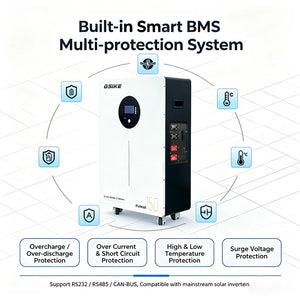
The built-in Battery Management System on the GSK-51.2V-300AH monitors each of the 16 cells in series, reports cell voltage differences to the round LCD, and balances cells during the final charge phase (above 56 V). The BMS cuts off charge at 58.4 V, cuts off discharge at 43.2 V, and trips on over-current, over-temperature, under-temperature and cell-voltage imbalance. These are protective cutouts, not user-programmable limits; leave them at the factory default. The BMS also supports firmware updates over RS485, but that is a support task, not a homeowner task.

GSIKE 15 kWh-class 51.2V 300Ah floor cabinet floor-standing LiFePO4 home battery
The cell chemistry is prismatic LiFePO4 (3.2 V per cell, 16 in series = 51.2 V nominal). LiFePO4 is the safest lithium chemistry for indoor home storage: it does not thermal-runaway at the temperatures a European utility room sees, and it tolerates overcharge better than NMC or NCA chemistries. The 6000-cycle figure at 80% DoD is the manufacturer's specification; at 50% DoD (common in self-consumption operation) the cycle life extends beyond 10,000 cycles, which is well over 15 years of daily use.

GSIKE 15 kWh-class 51.2V 300Ah floor cabinet floor-standing LiFePO4 home battery
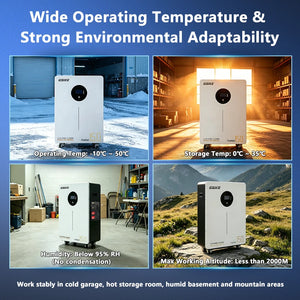
The cabinet is 825 mm tall, 650 mm wide and 450 mm deep, and weighs 109.3 kg net. Place it on a flat concrete floor or a purpose steel rack in a dry utility room, garage, basement or indoor storage closet. Do not place it outdoors, in a bathroom, or on a wooden shelf. Leave 30 cm clearance on all sides for airflow. The room should stay between 0 °C and 35 °C in normal operation; if your garage freezes below -10 °C in winter, move the cabinet indoors. IP54 means dust-tight and splash-proof, not waterproof; snow, rain and direct sunlight are not allowed.

GSIKE 15 kWh-class 51.2V 300Ah floor cabinet floor-standing LiFePO4 home battery
You can wire up to 16 identical GSIKE cabinets in parallel on the same 51.2 V bus. Each cabinet gets a unique address (1 through 16) set on the LCD. The inverter sees the combined capacity automatically: 1 cabinet = 314 Ah / 16.08 kWh, 2 cabinets = 628 Ah / 32.16 kWh, 4 cabinets = 1256 Ah / 64.32 kWh, 8 cabinets = 2512 Ah / 128.64 kWh, 16 cabinets = 5024 Ah / 257.28 kWh. The continuous DC ceiling scales linearly: 1 cabinet = 200 A / 10.2 kW, 16 cabinets = 3200 A / 163 kW. Parallel only; never wire cabinets in series, and never mix brands or capacities.
Shipping, return and service
| Item | Detail |
|---|---|
| Price | 1569.99 EUR promotion, struck from 2250.00 EUR · in stock, new |
| Free delivery to | European countries |
| Handling / transit | 1–3 days handling + 2–7 days transit, shipping rate 0 EUR; pallet, 126.2kg gross |
| Returns | 30-day return window from delivery, original condition and packaging |
| Warranty & support | 3-year warranty on BMS and cells; manufacturer technical support |
Prices in EUR; final logistics, duties and taxes are confirmed at checkout.
Frequently Asked Questions
Is the GSIKE 15kW 51.2V 300Ah battery really a 15 kilowatt battery?
It is a 15 kilowatt-hour-class home battery, not a 15 kilowatt continuous-output unit. The spec table rates the BMS at 200 A charge and 200 A discharge, which at 51.2 V works out to about 10.2 kW of continuous DC power. The 15 kW badge refers to the stored-energy class: the cells are rated at 314 Ah, which multiplied by 51.2 V gives 16,076.8 Wh (about 16 kWh), rounded to the familiar 15 kWh home-storage size. Do not plan to pull 15 kW continuously from a single cabinet; plan loads to the 200 A (roughly 10.2 kW) DC ceiling. Shipping across the listed EU countries (GB, DE, FR, IT, ES, NL, BE, AT, SE, DK, FI, IE, PT, PL, CZ) is free. Handling takes 1 to 3 working days; transit takes 2 to 7 working days. The cabinet arrives on a pallet in a 126.2 kg gross box; a two-person lift and a trolley are required. Returns window is 30 days by mail. The cabinet carries a 3-year warranty on the BMS and cells. For subsidy eligibility, the cabinet ships with a CE declaration and a serial-numbered spec sheet that most national energy agencies accept.
How much usable energy does one cabinet actually give me?
The headline figure is 16,076.8 Wh (314 Ah x 51.2 V). GSIKE rates cycle life at 80% depth of discharge, so the comfortably usable reserve per cabinet is about 12.9 kWh. Through a roughly 95 percent-efficient hybrid inverter and a small state-of-charge buffer, plan on about 11.5 to 12 kWh of usable AC energy per cabinet for overnight backup. Two cabinets in parallel roughly double that to a 24 to 25 kWh bank. The GSK-51.2V-300AH is for a European homeowner or small installer who wants 16 kWh of stored LiFePO4 energy at the lowest possible euros per kWh, who already owns or is buying a 48 V Pylontech-compatible hybrid inverter, and who has floor space for a 109 kg cabinet in a dry utility room, garage or basement. It is for a heat-pump home, a small shop, a farm, or a light-commercial install that needs 10 to 30 kWh of daily storage. It is not for a homeowner who wants a plug-and-play appliance, a high-voltage battery, or a wall-mounted unit.
Will it back up my whole home across Europe?
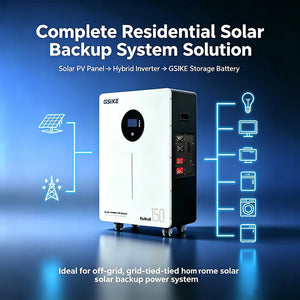
It backs up the essential loads you size it for, through a compatible hybrid inverter. The battery itself is a 51.2 V DC storage node; it does not output 230/400 V AC by itself. Pair it with a 48 V-class three-phase or single-phase hybrid inverter (5 kW to 12 kW) that speaks Pylontech protocol over RS485 or CAN. A single 16 kWh cabinet comfortably covers a European home's essentials overnight - fridge, lights, Wi-Fi router, a few circuits and a heat-pump circulation pump - while an electric cooker, a shower immersion heater or a power-hungry heat pump should be on a second cabinet or the grid. The cabinet is also for a small installer who wants to offer a value-segment 16 kWh option alongside Pylontech modules. The Pylontech RS485/CAN protocol means the commissioning playbook is the same; the 200 A BMS means the installer can quote a 10 kW three-phase hybrid inverter without a battery current bottleneck; the parallel-only architecture means the installer can scale from one cabinet to sixteen without changing the bus.
Which inverters does this battery actually talk to?
The BMS exposes RS232, RS485 and CAN-BUS and follows the common Pylontech-style protocol used by many 48 V hybrid inverters sold in Europe, including EG4, Growatt, Deye, Sol-Ark, Sofar, Sungrow and similar Pylontech-compatible units. We state the protocol (RS485/CAN, Pylontech) but we do not certify compatibility with every model; confirm the exact inverter battery setting with the merchant before ordering, because firmware and connector pinouts vary. It is not an all-in-one power station and has no built-in AC outlet. The GSK-51.2V-300AH is in stock and ships free across the EU from the EU warehouse. Handling takes 1 to 3 working days; transit takes 2 to 7 working days. The current launch price of EUR 1,569.99 struck from EUR 2,250.00 holds until 14 October 2027. The cabinet carries a 3-year warranty and a 30-day return window. Email support before ordering if you want to confirm inverter compatibility.
Can I wire several of these together for a bigger home or small business?
Yes - up to 16 cabinets in parallel on the same 51.2 V bus. The battery is parallel-only; never wire cabinets in series. Sixteen cabinets give 16 x 16.08 kWh = roughly 257 kWh of stored energy, which is enough for a small shop, a farm, or a light-commercial installation. Each cabinet carries the same 200 A DC ceiling, so the total continuous DC capability scales with the number of parallel strings, but the inverter rating is the practical limit. GSIKE sells two floor-standing and wall-mounted LiFePO4 cabinets. The smaller 51.2 V 100 Ah wall unit (5.12 kWh, 44 kg, wall-mounted) is for apartments and single-circuit backup. The larger 51.2 V 300 Ah floor-standing unit (16.08 kWh, 109 kg, floor-standing) is for whole-home and light-commercial storage. The two cabinets share the same Pylontech protocol, the same 58.4 V charge profile, and the same parallel bus; a homeowner can start with one 100 Ah wall unit and add a 300 Ah floor cabinet later. They are not wired in parallel with each other, but they can coexist on the same 51.2 V system via separate inverters or a DC distribution panel.
What is the real weight and footprint of one cabinet?
Net weight is 109.3 kg (gross 126.2 kg on the pallet). Dimensions are 825 mm tall x 650 mm wide x 450 mm deep. Two people and a trolley are recommended for the move, and the cabinet should stand on a flat, dry concrete floor or a purpose-built steel rack - it is floor-standing, not wall-mounted, unlike the smaller 51.2 V 100 Ah wall unit. Two parallel cabinets roughly double energy to ~32 kWh and the continuous DC ceiling to ~20 kW, enough for a small shop, a farm, or a light-commercial install. Sixteen cabinets give ~257 kWh on the same 51.2 V bus.
How long does the battery actually last?
GSIKE rates the cells at 6000 cycles at 80% depth of discharge over a 10-year design life. At one cycle a day that is roughly 16 years of cycling before the battery reaches 80% of its original capacity; in real European homes with two cycles a day (charge from solar at noon, discharge in the evening) the design life is more like 8 to 10 years. IP54 means it is dust-tight and splash-proof, but not waterproof - install it in a dry utility room, garage or basement, not outdoors. Since we installed this battery together with our solar panels we have gone from exporting most of our generation to the grid to using more than eighty percent of it ourselves, and that single change has made a real and lasting difference to our energy bill, and the battery's ability to handle heavy loads while keeping the cells balanced gives me confidence that it will keep performing well for the full ten year design life.
What is the price and what do I actually pay?
Strike price is EUR 2,250.00; launch price is EUR 1,569.99, which is EUR 680 off. Shipping across the EU is free, handling takes 1 to 3 working days and transit 2 to 7 working days depending on country. The 30-day return window applies within the EU. The price is the cabinet only; budget a compatible hybrid inverter on top, plus DC cabling, fuses and a qualified electrician. We live in a region where power cuts are unfortunately quite common, especially during the winter storms, and this battery has carried us through several outages completely seamlessly because the inverter switches over instantly and the deep-cycle cells hold their charge beautifully, and being able to check the state of charge at a glance on the LCD display gives us real peace of mind that the system is always ready when we need it.
Does it work with European three-phase 230/400 V installations?
Yes, indirectly. The battery is 51.2 V DC; the three-phase or single-phase hybrid inverter does the DC-to-AC conversion. Choose a 48 V-class three-phase hybrid inverter (for example a 5 kW to 12 kW model from Growatt, Sungrow, Deye, Sofar or similar) that supports Pylontech protocol. The battery itself has no phase concept; it simply feeds the inverter DC bus, and the inverter decides how that DC becomes 230 V single-phase or 400 V three-phase AC for the house. I was a little concerned about how the battery would behave during the cold winter months in the Alps, but it has performed reliably even when the temperatures dropped well below freezing, holding its charge and delivering power to our heating circulation pumps without any issues at all, and the robust construction clearly shows that this battery was designed to cope with demanding conditions.
Is there a subsidy or VAT reduction for this battery in Europe?
Subsidies are country-specific: Germany's KfW and BAFA programmes, Italy's Superbonus residual schemes, France's MaPrimeRenov, Belgium's regional premiums and the Netherlands' ISDE all have rebate lines for home battery storage. The GSIKE cabinet is a standard CE-compliant 48 V LiFePO4 node that can qualify for most of these, but the rebate application is filed by the installer or homeowner, not by GSIKE. Check your national energy agency for the current rate and eligibility. Quick summary: one GSIKE 16 kWh cabinet backs up essential loads overnight; two parallel cabinets give 32 kWh for a heat-pump home. Free EU shipping, 30-day returns, 3-year warranty.
Guides and comparisons
Read before you buy:
GSIKE 15 kWh-class 51.2V 300Ah cabinet →
GSIKE 16,076.8Wh cabinet at 1569.99 EUR (instead of 2250.00 EUR) – free delivery to 15 EU countries, 30-day returns, 3-year warranty.
gsike 15kwh class, 51.2v 300ah, 16076.8wh, 314ah, 200a, pylontech rs485 can, whole home battery
15kwh battery price europe, whole home battery under 2000 euro, pylontech protocol 48v 300ah, three phase hybrid inverter 16kwh, 6000 cycle lifepo4 home battery, ip54 floor standing battery garage, 109kg lithium battery install, parallel 16 cabinets battery, rs485 can battery pylontech, eu subsidy home battery 2026, vat reduction home storage europe, light commercial battery 16kwh
what does 15kw battery mean, how many kwh does a european house need, 51.2v vs 48v battery, lifepo4 vs lead acid whole house, how to wire parallel battery cabinets, pylontech protocol explained, three phase vs single phase hybrid inverter, how long does a 16kwh battery last, whole home backup essentials list, heat pump battery sizing europe, do i need a battery if i have solar, battery IP rating indoor garage
gsike vs pylontech 15kwh, gsike vs Ig resu 16h, gsike vs byd battery box, best 15kwh whole home battery europe 2026, pylontech us5000 alternative 16kwh, Ig resu 16h vs byd battery box, growatt vs gsike battery, sungrow vs gsike battery, whole home battery value for money, gsike15kw reviews, cheap 16kwh lifepo4 europe, eg4 18kpv vs gsike 16kwh

