


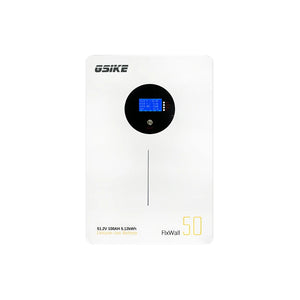
GSIKE 51.2.V 100AH LiFePO4 Battery with BMS
Estimate delivery times: 2-7 Business days (European Union, United States).
Return within 30 days of purchase. Duties & taxes are non-refundable.
GSIKE 51.2.V 100AH LiFePO4 Battery with BMS
Description
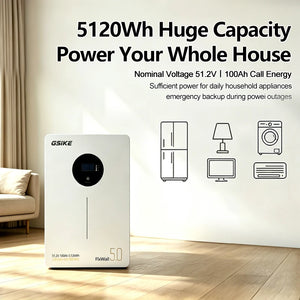
GSIKE FixWall 51.2V 100Ah LiFePO4 Battery with BMS — 5.12kWh Wall-Mounted Home Storage, 50A Rated / 100A Max, RS485/CAN, 16 Parallel to 81.92kWh, Free EU Shipping
The GSIKE 51.2V 100Ah LiFePO4 Battery with BMS (FixWall 5.0 / FlxWall 5.0, engineering model GSK-51.2V-100AH) is a slim wall-mounted 48V-class home storage pack: sixteen 3.2V cells in series (16S1P) give 51.2V and 100Ah = 5120Wh = 5.12kWh, a smart BMS delivers 2560W rated at 50A continuous and 5120W maximum at 100A short-time, with RS232/RS485/CAN to pair with a separate 48V hybrid inverter, 6000 cycles at 80% DoD in a 44kg IP54 case — sold across Europe at €849.99, struck from a real €1,250 regular price, with free delivery and a 30-day return.
5120 Wh / 5.12kWh 51.2V / 48V class 16S1P 2560W rated (50A) 5120W max (100A) 6000 cycles @80% DoD RS232 / RS485 / CAN 58.4V charge IP54 wall mount round LCD up to 81.92 kWh bank

Manual specifications (GSK-51.2V-100AH)
| Parameter | Value |
|---|---|
| Chemistry / assembly | LiFePO4 (LFP) 3.2V/100Ah cells, 16S1P — 16 in series, 1 parallel string |
| Nominal voltage / class | 51.2 V nominal (the "48V class" home-storage bus) |
| Rated capacity / energy | 100 Ah / 5120 Wh = 5.12 kWh (51.2V × 100Ah) |
| Rated continuous power | 50 A charge/discharge = 2560 W rated (plan ordinary loads to ~2.56kW) |
| Maximum short-time power | 100 A charge/discharge = 5120 W maximum (short-time ceiling only; not rated/sustained) |
| Working voltage | 43.2 V – 58.4 V (discharge cut-off ~43.2V) |
| Charge voltage | 58.4 V bulk/absorption (standard 16S LFP CC/CV) |
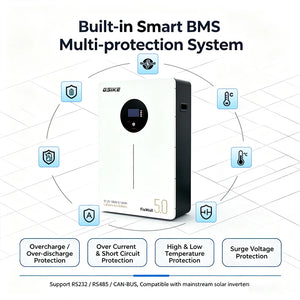
| BMS | Built-in smart BMS (OEM): over-charge, over-discharge, over-current, short-circuit, high/low temperature and surge-voltage protection |
| Communications | RS232 / RS485 (9600 bps, dual RS485) / CAN-BUS (500 kbps) to pair with a mainstream 48V hybrid inverter |
| Cycle life / design life | 6000 cycles at 80% DoD @25°C; ~10-year design life |
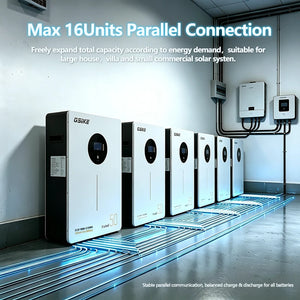
| Parallel expansion | Parallel only, up to 16 units = 81.92 kWh (51.2V × 1600Ah); no series stacking |
| Mounting / display | Wall mount with steel bracket + expansion bolts; round LCD front display; power switch; power terminals (copper-alloy ring lugs) |
| Housing / ingress | ABS / metal case, IP54; CE, RoHS, UN38.3 |
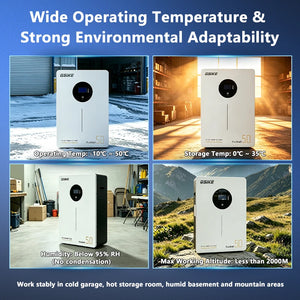
| Environment | Operating −10°C to 50°C; storage 0–35°C; humidity <95% RH; altitude <2000 m |
| Weight / size (headline) | Net 44 kg (44 ±2 kg); 640 H × 428 W × 160 D mm; wall bracket ~409.5 × 322 mm |
| Warranty | 3-year warranty; ~10-year design life |
| Price / stock | €849.99 EUR sale, struck from €1,250.00 (32.0% off); In stock, new, valid from 2026-07-09 |
| Delivery / returns | Free shipping (1–3 days handling + 2–7 days transit) · 30-day returns |
Pick the right GSIKE home pack — this 100AH wall battery vs the 300AH floor-standing sibling
Same GSIKE 48V home-storage family, two form factors. This page sells the slim 100AH wall-mount (5.12kWh). The larger 300AH appears below as context only — never confuse its figures with this pack.
| Parameter | GSIKE 51.2V 100AH (this page, wall) | GSIKE 51.2V 300AH sibling (floor, context only) |
|---|---|---|
| Form factor | Wall-mounted, slim 640×428×160 mm | Floor-standing |
| Cell capacity | 100 Ah | 314 Ah class |
| Energy | 5120 Wh = 5.12 kWh | 16076.8 Wh = 16.0768 kWh |
| Continuous current | 50A rated / 100A max | 200A charge/discharge |
| Net / gross weight | 44 kg net | 109.3 / 126.2 kg |
| Dimensions | 640×428×160 mm | 825×650×450 mm |
| Best for | single-wall 5.12kWh home/starter system; garage, utility room, apartment | larger floor-standing whole-home / multi-kWh installs |
Expected run-time by load (5120 Wh ÷ load; 50A rated / 100A max)
Ideal DC hours at the 5120Wh nameplate, before derating. Plan ordinary continuous loads to the 2560W rated line (50A); the 3000W and 5120W rows are short-time only. When running through the paired 48V hybrid inverter, derate roughly 10% for AC efficiency.
| Load | Example use | Runtime (5120 Wh nameplate) |
|---|---|---|
| 300 W | LEDs + router + fridge compressor average | 17.1 h |
| 500 W | Essential overnight loads | 10.2 h |
| 800 W | Fridge + lights + small electronics | 6.4 h |
| 1000 W | Average home essential load | 5.12 h |
| 1500 W | Essentials plus occasional kettle/microwave cycles | 3.41 h |
| 2000 W | Heavier essential load | 2.56 h |
| 2560 W | Rated continuous ceiling (50A) | 2.0 h |
| 3000 W | Short-time only (near the 100A max) | 1.7 h |
| 5120 W | Absolute short-time ceiling (100A max) | 1.0 h |
Parallel autonomy ladder (parallel only; already 48V)
Because this is already a 48V-class pack you expand in parallel, never in series. Each added 5.12kWh unit stacks capacity at the same 51.2V bus; the BMS parallel limit is 16 units = 81.92kWh (51.2V × 1600Ah).
| Units in parallel | Voltage | Capacity | Energy | Typical role |
|---|---|---|---|---|
| 1 | 51.2 V | 100 Ah | 5.12 kWh | single-wall starter / self-consumption |
| 2 | 51.2 V | 2 × 100 Ah | 10.24 kWh | overnight essentials |
| 4 | 51.2 V | 4 × 100 Ah | 20.48 kWh | multi-day backup |
| 8 | 51.2 V | 8 × 100 Ah | 40.96 kWh | whole-home partial backup |
| 16 | 51.2 V | 16 × 100 Ah | 81.92 kWh | max parallel bank |
Charge, communications & environment
| Item | Specification |
|---|---|
| Charge voltage (bulk/absorption) | 58.4 V (standard 16S LFP CC/CV); discharge cut-off ~43.2V |
| Working voltage window | 43.2 V – 58.4 V |
| Recommended pairing | a mainstream 48V hybrid inverter with a 51.2V LFP battery profile; the inverter is a separate device (this battery has no AC output) |
| Communications | RS232 / RS485 (9600 bps, dual RS485) / CAN-BUS (500 kbps) — match the inverter's protocol/profile |
| Operating temperature | −10°C to 50°C; do not charge below 0°C without a heater (no self-heating built in) |
| Storage temperature | 0°C to 35°C; humidity <95% RH (no condensation); altitude <2000 m |
| Ingress protection | IP54 (dust-protected, splash-proof) — indoor / sheltered installation |
| Display / switches | round LCD (per-pack voltage / capacity), power switch |
| In the box | wall bracket, expansion bolts, power cable, communication cable, manual |
Pros & cons
Pros
- 5.12kWh in a slim wall box — 640×428×160mm on a steel bracket keeps a whole wall's worth of energy off the floor; ~116 Wh/kg density.
- Honest 48V home-storage spec — 16S1P, 58.4V charge, 43.2–58.4V window, and RS232/RS485/CAN to talk to a mainstream 48V hybrid inverter (not a DIY wire-only pack).
- €849.99 struck from €1,250.00 — the cheapest verified dedicated wall pack with a real review set: LiTime 48V 100Ah €1,199.99, ECO-WORTHY Cubix100 €1,009.99, Redodo ~€855.59 — with 30-day returns and free EU shipping.
- Parallel up to 16 = 81.92kWh, so one 5.12kWh wall pack grows into a multi-pack bank on the same 51.2V bus (no series).
- 6000 cycles at 80% DoD with a ~10-year design life; round LCD for at-a-glance state of charge.
- Real buyer rating 4.85 / 5 from 13 reviews, praising the capacity for camper, cabin and home-backup use.
Cons
- A 44kg wall unit needs a strong wall, the steel bracket and expansion bolts, and a two-person install — not a hang-it-yourself job.
- It is a battery, not an inverter — you must pair it with a compatible 48V hybrid inverter; there is no AC output on its own.
- Parallel-only, cannot series (already 48V) — you cannot stack it higher to a 102V-class bus.
- Rated continuous is 2.56kW (50A), so one pack will under-feed a 5kW inverter for sustained draws; 5.12kW is short-time only.
- The charger/inverter must do 58.4V bulk with a 51.2V LFP profile — a generic 48V charger without that absorption setting will not finish.
- Indoor / IP54, not fully outdoor, and there is no self-heating (do not charge below 0°C). It also has a round LCD rather than the WiFi/Bluetooth app monitoring some rivals add.
Where this wall battery fits — real European installations
Garage wall
Mounted flush on a garage wall next to the main consumer unit, the slim 16cm-deep box keeps its 5.12kWh off the floor.
Utility / boiler room
Hung in the utility room near the boiler and switchgear, it backs the heating controls and essentials through an outage.
Beside a separate inverter
The battery and the paired 48V hybrid inverter sit side by side — remember the inverter is a separate device over RS485/CAN.
Whole-home night backup
At night it carries lights, router and fridge; one pack covers overnight essentials, parallel packs extend it.
Solar self-consumption
It stores daytime solar for evening use, cutting grid import in a self-consumption setup.
Modern apartment
The clean blank panel suits a visible powerwall location in a bright apartment without a garage.
Nordic off-grid cabin
On a cabin wall it stores solar for lights and devices after dark; the LCD shows state of charge at a glance.
Two units in parallel
Two packs side by side = 10.24kWh on the same 51.2V bus; the parallel path scales up to 16 units.
Gallery
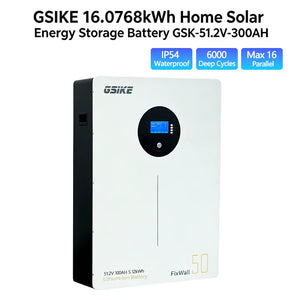
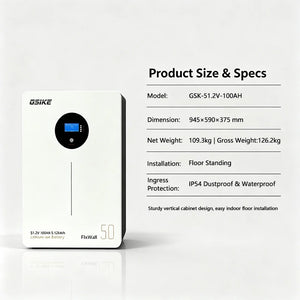
These are the four accurate official images (main unit first). Two marketing graphics are deliberately excluded: one is headed with the larger floor-standing 300AH model, and one is mislabeled with that model's weight and dimensions — neither figure is used on this page.


Shipping & returns
| Policy point | Detail |
|---|---|
| Price | €849.99 EUR sale, struck from €1,250.00 (32.0% off) · In stock, new condition (valid from 2026-07-09) |
| Free delivery to | European countries |
| Handling / transit | Handling 1–3 days + transit 2–7 days, shipping rate EUR 0 |
| Returns | 30-day return window from delivery, by post, in original condition and packaging |
| Return cost | Return shipping is handled by the merchant; original import duties and taxes are non-refundable |
Frequently asked questions
How big a home battery do I actually need — is one 5.12kWh pack enough?
It depends on the goal. For overnight essentials (fridge, LED lighting, router, boiler controls running roughly 0.5–1.5kW), one 5.12kWh pack gives about an evening of backup. If you want to run higher average loads, cover cloudy days, or back a whole house including cooking, add more packs in parallel: two units make 10.24kWh, four make 20.48kWh, and the ladder scales to 81.92kWh across sixteen units.
Can this one wall battery run my whole house or a 5kW inverter?
Not continuously on its own. This pack is rated for 2560W continuous (50A); the 5120W figure (100A) is a short-time ceiling, not a sustained rating. A single 5.12kWh unit will under-feed a 5kW inverter for steady draws, though it can handle short surges. Plan ordinary household loads to about 2.56kW per pack and parallel more units if your inverter runs higher for long periods.
How do I connect it to my hybrid inverter — which cable and protocol?
Use the built-in RS232 / RS485 / CAN links (RS485 9600 bps with a dual port, CAN at 500 kbps) to a mainstream 48V hybrid inverter. Before commissioning, set the inverter battery profile to 51.2V LiFePO4 with a 58.4V charge voltage and a 43.2V cut-off. This is a battery, not an inverter — it has no AC output of its own — and it does not include WiFi app monitoring, only a round LCD.
What charger voltage does it need — will my current charger work?
It needs a 16S LiFePO4 charge profile with a 58.4V bulk/absorption stage and a 43.2V lower cut-off. A generic 48V charger without that exact absorption setting will not fully charge the pack, and a 12V or 24V charger is completely unsuitable. Confirm the charger or hybrid inverter can deliver 58.4V before you buy.
Can I stack several of these in series to get a higher voltage?
No. This is already a 48V-class (51.2V) pack, so you expand in parallel only — never in series. Parallel stacking keeps the bus at 51.2V and adds capacity: one unit is 5.12kWh, two is 10.24kWh, four is 20.48kWh, eight is 40.96kWh and sixteen reaches 81.92kWh. You cannot series-stack it toward a 102V-class system.
How many units can I parallel before I hit the limit?
The on-page table and pack images support up to 16 units in parallel, giving 51.2V × 1600Ah = 81.92kWh. (A line in the body copy mentions a lower figure; we follow the table/images and recommend you confirm the exact parallel limit with the merchant.) Use identical units and matched state of charge, and use the dual RS485 port to daisy-chain packs.
Is it safe to wall-mount a 44kg battery myself?
We recommend a strong wall, the included steel bracket (~409.5×322mm) and expansion bolts into a solid substrate, plus a two-person lift given the 44kg weight. Plan clearances around the unit and the terminal cover, and follow the install guide for anchoring, grounding and cabling rather than hanging it on plasterboard alone.
Can I leave it in an unheated garage through winter?
It operates down to −10°C and stores best between 0°C and 35°C, with an IP54 indoor/sheltered rating. It has no self-heating element, so do not charge it below 0°C — if your winter room can drop that low, add heating or choose a self-heating rival. The manual's printed temperature labels vary; follow standard LiFePO4 practice and confirm derating with the merchant.
How long will 5.12kWh actually last on essential loads?
At the nameplate: 300W lasts about 17 hours, 500W about 10 hours, 1000W about 5 hours, and the 2560W rated line lasts 2 hours. In practice a typical essential load of fridge, lighting, router and boiler controls sits around 0.5–1.5kW, so one pack comfortably covers an overnight outage; derate about 10% for the inverter, and parallel more packs for longer autonomy.
What is in the box, and how does the price compare to Pylontech or LiTime?
The box contains the wall bracket, expansion bolts, a power cable, a communication cable and the manual. At €849.99 (struck from €1,250) this is cheaper than LiTime 48V 100Ah (€1,199.99) and ECO-WORTHY Cubix100 (€1,009.99) and near Redodo (€855), but it is modestly dearer than the established Pylontech US5000 4.8kWh (~€718) — GSIKE counters with a little more usable energy (5.12 vs 4.8kWh), a dedicated wall mount, the round LCD and 30-day returns, while Pylontech has the longer inverter-compatibility track record.
Guides & comparisons
Go deeper before you buy:
48v 100ah lifepo4 battery,51.2v 100ah lifepo4 battery,5kwh home battery,5120wh lithium battery,wall mounted 48v solar battery,48v lifepo4 battery with bms can rs485,gsike fixwall 51.2v 100ah battery,buy 48v 100ah lifepo4 battery europe,5kwh home battery under 900 eur,5kwh powerwall battery europe,home solar storage battery 5kwh price comparison europe,stackable 48v battery parallel up to 16
buy 48v 100ah lifepo4 battery europe, 5kwh home battery under 900 eur, 48v 100ah lifepo4 eu warehouse, wall mounted solar battery for home storage, 5kwh powerwall battery europe, gsike fixwall 51.2v 100ah price, 48v battery compatible with hybrid inverter, home solar storage battery 5kwh price comparison europe, 48v lifepo4 battery for off grid home backup, stackable 48v battery parallel up to 16, wall mounted 48v battery with Icd screen, 51.2v 100ah battery free shipping europe
how many kwh to power a house, how many 5kwh batteries doi need for off grid, 48v battery sizing for hybrid inverter, 51.2v lifepo4 charge voltage 58.4v, how to wire parallel 48v lifepo4 batteries, can rs485 48v battery inverter communication, wall mounted solar battery installation guide, 48v vs 24v vs 12v home solar battery, how long will a 5kwh battery run a house, 48v lifepo4 working voltage 43.2 to 58.4, self consumption vs backup battery sizing, how to mount a 48v lithium battery on wall
best 48v 5kwh home battery europe 2026, gsike vs litime 48v 100ah lifepo4, gsike vs renogy 48v 100ah home battery, pylontech us5000 vs gsike 51.2v 100ah, redodo 48v 100ah vs gsike, eco-worthy 48v 100ah vs gsike, 48v 100ah wall vs server rack battery, cheap 5kwh home battery europe, 5kwh lifepo4 under 1000 eur europe, gsike51.2v100ahvs300ahsiblingwhichbatter, litime vs pylontech 48v home battery, 48v battery can bus vs bluetooth monitoring

