


Gsike 314Ah 16.08kWh Floor Cabinet: 51.2V 200A BMS Battery for Germany
Estimate delivery times: 2-7 Business days (European Union, United States).
Return within 30 days of purchase. Duties & taxes are non-refundable.
Gsike 314Ah 16.08kWh Floor Cabinet: 51.2V 200A BMS Battery for Germany
Description
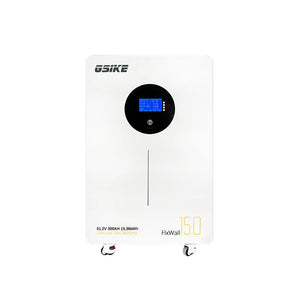
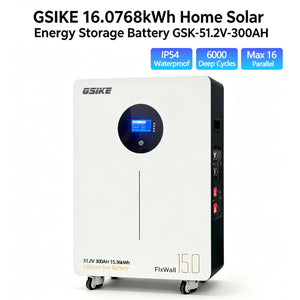
GSIKE FixWall 15.0: 51.2V 300Ah (314Ah) 16.08kWh Floor LiFePO4 Cabinet for Germany, With 200A BMS
The GSIKE FixWall 15.0 is a caster-mounted 51.2V 314Ah LiFePO4 cabinet storing 16.08kWh, listed at €1,569.99 EUR with a struck price of €2,250.00, delivered as a battery-only DC node without AC output that pairs with a separate 230/400V hybrid inverter.
Product Overview
This high-capacity 48V-class cabinet rolls on casters into a garage, cellar, heating room, or farm holding, where it feeds a compatible German hybrid inverter; it performs DC storage only and does not generate alternating current on its own.

Priced at €1,569.99 EUR after a cut from the €2,250.00 reference price; a single variant, held in stock at present. Free delivery to 15 EU markets including Germany; 30-day return window; three-year warranty. Duties and taxes are non-refundable.
Battery and Electrical Specifications
All values below come from the checked 300AH cabinet dataset: 3.2V prismatic LFP cells made by Penghui (Great Power) are arranged 16S1P and monitored by a 200A smart BMS.
| Specification | Detail |
|---|---|
| Chemistry and assembly | LiFePO4 3.2V prismatic cells, 16S1P; cell brand Penghui (Great Power) |
| Nominal voltage | 51.2 V (48V-class bus) |
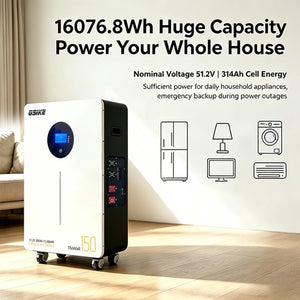
| Real capacity and energy | 314Ah / 16,076.8Wh = 16.08kWh; the printed 300Ah / 15.36kWh figure is the nominal marketing label |
| BMS current rating | 200A charge and 200A discharge, about a 10.2kW DC ceiling (10,240W at 51.2V); this is not a 15kW continuous output |
| Working voltage | 43.2V – 58.4V; discharge cut-off near 43.2V |
| Charge voltage | 58.4V bulk/absorption, standard 16S LFP CC/CV profile |
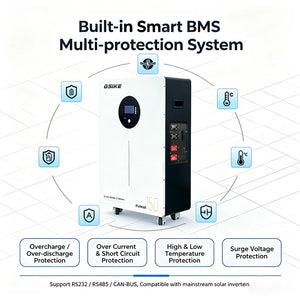
| Built-in smart BMS | Over-charge, over-discharge, over-current, short-circuit, high and low temperature, surge-voltage protection |
| Communication | RS232, RS485 (Pylontech protocol), CAN-BUS to pair with a 48V Pylontech-compatible hybrid inverter |
| Inverter compatibility | Compatible units such as Deye, Growatt, Sungrow, Sofar, Sol-Ark, and EG4; compatibility is not certified for every model, so verify before purchase |
| Cycle life | 6000 cycles at 80% DoD @25°C; about a 10-year design life; beyond 10,000 cycles at 50% DoD |
| Usable reserve | About 12.9kWh at 80% DoD; roughly 11.5 to 12kWh usable AC through an inverter of about 95% efficiency |
| AC output | None; battery-only DC node, and single- or three-phase supply depends on the paired inverter |
| Monitoring | Round LCD and on/off switch; WiFi and Bluetooth are not supported, and there is no phone application |


Expansion, Cabinet Build and Environment
Several of these cabinets can be wired alongside one another on the 51.2V bus; wheels move the unit into place, and the IP54 enclosure is designed for dry rooms indoors or under shelter.
| Specification | Detail |
|---|---|
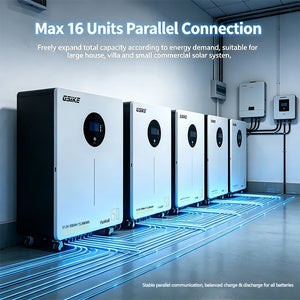
| Expansion topology | Parallel only, up to 16 cabinets on the 51.2V bus with unique address 1–16; series connection is not supported |
| Mixing rule | Do not mix brands or capacities inside the same parallel bank |
| Form factor | Floor-standing rolling cabinet on casters; round LCD, on/off switch, terminal blocks |
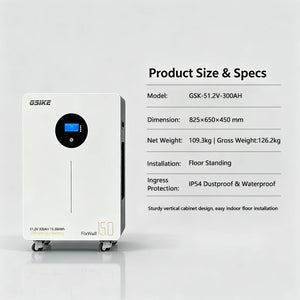
| Ingress rating | IP54 dust-tight and splash-proof; not waterproof; indoor or sheltered dry-room use |
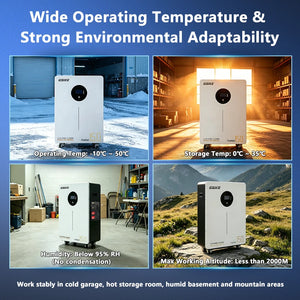
| Operating temperature | −10°C to 50°C |
| Storage temperature | 0°C to 35°C; humidity below 95% RH without condensation; altitude under 2000 m |
| Low-temperature charging | No self-heating function; do not charge below 0°C |
| Net weight | 109.3 kg |
| Gross weight | 126.2 kg on pallet |
| Dimensions | 825 H × 650 W × 450 mm |


German Whole-Home and Solar Context
One cabinet supplies enough reserve to keep essential household circuits running through the night, and on a dynamic or hourly tariff it moves saved solar energy toward the evening demand peak. How long loads keep running depends on household consumption, inverter efficiency, depth of discharge, and how many cabinets share the bus.
| Specification | Detail |
|---|---|
| Whole-home reserve | Roughly 12.9kWh usable at 80% DoD before inverter losses; essential circuits are sized to this reserve rather than the full 16.08kWh nameplate |
| Three-phase pairing | Works with a compatible 230/400V three-phase hybrid inverter; phase count and backup switching remain the inverter's responsibility |
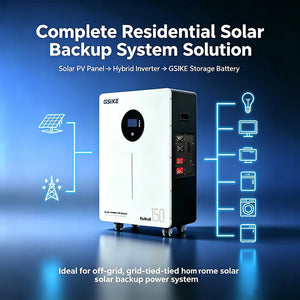
| Solar self-consumption | Charged from PV through the hybrid inverter or MPPT controller; autonomy days are planned against daily harvest and evening load |
| Installation space | Floor position with caster access; confirm floor loading, ventilation, and delivery clearance before pallet arrival |


In the Box
| Specification | Detail |
|---|---|
| FixWall 15.0 51.2V 314Ah cabinet with casters | Yes |
| Terminal blocks and connection hardware | Included per the listing; confirm cables on the product page before purchase |
| User manual | Included |
| Hybrid inverter, solar panels, or mounting rails | Not included; selected separately to match the German installation |
Pros & Cons
Objective Strengths
- Large reserve: The 314Ah rating stores 16.08kWh for whole-home Notstrom, evening self-consumption, and off-grid autonomy in a German household.
- Heavy-duty BMS: 200A charge and discharge with six-guard protection and cell balancing for sustained household and workshop loads.
- Closed-loop comms: RS232, RS485 Pylontech protocol, and CAN-BUS align charge limits with a compatible 48V inverter.
- Expandable array: As storage needs rise, as many as 16 cabinets can run in parallel on the 51.2V bus.
- Service life: Rated for 6000 cycles at 80% depth of discharge and 25°C, roughly a ten-year design life, backed by a three-year warranty.
- Rolling format: Casters position the cabinet in a garage, cellar, or plant room without wall mounting.
Objective Weaknesses
- DC only: No AC output; a separate 48V hybrid inverter is required to supply German household circuits.
- DC ceiling: The 200A figure is a roughly 10.2kW DC ceiling, not a 15kW continuous rating; size loads against this boundary.
- No mobile app: The round LCD is the only status display; WiFi, Bluetooth, and smartphone control are not provided.
- Parallel wiring only: Series strings are unavailable, and cabinets of differing makes or ratings must not occupy the same bank.
- No built-in heater: The pack has no low-temperature self-heating element, and charging the cells below 0°C is not allowed.
- Heavy enclosure: The 109.3kg net weight (126.2kg pallet gross) calls for a solid floor, two people to move it, and enough delivery room.
Real-World Scenarios
The cabinet suits fixed high-capacity storage where a 48V DC node feeds a German inverter: residential backup, basement and heating rooms, farm holdings, and garage installations.

Utility Room Install
The cabinet occupies a dedicated utility room with clear ventilation and a cable run to the hybrid inverter.

Basement Parallel Bank
Extra cabinets join in parallel on the bus to raise total stored energy for a larger German household.

Farm and Light Commercial
This unit supports a farmstead or compact workshop, keeping tools and building circuits supplied from a stable reserve.

Garage Floor Position
The wheels allow the unit to be moved into the garage for installation and maintenance, with no wall bracket required.
Frequently Asked Questions
Which voltage, Ah rating and stored energy does the FixWall 15.0 hold?
The cabinet sits on a 51.2V nominal 48V-class bus, carries a 314Ah rating, and stores 16,076.8Wh, equal to 16.08kWh, from 3.2V LiFePO4 cells arranged 16S1P. The 300Ah / 15.36kWh marking printed on the unit is the nominal marketing label rather than the measured cell rating.
What DC power ceiling applies to the 314Ah cabinet through its BMS?
The smart BMS caps both charging and discharging at 200A, which works out to a roughly 10.2kW DC ceiling (10,240W at 51.2V). This figure is not a 15kW continuous rating, and any AC power reaching household loads depends on the separate inverter you pair with the battery.
Can the cabinet supply household appliances by itself?
No AC outlet is built into the cabinet, so it stays a battery-only DC node. Single-phase 230V or three-phase 400V AC supply for German household circuits is produced by the separate hybrid inverter connected to the system, not by the cabinet itself.
Which hybrid inverters does the battery talk to in a German setup?
The battery exchanges data through RS232, an RS485 Pylontech-protocol link, and a CAN-BUS connection. It is designed for 48V Pylontech-compatible inverters such as Deye, Growatt, Sungrow, Sofar, Sol-Ark, or EG4; compatibility is not certified for every model, so confirm the protocol match before ordering.
How many cabinets may be joined on the 51.2V bus?
Up to 16 cabinets can be paralleled on the 51.2V bus, each assigned a unique address from 1 to 16. Series strings cannot be formed, and cabinets of different brands or capacities must never share the same bank.
How many cycles and what design life carry the warranty?
The rating lists 6000 cycles at 80% depth of discharge and 25°C, a design life around ten years, and more than 10,000 cycles when cycled at 50% DoD. The unit is covered by a three-year warranty sold to the German market.
How much usable AC energy stays after depth-of-discharge and inverter losses?
Cycling to 80% DoD leaves a reserve of about 12.9kWh before inverter losses, and roughly 11.5 to 12kWh of usable AC reaches the home through an inverter running near 95% efficiency.
Where does it stand indoors, and what are its weight and size?
The unit rolls on casters into position rather than mounting on a wall. Net weight is 109.3kg, or 126.2kg gross on pallet, and the enclosure measures 825 H × 650 W × 450 mm. It carries a round LCD, an on/off switch, terminal blocks, and an IP54 rating for indoor or sheltered dry-room placement.
Which fault protections run inside the built-in smart BMS?
The controller guards against over-charge, over-discharge, over-current, short-circuit, high and low temperature events, and surge voltage, while keeping the internal cells balanced against one another.
What ambient limits apply, and is charging below 0°C allowed?
Ambient operation spans −10°C to 50°C, and storage should remain between 0°C and 35°C. No self-heating element is fitted to the cabinet, and charging the pack when it sits below 0°C is prohibited.
Related GSIKE German Guides
How hourly dynamic tariffs, evening peak shifting, and winter Stromausfall risk change the value case for a 16kWh cabinet in Germany.
Compare the cabinet with established 16kWh European and Asian options on capacity, communication, format, and warranty positioning.
Plan stored energy for multi-day autonomy across northern, alpine, and rural German conditions, against daily load and solar harvest.
Review three-phase inverter pairing, parallel cabinet addressing, wiring checks, and pallet delivery for a German install.
51.2V 300Ah LiFePO4 Batterie, 16kWh Hausbatterie, 48V 314Ah 16.08kWh LFP-Standschrank, GSIKE FixWall 15.0, 16kWh Stromspeicher Photovoltaik Deutschland, Ganzhaus-Notstrom Batterie, 400V Drehstrom Hybridwechselrichter Batterieverbund, 200A BMS stehender Schrank, dynamischer Tarif Eigenverbrauch, 16kWh Speicher für Bauernhof Werkstatt Garage Keller

