


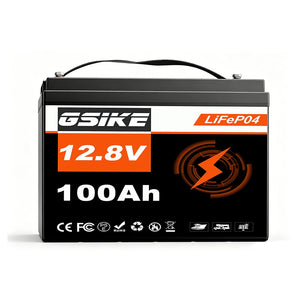

Gsike 12.8V 100Ah LiFePO4 Battery, 1280Wh 100A BMS Off-Grid Pack Italy
Estimate delivery times: 2-7 Business days (European Union, United States).
Return within 30 days of purchase. Duties & taxes are non-refundable.
Gsike 12.8V 100Ah LiFePO4 Battery, 1280Wh 100A BMS Off-Grid Pack Italy
Description
Gsike 12.8V 100Ah LiFePO4 Battery (1280Wh, 100A BMS) for RV, Boat and Off-Grid Solar
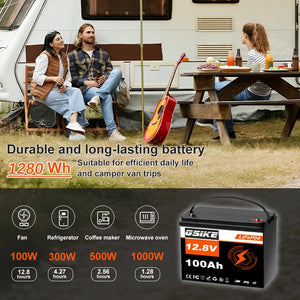
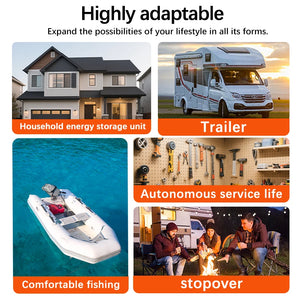
Wondering what kind of leisure store this Gsike unit actually is? It pairs a 12.8V, 100Ah LiFePO4 chemistry with 1280Wh of capacity, a 100A BMS and a 6000-cycle life, aimed at campervans, boats, camping rigs and modest off-grid solar setups.
Overview: a light 12V-class LFP store for modest off-grid and leisure loads
What kind of equipment is this pack, and what role does it play in a system? In short, it is a deep-cycle LFP leisure store: four LFP cells joined in series sit behind a 100A BMS, holding 1280Wh on a 12.8V bus. Who is it built for? Campervan and motorhome leisure circuits, boat and trolling-motor applications, compact solar sheds and cabins, weekend camping setups, plus an evening home reserve that keeps essential circuits alive. One question comes up often: does it combine battery, inverter and outlet in one box? It does not. This is a DC-only store, so it brings neither an onboard charger nor an onboard inverter nor a mains AC socket; every 230V appliance has to be fed by a separately selected 12V inverter.
€159.99 EUR — as of October 12, 2026
Compare-at price €250.00 EUR — as of October 12, 2026. Which currency figures appear here? Only these EU storefront amounts are shown; the page quotes no other currency.

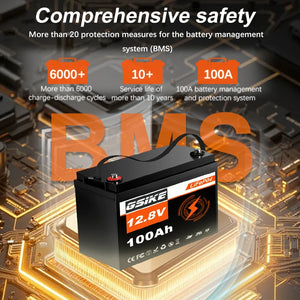
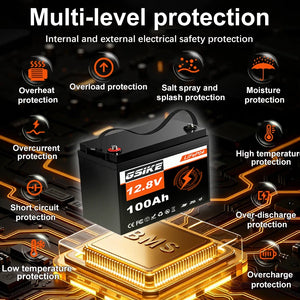
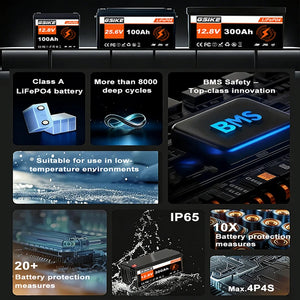
How easy is it to handle and mount? At 9.8kg net and 315 × 215 × 280mm, it moves far more readily than an equivalent-energy lead-acid pack, and its ABS housing carries an IP65 rating for protected indoor spots and sheltered outdoor locations. What protects the cells inside? The 100A BMS watches for over-charge, over-discharge, over-current, over-temperature and short-circuit events, cutting discharge around 10V when the cells approach their lower limit.

Which figures can you take as certain? Only those recorded on this model's own spec record. If the record leaves something unanswered — say which accessories ship in the box, the cell brand, or a precise maximum panel wattage for the controller — that uncertainty is stated plainly instead of borrowed from a sibling model or a rival listing.
Full specification
| Specification | Value for this unit |
|---|---|
| Chemistry and assembly | LiFePO4 (LFP), 4 cells in series (4S), 12.8V nominal |
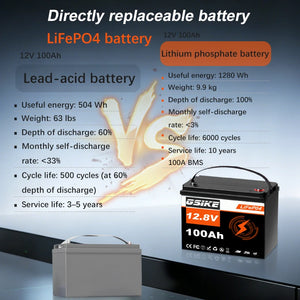
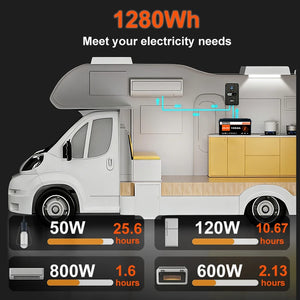
| Capacity / stored energy | 100Ah / 1280Wh (12.8V × 100Ah) |
| Continuous current | 100A charge, 100A discharge |
| Continuous power ceiling | 1280W DC (12.8V × 100A) |
| Peak pulse | 400A for 1 second only — startup inrush, not a continuous rating |
| BMS | 100A BMS: over-charge, over-discharge, over-current, over-temperature and short-circuit protection; discharge cuts off around 10V |
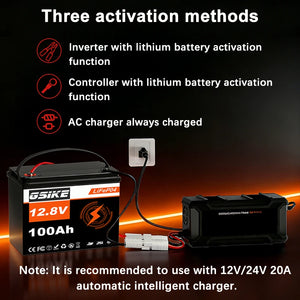
| Charge profile | CC/CV, 14.4V ±0.2V; recommended charge current 20A (0.2C); BMS permits up to 100A continuous charge |
| End-of-discharge | 10V |
| Cycle life | 6000 cycles at 80% DoD; roughly 5000+ at full 100% DoD; about a 10-year design life |
| Expansion | Up to 4P4S — 16 units for a 20.48kWh bank (4S = 51.2V, 4P = 400Ah) |
| Internal resistance | ≤20mΩ |
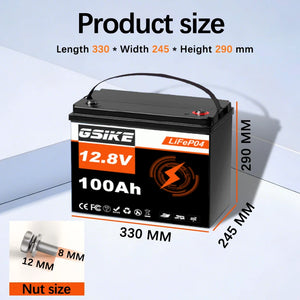
| Terminals | M8 bolt terminals (8mm bolt / 12mm nut) |
| Housing and ingress | ABS housing, IP65 |
| Certifications | CE, RoHS, UN38.3 |
| Weight | 9.8kg net; 10.35kg gross |
| Dimensions | 315 × 215 × 280 mm (L × W × H) |
| Self-discharge | Under 3% per month |
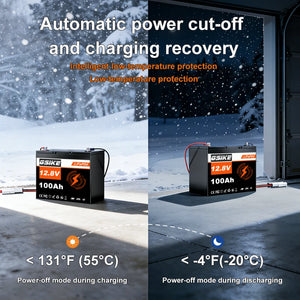
| Charge temperature | 0°C to 50°C; do not charge below 0°C; the BMS stops charging around 55°C |
| Discharge temperature | −20°C to 60°C |
| Storage temperature | −10°C to 50°C; store at roughly 50% charge |
| Low-temperature heating | None — no self-heating element and no low-temperature charging function |
| Built-in charger / inverter / outlet | None; this is a DC-only node, and 230V appliances need a separate 12V inverter |
| Display and communication | No LCD listed; no CAN, RS485 or RS232 port listed; Wi-Fi, app and Bluetooth are not documented on the spec sheet |
| Warranty and returns | 3-year warranty; about a 10-year design life; 30-day return by mail in original condition |
System pairing and installation context
Which system class does it belong to, and what partners does it need? The pack is a 12V-class node: pair it with an external 12V inverter chosen against your actual AC appliances, and with a 14.4V LiFePO4 charger or an MPPT controller switched to the LFP profile. What happens if you plug in an older lead-acid charger? Such a charger floating around 13.5–13.8V with no LFP setting cannot bring this pack back to full. How much energy is lost on the AC side? Inverters of this class usually convert at 90–95%, so plan AC runtime from the DC store after that efficiency cut.
| System element | Guidance for this pack |
|---|---|
| Inverter | Separate 12V inverter; match its continuous VA rating to your appliances and keep startup inrush in view |
| Charger / MPPT | 14.4V ±0.2V LFP charge profile (CC/CV); recommended charge current 20A (0.2C), with the BMS permitting up to 100A continuous charge |
| Cabling | M8 bolt terminals (8mm bolt / 12mm nut); use ring lugs sized to cable current and keep DC runs short |
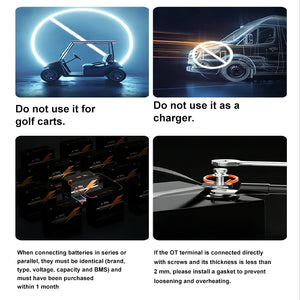
| Expansion matching | If more than one unit is connected, match identical units within roughly one month of production and charge history; do not mix new and worn cells |
| Monitoring | No display, app, Bluetooth or communication bus is documented for this pack; plan any state-of-charge reading through your inverter, charger or an external meter |

Shipping, returns and regional context for buyers in Italy
| Service item | Detail |
|---|---|
| Free delivery | 0 EUR to GB, DE, FR, IT, ES, NL, BE, AT, SE, DK, FI, IE, PT, PL and CZ — Italy (IT) is among these listed markets |
| Handling and transit | Handling 1–3 days; transit 2–7 days within the listed markets |
| Returns | 30-day return by mail, original condition and packaging; duties and taxes are non-refundable |
| Other destinations | The carriage and return terms above apply only to the 15 markets listed in this row; buyers elsewhere should confirm local delivery and import terms with the seller before ordering |
| Warranty | 3-year warranty; about a 10-year design life |
What does delivery mean for someone ordering to an Italian address? Italy appears among the listed destination markets, so an Italian delivery enjoys the 0 EUR carriage and the 30-day mail return set out in the table above. How far do those terms reach? They remain confined to the 15 markets named there; anyone buying from another destination should check carriage, import duties and local after-sales details with the seller before ordering, rather than assuming the listed rules travel further.
Objective strengths and limitations
Strengths
- Stored capacity: 1280Wh held on the 12.8V bus from 100Ah, with a 100A steady discharge headroom for light continuous loads.
- Long service life: 6000 cycles measured at 80% DoD, an approximate ten-year design life, and 3 years of warranty cover.
- Compact and light: 9.8kg net in a 315 × 215 × 280mm case, simple to place inside a camper, on a boat or in a utility nook.
- Integral protection: the 100A BMS guards against over-charge, over-discharge, over-current, over-temperature and short circuits; the ABS case carries IP65 plus CE, RoHS and UN38.3 certification.
- Expandable later: documented bank configurations reach 4P4S, 16 units totalling 20.48kWh, should capacity need to grow.
- Low standing loss: self-discharge below 3% each month, a good fit for storage between one trip and the next.
Limitations
- DC-only node: no charger, inverter or mains socket is built in; each 230V appliance must go through an external 12V inverter.
- Steady-power ceiling: 100A steady translates to 1280W DC; the 400A number lasts a single second for startup inrush only and cannot be held as a continuous load.
- No listed display or app: the spec record names no LCD, Wi-Fi, Bluetooth or app-based monitoring for this model.
- Cold charging barred: charging must stay above 0°C; no self-heating element or low-temperature charging feature is provided.
- Older chargers may underperform: a charger tuned only to lead-acid voltages, with no LFP profile, cannot finish topping the pack up.
- Accessories not itemized: cables, lugs, fuses and a manual are not itemized in the record, so check what ships in the box with the seller.
Where this pack fits in real systems

RV and campervan leisure power
Over a trip it supplies lights, USB and device charging, a portable fridge and modest entertainment draws; the 400A one-second burst handles fridge and compressor switch-on.

Boat and trolling motor
It feeds a small electric trolling motor at a steady 100A discharge, and the 1280Wh store carries a moderate day afloat.

Home evening backup
When the mains falters in the evening it keeps lights, a router and a handful of essential appliances going on solar or mains-charged reserve, with room to add capacity later should demand grow.
Frequently asked questions about the Gsike 12.8V 100Ah battery
How much energy does the Gsike 12.8V 100Ah battery store?
How much capacity is that, exactly? On a 12.8V nominal bus the 100Ah rating works out to 1280Wh of stored energy. What current can it keep up? Steady discharge runs to 100A, a 1280W DC ceiling; the 400A figure is a startup pulse lasting one second, not a figure you can rely on as a continuous load.
Which inverter works with this battery?
What kind of inverter fits it? Because the pack sits in the 12V class, you choose an external 12V inverter to match the AC appliances you actually own. Is there a socket on the battery itself? No mains outlet is built in; the inverter lifts the 12.8V DC bus to 230V AC, usually converting at roughly 90–95%.
What charger voltage does the battery require?
Which charge voltages does it expect? Refill follows a CC/CV LFP profile ending at 14.4V ±0.2V. What current is typical? The suggested charge current is 20A (0.2C), although the BMS allows up to 100A of continuous charge. What if the source is a lead-acid charger? One floating at 13.5–13.8V with no LFP setting cannot top the pack up completely.
How long does the battery last in cycles?
How many cycles should you plan around? The published figure is 6000 cycles at 80% depth of discharge, roughly 5000+ cycles when cycling to a full 100% DoD, alongside an approximate ten-year design life. Does that count always hold? The real number moves with depth of discharge, temperature and the way the pack is charged and discharged.
Can several units be combined into a larger bank?
Can more units be joined later? Yes: the documented expansion reaches 4P4S, 16 units forming a 20.48kWh bank (4S = 51.2V, 4P = 400Ah). What matching rules apply? Pick units that match one another closely in production date and charge history; worn cells should never sit alongside fresh ones.
What are the weight and dimensions?
How heavy and large is it? Net weight comes to 9.8kg, 10.35kg gross, inside a 315 × 215 × 280mm (L × W × H) case. How do the cables attach? M8 bolt terminals take an 8mm bolt and a 12mm nut.
Does the battery include a screen, app or Wi-Fi monitoring?
Is there a screen, app or wireless monitoring? The record lists no LCD, Wi-Fi, Bluetooth, app or communication bus for this model. Then how do you check charge level? Read it off the inverter, the charger or an external meter; if a seller advertises an app-connected function, verify it with them before purchase.
Can the battery be charged in cold weather?
Can it be charged in winter conditions? Charging is rated between 0°C and 50°C, and any charging below 0°C must be avoided; the pack has neither a self-heating element nor a low-temperature charging feature. What about the other limits? Discharge is permitted from −20°C to 60°C, and idle storage should sit between −10°C and 50°C at about 50% charge.
What accessories are supplied with the battery?
Which parts ship in the box? The published record does not itemize cables, ring lugs, fuses, mounting hardware or a printed manual. How should that be handled? Treat it as an open data point, and check the included parts with the seller before buying.
What warranty, shipping and return terms apply to buyers in Italy?
What do warranty, delivery and returns look like for an Italian buyer? Warranty cover runs 3 years, against an approximate ten-year design life. Italy is one of the listed markets, so carriage is 0 EUR: 1–3 days handling, 2–7 days transit, and a 30-day return by mail in original condition. How wide do those terms go? The listed carriage and return rules stay within the 15 named markets; buyers in other destinations should verify local delivery and import terms with the seller.
Gsike 12.8V 100Ah LiFePO4 battery, 1280Wh leisure battery, 12V off-grid battery, 100A BMS, RV solar battery, trolling motor battery, IP65 LFP pack

