


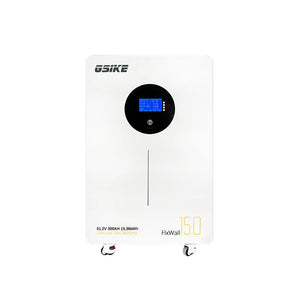
Gsike 314Ah 16.08kWh Floor Cabinet: 51.2V 200A BMS Battery for Ukraine
Estimate delivery times: 2-7 Business days (European Union, United States).
Return within 30 days of purchase. Duties & taxes are non-refundable.
Gsike 314Ah 16.08kWh Floor Cabinet: 51.2V 200A BMS Battery for Ukraine
Description
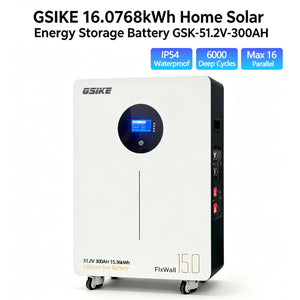
GSIKE FixWall 15.0: 51.2V 300Ah (314Ah) 16.08kWh Floor LiFePO4 Cabinet for Ukraine, With 200A BMS
The GSIKE FixWall 15.0 is a caster-mounted 51.2V 314Ah LiFePO4 cabinet holding 16.08kWh, listed at €1,569.99 EUR against a struck reference price of €2,250.00. It arrives as a battery-only DC node with no built-in AC outlet, intended to sit behind a separate 230V or 230/400V hybrid inverter for backup power and solar self-consumption in Ukrainian homes.
Product Overview
This high-capacity 48V-class cabinet rolls on casters into a garage, storeroom, plant room, dacha, or farm holding, where it feeds a compatible hybrid inverter. It stores DC energy only and does not produce alternating current on its own, so household circuits remain supplied through the inverter matched to the installation.

Offered at €1,569.99 EUR after a reduction from the €2,250.00 reference price; one single variant, held in stock at present. The verified offer covers free delivery to the 15 listed EU markets, a 30-day return window, and a three-year warranty; duties and taxes are non-refundable. The offer does not state a local Ukraine delivery promise, so shipping terms for a Ukrainian address should be confirmed at checkout.
Battery and Electrical Specifications
Every figure below follows the checked 300Ah cabinet dataset: 3.2V prismatic LFP cells supplied by Penghui (Great Power) are arranged 16S1P and monitored by a 200A smart BMS.
| Specification | Detail |
|---|---|
| Chemistry and assembly | LiFePO4 3.2V prismatic cells, 16S1P; cell brand Penghui (Great Power) |
| Nominal voltage | 51.2 V (48V-class bus) |
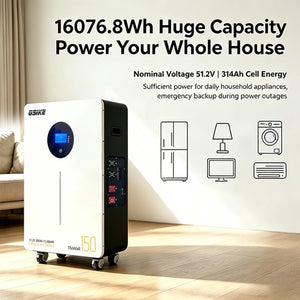
| Real capacity and energy | 314Ah / 16,076.8Wh = 16.08kWh; the printed 300Ah / 15.36kWh figure is the nominal marketing label |
| BMS current rating | 200A charge and 200A discharge, about a 10.2kW DC ceiling (10,240W at 51.2V); this is not a 15kW continuous output |
| Working voltage | 43.2V – 58.4V; discharge cut-off near 43.2V |
| Charge voltage | 58.4V bulk/absorption, standard 16S LFP CC/CV profile |
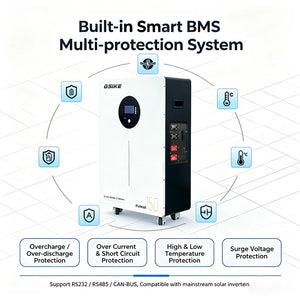
| Built-in smart BMS | Over-charge, over-discharge, over-current, short-circuit, high and low temperature, surge-voltage protection |
| Communication | RS232, RS485 (Pylontech protocol), CAN-BUS to pair with a 48V Pylontech-compatible hybrid inverter |
| Inverter compatibility | Compatible units such as Deye, Growatt, Sungrow, Sofar, Sol-Ark, and EG4; compatibility is not certified for every model, so verify before purchase |
| Cycle life | 6000 cycles at 80% DoD @25°C; about a 10-year design life; beyond 10,000 cycles at 50% DoD |
| Usable reserve | About 12.9kWh at 80% DoD; roughly 11.5 to 12kWh usable AC through an inverter of about 95% efficiency |
| AC output | None; battery-only DC node, and single- or three-phase supply depends on the paired inverter |
| Monitoring | Round LCD and on/off switch; WiFi and Bluetooth are not supported, and there is no phone application |


Expansion, Cabinet Build and Environment
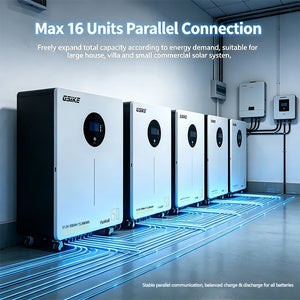
Several of these cabinets can be wired alongside one another on the 51.2V bus; wheels move the unit into place, and the IP54 enclosure is meant for dry rooms indoors or under shelter.
| Specification | Detail |
|---|---|
| Expansion topology | Parallel only, up to 16 cabinets on the 51.2V bus with unique address 1–16; series connection is not supported |
| Mixing rule | Do not mix brands or capacities inside the same parallel bank |
| Form factor | Floor-standing rolling cabinet on casters; round LCD, on/off switch, terminal blocks |
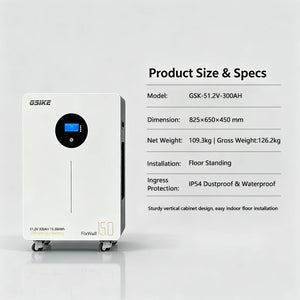
| Ingress rating | IP54 dust-tight and splash-proof; not waterproof; indoor or sheltered dry-room use |
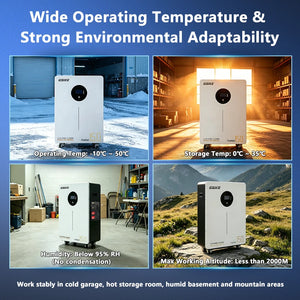
| Operating temperature | −10°C to 50°C |
| Storage temperature | 0°C to 35°C; humidity below 95% RH without condensation; altitude under 2000 m |
| Low-temperature charging | No self-heating function; do not charge below 0°C |
| Net weight | 109.3 kg |
| Gross weight | 126.2 kg on pallet |
| Dimensions | 825 H × 650 W × 450 mm |


Ukrainian Home and Solar Context
One cabinet supplies enough reserve to keep essential household circuits running through an evening outage, and on a self-consumption setup it shifts harvested solar energy toward the evening demand peak. The runtime you can expect changes with daily household draw, inverter efficiency, the depth of discharge, and how many cabinets share the bus.
| Specification | Detail |
|---|---|
| Whole-home reserve | Roughly 12.9kWh usable at 80% DoD before inverter losses; essential circuits are sized to this reserve rather than the full 16.08kWh nameplate |
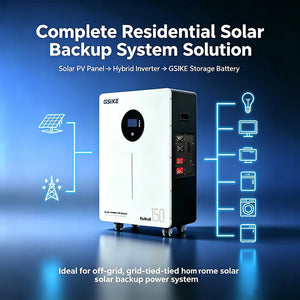
| Hybrid inverter pairing | Works with a compatible 230V single-phase or 230/400V three-phase hybrid inverter; phase count and backup switching remain the inverter's responsibility |
| Solar self-consumption | Charged from rooftop PV through the hybrid inverter or MPPT controller; autonomy days are planned against daily harvest and evening load |
| Installation space | Floor position with caster access; confirm floor loading, ventilation, and delivery clearance before pallet arrival |


In the Box
| Specification | Detail |
|---|---|
| FixWall 15.0 51.2V 314Ah cabinet with casters | Yes |
| Terminal blocks and connection hardware | Included per the listing; confirm cables on the product page before purchase |
| User manual | Included |
| Hybrid inverter, solar panels, or mounting rails | Not included; selected separately to match the Ukrainian installation |
Pros & Cons
Objective Strengths
- Large reserve: The 314Ah rating stores 16.08kWh for whole-house backup, evening self-consumption, and multi-day autonomy in a Ukrainian household.
- High-current protection: 200A charge and discharge with six-guard monitoring and cell balancing to sustain steady home and workshop draw.
- Signal integration: RS232 plus an RS485 Pylontech line and CAN-BUS keep charging limits aligned with a compatible 48V inverter.
- Scalable bank: Once demand grows, up to 16 cabinets may be added in parallel across the 51.2V bus.
- Long cycle rating: 6000 cycles at 80% depth of discharge and 25°C, around a ten-year design horizon, covered by the three-year warranty.
- Rolling format: Casters position the cabinet in a garage, storeroom, or plant room without wall mounting.
Objective Weaknesses
- DC only: No AC output; a separate 48V hybrid inverter is required to supply household circuits.
- Power boundary: 200A translates to roughly a 10.2kW DC ceiling rather than a 15kW continuous rating; design loads around that limit.
- Status display only: A round LCD shows state of charge; there is no WiFi, Bluetooth, or phone-based control.
- Parallel topology: Series strings are not an option, and banks may not mix cabinet brands or ratings.
- No thermal heater: The pack lacks a low-temperature warming element, and cells must not be charged below 0°C.
- Substantial weight: 109.3kg net (126.2kg on pallet) needs a firm floor, two-person handling, and clear delivery access.
Real-World Scenarios
The cabinet suits fixed high-capacity storage where a 48V DC node feeds a compatible inverter: residential backup, basement and heating rooms, farm holdings, and garage installations.

Private House Utility Room
The cabinet occupies a dedicated utility room with clear ventilation and a cable run to the hybrid inverter, keeping essential circuits ready during an outage.

Parallel Reserve Bank
Extra cabinets join in parallel on the bus to raise total stored energy for a larger household or a property with longer backup needs.

Farmstead and Small Shop
This unit supports a farmstead, compact workshop, or small shop and cafe, keeping tools, fridges, and building circuits supplied from a stable reserve.

Garage or Storeroom Placement
The wheels allow the unit to be moved into the garage or storeroom for installation and maintenance, with no wall bracket required.
Frequently Asked Questions
What voltage, capacity in Ah, and energy in kWh does the FixWall 15.0 provide?
It runs on a 51.2V bus in the 48V class, carries 314Ah, and holds 16,076.8Wh, or 16.08kWh, built from 3.2V LiFePO4 cells in a 16S1P arrangement. The 300Ah / 15.36kWh figure printed on the enclosure is the nominal marketing label, not the measured cell rating.
How much continuous DC power can the 314Ah cabinet pass through its BMS?
The smart BMS limits both charge and discharge to 200A, equal to a DC ceiling near 10.2kW (10,240W at 51.2V). That limit is not a 15kW continuous rating, and any alternating current reaching home loads comes from the separate inverter paired with the pack.
Will this cabinet run home appliances on its own?
There is no AC socket on the cabinet, so it remains a DC-only battery node. Whether the home receives single-phase 230V or three-phase 230/400V alternating current depends on the separate hybrid inverter in the system, not the cabinet.
Which hybrid inverters exchange data with this battery in a Ukrainian installation?
Data travels over RS232, an RS485 Pylontech-protocol port, and CAN-BUS. The pack targets 48V Pylontech-compatible inverters such as Deye, Growatt, Sungrow, Sofar, Sol-Ark, and EG4; not every model is certified compatible, so confirm the protocol before you order.
How many cabinets can be wired together on the 51.2V bus?
The 51.2V bus supports up to 16 cabinets in parallel, each set to a unique address from 1 to 16. Series strings are not permitted, and cabinets of different makes or capacities must never share one bank.
What cycle count, design lifespan, and warranty period apply to the cabinet?
The specification cites 6000 cycles at 80% depth of discharge and 25°C, a design horizon near ten years, and over 10,000 cycles when held to 50% DoD. The pack carries a three-year warranty offered on the EU market.
After DoD limits and inverter efficiency losses, how much usable AC energy remains?
At an 80% DoD cycling depth the pre-inverter reserve is about 12.9kWh, and roughly 11.5 to 12kWh of usable AC reaches the home through an inverter near 95% efficient.
How is the cabinet placed indoors, and what are its weight and dimensions?
It rolls into position on casters instead of hanging on a wall. Net weight is 109.3kg, 126.2kg gross on the pallet, and the enclosure measures 825 H × 650 W × 450 mm. A round LCD, power switch, and terminal blocks are fitted, with IP54 protection for indoor or sheltered dry-room placement.
What fault protections does the cabinet's built-in smart BMS provide?
The controller watches for over-charge, over-discharge, over-current, short-circuit, high and low temperature, and surge-voltage events, while balancing the internal cells against one another.
What ambient temperature limits apply, and may the pack be charged below freezing?
It operates between −10°C and 50°C, and should be stored between 0°C and 35°C. The cabinet has no self-heating element, and charging the pack below 0°C is not permitted.
Related GSIKE Ukraine Guides
How repeated outages and evening load shifting change the value case for a 16kWh cabinet backing a Ukrainian home.
Compare the cabinet with established 16kWh European and Asian options on capacity, communication, format, and warranty positioning.
Plan stored energy for multi-day autonomy against daily load and solar harvest at a dacha, farm, or remote property.
Review three-phase inverter pairing, parallel cabinet addressing, wiring checks, and pallet delivery for a domestic install.
51.2V 300Ah LiFePO4 battery, 16kWh home backup battery Ukraine, 48V 314Ah 16.08kWh LFP floor-standing cabinet, GSIKE FixWall 15.0, 16kWh PV self-consumption storage, whole-house outage reserve, 230V hybrid inverter battery, 230/400V three-phase inverter battery bank, 200A BMS floor cabinet, 16kWh storage for dacha farm small shop cafe

