


GSIKE FixWall 15.0: 314Ah 16.08kWh Floor LiFePO4 Cabinet, Czechia
Estimate delivery times: 2-7 Business days (European Union, United States).
Return within 30 days of purchase. Duties & taxes are non-refundable.
GSIKE FixWall 15.0: 314Ah 16.08kWh Floor LiFePO4 Cabinet, Czechia
Description
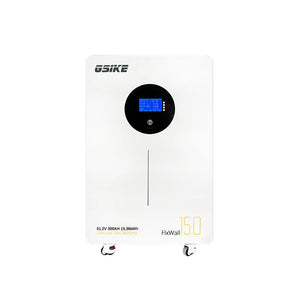
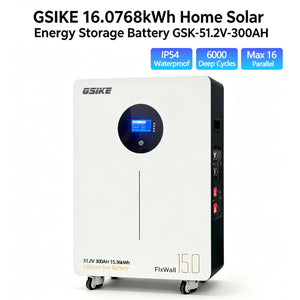
GSIKE FixWall 15.0 — 51.2V 300Ah (314Ah) 16.08kWh Floor LiFePO4 Cabinet With 200A BMS for Czechia
The GSIKE FixWall 15.0 is a rolling 51.2V 314Ah LiFePO4 cabinet holding 16.08kWh, listed at €1,569.99 against a struck reference of €2,250.00. It is a battery-only DC node with no built-in AC outlet, working behind a separate 230V or 230/400V hybrid inverter for backup and PV self-consumption in Czech family houses, countryside properties and light-business premises.
Product Overview
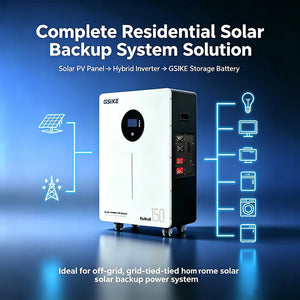
On its casters, this 48V-class cabinet takes a garage, cellar, plant room, country property or business outbuilding and feeds a compatible hybrid inverter. It stores DC energy only and makes no AC itself; appliances run through the inverter chosen for the project.

On the EU storefront the price reads €1,569.99, reduced from €2,250.00; one variant, in stock. Free delivery covers the 15 listed EU markets, Czechia included: order handling 1–3 days, onward transit 2–7 days, a 30-day return and a three-year warranty; duties and taxes are non-refundable. Storefront entry: GSIKE 51.2V 314Ah LiFePO4 cabinet on gesike.com.
Battery and Electrical Specifications
Figures below follow the verified 300Ah cabinet record: prismatic 3.2V LFP cells from Penghui (Great Power) sit in a 16S1P block watched by a smart 200A BMS.
| Specification | Detail |
|---|---|
| Chemistry and assembly | Prismatic 3.2V LiFePO4 cells in a 16S1P block, supplied by Penghui (Great Power) |
| Nominal voltage | 51.2V, the 48V-class residential bus |
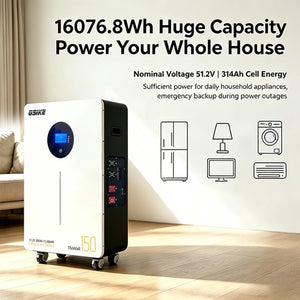
| Real capacity and energy | 314Ah at 16,076.8Wh, equal to 16.08kWh; the printed 300Ah / 15.36kWh mark is the nominal marketing label |
| BMS current | 200A charge and 200A discharge, a DC ceiling near 10.2kW (10,240W at 51.2V); not a 15kW continuous rating |
| Working voltage | 43.2V to 58.4V, with discharge cut-off close to 43.2V |
| Charge voltage | 58.4V bulk and absorption, the standard CC/CV profile for 16S LFP |
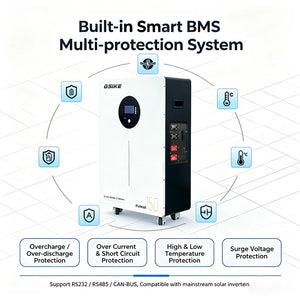
| Built-in smart BMS | Guards against over-charge, over-discharge, over-current, short-circuit, high and low temperature, and surge events |
| Communication | RS232, RS485 on the Pylontech protocol, and CAN-BUS for pairing with a compatible 48V hybrid inverter |
| Inverter compatibility | Matches devices such as Deye, Growatt, Sungrow, Sofar, Sol-Ark, EG4; model-by-model compatibility is not certified, verify before purchase |
| Cycle life | 6000 cycles at 80% DoD and 25°C, design life around ten years; beyond 10,000 cycles at 50% DoD |
| Usable reserve | Around 12.9kWh at 80% DoD; roughly 11.5–12kWh usable AC through an inverter near 95% efficiency |
| AC output | None; battery-only DC node, and phase count follows the connected inverter |
| Monitoring | Round LCD and on/off switch; no WiFi, Bluetooth or mobile app |


Expansion, Cabinet Build and Environment
Several cabinets stand side by side on the 51.2V bus; casters roll the unit into place, and the IP54 case is meant for dry indoor rooms or a closed sheltered spot in a Czech home or premises. Under the continental climate, keep the enclosure in a frost-free, ventilated cellar or plant room rather than an unheated shed exposed to winter frost.
| Specification | Detail |
|---|---|
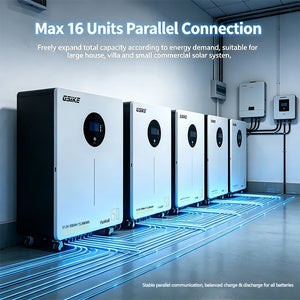
| Expansion scheme | Parallel only, up to 16 cabinets on the 51.2V bus with unique address 1–16; series wiring is excluded |
| Mixing rule | Brands and capacities are never mixed inside one parallel bank |
| Form factor | Floor-standing rolling cabinet on casters; round LCD, on/off switch, terminal blocks |
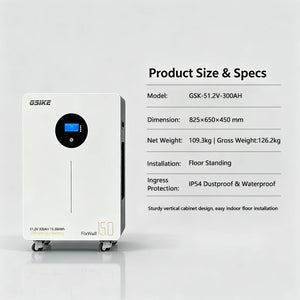
| Ingress rating | IP54, dust-tight and splash-proof but not waterproof; indoor or dry sheltered use only |
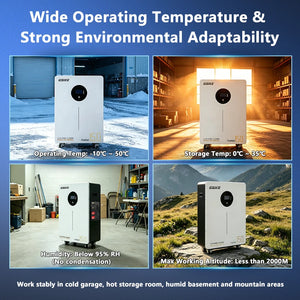
| Operating temperature | −10°C up to 50°C |
| Storage temperature | 0°C to 35°C, humidity under 95% RH without condensation, altitude below 2000m |
| Low-temperature charging | No self-heating fitted; charging must not occur below 0°C |
| Net weight | 109.3kg |
| Gross weight | 126.2kg on pallet |
| Dimensions | 825 high × 650 wide × 450 deep mm |


Home and Solar Context in Czechia
One cabinet holds essential household circuits through an evening cut and, in self-consumption mode, shifts solar energy toward the afternoon and evening draw. Runtime reflects household consumption, inverter efficiency, DoD and how many cabinets share the bus.
| Context Point | Detail |
|---|---|
| Whole-home reserve | Around 12.9kWh usable at 80% DoD before inverter losses; essential circuits are sized to this reserve rather than the full nominal 16.08kWh |
| Inverter pairing | Works with a compatible single-phase 230V or three-phase 230/400V inverter; phase count and backup switching belong to that inverter |
| PV self-consumption | Charged by rooftop or ground-mounted PV through the hybrid inverter or MPPT regulator; autonomy days are planned around daily yield and the evening load |
| Heavy household loads | Heat-pump, circulation-pump and well-pump startup current must be checked against the 200A BMS ceiling before sizing the system |
| Placement | Floor standing with caster clearance; check floor load-bearing capacity, frost-free ventilation and the delivery route before the pallet arrives |


In the Packaging
| Item | Detail |
|---|---|
| FixWall 15.0 51.2V 314Ah cabinet with casters | Yes |
| Terminal blocks and connection fittings | As specified; check the cables on the product listing before purchase |
| User manual | Included |
| Hybrid inverter, solar panels or mounting rails | Supplied separately for the Czech installation |
Pros & Cons
Objective Strengths
- Large reserve: the 314Ah rating holds 16.08kWh for whole-home backup, evening self-consumption and multi-day autonomy around a Czech home or holding.
- Capable BMS: 200A charge and discharge, six protection levels and cell balancing steady household and workshop draws.
- Linked communication: RS232, Pylontech RS485 and CAN-BUS keep charge limits aligned with the compatible 48V inverter.
- Expandable bank: sixteen cabinets can later be paralleled on the 51.2V bus as demand grows.
- Long service span: 6000 cycles at 80% DoD and 25°C, a ten-year design horizon, three-year warranty.
- Caster format: wheels move the cabinet into a garage, cellar or technical room without any wall bracket.
Objective Weaknesses
- DC only: no mains outlet; household circuits need a separate 48V hybrid inverter.
- DC ceiling: the 200A rating sets a DC ceiling near 10.2kW, not a 15kW continuous nominal; loads must stay within that ceiling.
- No companion app: the round LCD is the only status display; WiFi, Bluetooth and remote phone control are not provided.
- Bank layout: series strings are ruled out; cabinets of another make or rating never join one bank.
- Cold-weather limit: no warming element is fitted; charging below 0°C is prohibited.
- Weighty case: 109.3kg net and 126.2kg gross palletised; plan a solid floor, two-person handling and an accessible delivery route.
Practical Applications
This cabinet is built for large fixed stores: its 48V DC node drives a compatible inverter in home backup, cellar or plant room, farm and small-business premises, and garage installs.

Home Technical Room
The cabinet stands in a ventilated technical room, wired to the hybrid inverter, so essential circuits are ready for an interruption.

Parallel Reserve Bank
Extra cabinets parallel onto the bus, raising total stored energy for a larger home or a premises with longer backup needs.

Farm, Workshop and Small Shop
The unit backs a farm holding, compact workshop or small shop, keeping tools, fridges and circuits steady on reserve.

Garage or Outbuilding Placement
Casters roll the unit into a garage or outbuilding for fitting and servicing; no wall bracket is involved.
Frequently Asked Questions
What voltage, Ah rating and stored energy does the FixWall 15.0 specify?
On the 51.2V nominal 48V-class bus the cabinet carries 314Ah and holds 16,076.8Wh, or 16.08kWh, from 3.2V LiFePO4 cells in a 16S1P block. The printed 300Ah / 15.36kWh figure is the nominal sales label, not the measured cell rating.
What DC power ceiling does the BMS set on the 314Ah cabinet?
The smart BMS caps both charging and discharging at 200A, a DC ceiling near 10.2kW (10,240W at 51.2V). This is not a 15kW continuous rating; any AC reaching household loads comes from the separate inverter attached to the bank.
Can the cabinet supply appliances without a separate inverter?
It cannot. No built-in mains outlet exists, so the unit stays a DC-only node. Household circuits get single-phase 230V or three-phase 230/400V AC from the system's own hybrid inverter rather than from the cabinet.
Which inverters exchange data with this battery on a three-phase system?
The link uses RS232, an RS485 Pylontech line and CAN-BUS. Suitable 48V Pylontech-compatible makes include Deye, Growatt, Sungrow, Sofar, Sol-Ark and EG4; per-model compatibility is unverified, so check the protocol before ordering.
How many cabinets may be paralleled onto one 51.2V bus?
Sixteen units top out the parallel bus, each with a distinct address 1 to 16. Series strings are excluded, and cabinets of another make or Ah rating must never enter the same bank.
How long will the cabinet last in cycles, and what warranty is attached?
The cells reach 6000 cycles at 80% DoD and 25°C, a roughly ten-year design span, and past 10,000 cycles at 50% DoD; the unit is sold within the EU on a three-year warranty.
How much AC energy survives depth-of-discharge and inverter losses?
Cutting to 80% DoD leaves about 12.9kWh before conversion losses; a roughly 95%-efficient inverter passes on around 11.5–12kWh of usable AC to the building.
Where does the cabinet stand indoors, and what are its weight and case size?
Wheels carry it into position rather than a wall mount. Net mass 109.3kg, 126.2kg gross on the pallet; case 825 H × 650 W × 450 D mm; round LCD, switch and terminal blocks, IP54 indoors or in a dry sheltered spot.
Which faults does the cabinet BMS defend against?
Over-charge, over-discharge, over-current, short-circuit, high and low temperature, and surge events are all monitored, with internal cells kept balanced against one another.
What ambient and storage bands apply, and is charging allowed below freezing?
Use runs between −10°C and 50°C; storage between 0°C and 35°C. No warming element exists, and sub-zero charging is not permitted.
Related GSIKE Guides for Czechia
Where repeated cuts and evening load shifting place the value of a 16kWh cabinet in a Czech household.
A side-by-side look at the cabinet versus established European and Asian 16kWh options across capacity, communication, format and warranty.
Work out stored-energy targets for multi-day autonomy from daily draw and solar yield at a country house, farm or isolated plot.
Walk through three-phase inverter pairing, parallel cabinet addressing, wiring checks and pallet delivery on a residential install.
LiFePO4 battery 51.2V 300Ah, 314Ah 16kWh home battery, whole-house backup battery for Czechia, 48V 314Ah 16.08kWh LFP cabinet, GSIKE FixWall 15.0, 16kWh LiFePO4 battery for a solar system, floor cabinet with 200A BMS, 16kWh battery for self-consumption, GSIKE 16kWh floor storage for backup, RS485 Pylontech-protocol and CAN battery, high-capacity 48V bank for family house, farm and light business

