


GSIKE FixWall 15.0: 314Ah 16.08kWh Floor LiFePO4 Cabinet, Portugal
Estimate delivery times: 2-7 Business days (European Union, United States).
Return within 30 days of purchase. Duties & taxes are non-refundable.
GSIKE FixWall 15.0: 314Ah 16.08kWh Floor LiFePO4 Cabinet, Portugal
Description
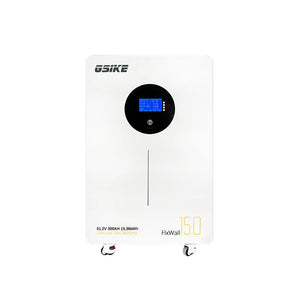
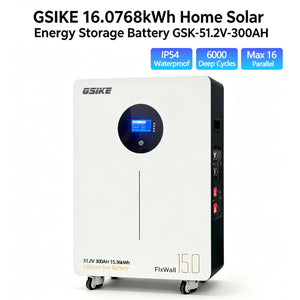
GSIKE FixWall 15.0 — 51.2V 300Ah (314Ah) 16.08kWh Floor LiFePO4 Cabinet With 200A BMS for Portuguese Homes and Rural Properties
The GSIKE FixWall 15.0 is a rolling 51.2V 314Ah LiFePO4 cabinet holding 16.08kWh, listed at €1,569.99 against a struck reference of €2,250.00. It is a battery-only DC node with no built-in AC outlet, working behind a separate 230V or 230/400V hybrid inverter for whole-home backup and PV self-consumption in Portuguese villas, quintas, farms and light-business premises.
Product Overview
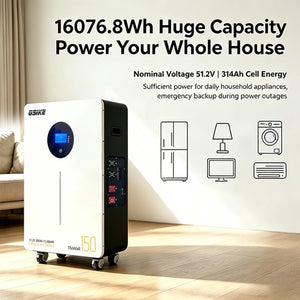
This sizeable 48V-class cabinet on casters is placed in a garage, plant room, quinta outbuilding, farm building or workshop and feeds a compatible hybrid inverter. It holds DC energy only and produces no AC on its own; the circuits in the home are fed by whichever inverter the installation uses.

Listed at €1,569.99 against a former €2,250.00 price; a single variant, currently in stock. Delivery to the 15 listed EU markets is free; handling takes 1–3 days and transit 2–7 days, the return window is 30 days, and a three-year warranty applies, with any duties and taxes non-refundable. Product listing: View the GSIKE 51.2V 314Ah cabinet on gesike.com.
Battery and Electrical Specifications
The figures below come from the verified 300Ah cabinet record: 3.2V prismatic LFP cells from Penghui (Great Power) in a 16S1P layout, watched over by a smart 200A BMS.
| Specification | Detail |
|---|---|
| Chemistry and assembly | Prismatic 3.2V LiFePO4 cells, 16S1P; cell brand Penghui (Great Power) |
| Nominal voltage | 51.2V (48V-class bus) |
| Real capacity and energy | 314Ah / 16,076.8Wh = 16.08kWh; the printed 300Ah / 15.36kWh mark is the nominal marketing label |
| BMS current | 200A charge and 200A discharge, DC ceiling about 10.2kW (10,240W at 51.2V); this is not a 15kW continuous rating |
| Working voltage | 43.2V – 58.4V; discharge cut-off near 43.2V |
| Charge voltage | 58.4V bulk/absorption, standard CC/CV profile for 16S LFP |
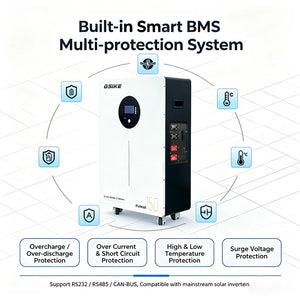
| Built-in smart BMS | Protection against over-charge, over-discharge, over-current, short-circuit, high and low temperature, surge voltage |
| Communication | RS232, RS485 (Pylontech protocol), CAN-BUS for pairing with a compatible 48V hybrid inverter |
| Inverter compatibility | Suitable devices: Deye, Growatt, Sungrow, Sofar, Sol-Ark, EG4; compatibility is not certified for every model, verify before purchase |
| Cycle life | 6000 cycles at 80% DoD, 25°C; design life roughly ten years; beyond 10,000 cycles at 50% DoD |
| Usable reserve | About 12.9kWh at 80% DoD; roughly 11.5–12kWh usable AC through an inverter of around 95% efficiency |
| AC output | None; battery-only DC node; phase count depends on the connected inverter |
| Monitoring | Round LCD and on/off switch; no WiFi or Bluetooth, no mobile app |


Expansion, Cabinet Build and Environment
Several cabinets stand side by side on the 51.2V bus; casters let the unit be rolled into position, and the IP54 case is intended for dry indoor rooms or a closed sheltered spot in a Portuguese home or premises.
| Specification | Detail |
|---|---|
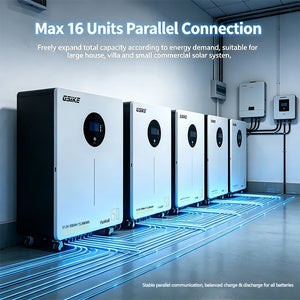
| Expansion scheme | Parallel only, up to 16 cabinets on the 51.2V bus with unique address 1–16; series connection not allowed |
| Mixing rule | Do not mix brands or capacities in the same parallel bank |
| Form factor | Floor-standing cabinet on casters, rollable; round LCD, on/off switch, terminal blocks |
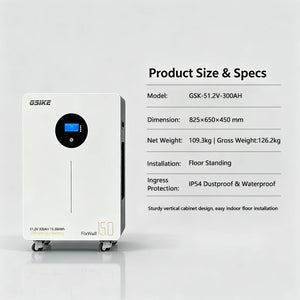
| Ingress rating | IP54, dust-tight and splash-proof; not waterproof; indoor or dry sheltered use only |
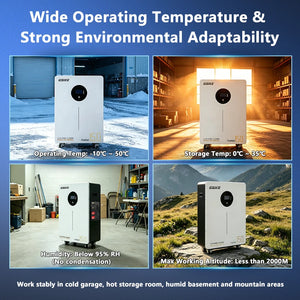
| Operating temperature | −10°C to 50°C |
| Storage temperature | 0°C to 35°C; humidity below 95% RH without condensation; altitude below 2000m |
| Low-temperature charging | No self-heating; do not charge below 0°C |
| Net weight | 109.3kg |
| Gross weight | 126.2kg on pallet |
| Dimensions | 825 H × 650 W × 450 D mm |


Home and Solar Context in Portugal
One cabinet keeps essential household circuits through an evening interruption and, set for self-consumption, shifts solar energy toward the afternoon and evening load. Runtime depends on daily consumption, inverter efficiency, depth of discharge and the number of cabinets on the bus. In a mild Mediterranean climate the unit still needs a ventilated, condensation-free indoor position rather than an exposed outdoor corner.
| Context Point | Detail |
|---|---|
| Whole-home reserve | About 12.9kWh usable at 80% DoD before inverter losses; essential circuits are sized to this reserve rather than to the full nominal 16.08kWh |
| Inverter pairing | Works with a compatible single-phase 230V or three-phase 230/400V inverter; phase count and backup switching belong to the inverter |
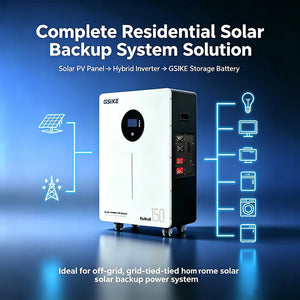
| PV self-consumption | Charged by rooftop or ground-mounted PV through the hybrid inverter or MPPT regulator; autonomy days are planned around daily yield and the evening load |
| Typical backed-up loads | Fridge, lighting, network gear and circulation pumps; heavier loads such as pool pumps and heat pumps must be sized against the DC ceiling and inverter rating before connection |
| Placement | Floor standing with room for the casters; check floor load-bearing capacity, ventilation and the delivery route before pallet arrival |


In the Packaging
| Item | Detail |
|---|---|
| FixWall 15.0 51.2V 314Ah cabinet with casters | Yes |
| Terminal blocks and connection fittings | As specified; check the cables on the product listing before purchase |
| User manual | Included |
| Hybrid inverter, solar panels or mounting rails | Not included; chosen separately for the Portuguese installation |
Pros & Cons
Objective Strengths
- Generous reserve: the 314Ah rating stores 16.08kWh for whole-home backup, evening self-consumption and multi-day autonomy in a Portuguese home or holding.
- Robust BMS: 200A on charge and discharge, six protection stages and active cell balancing for steady household and workshop loads.
- Linked communication: the RS232, Pylontech-protocol RS485 and CAN-BUS lines match charge limits to the matched 48V inverter.
- Expandable array: as many as 16 cabinets may be paralleled on the 51.2V bus when capacity needs rise.
- Longevity: 6000 cycles at 80% DoD and 25°C, roughly a ten-year design horizon, covered by a three-year warranty.
- Rollable format: casters place the cabinet in a garage, plant room or quinta outbuilding without a wall bracket.
Objective Weaknesses
- DC-only node: the cabinet outputs no AC, so household circuits require a separate 48V hybrid inverter.
- DC ceiling: 200A corresponds to a roughly 10.2kW DC ceiling rather than a 15kW continuous rating; keep connected loads within that bound.
- No software link: the round LCD alone shows status; there is no WiFi, Bluetooth or phone app.
- Parallel-only wiring: series strings cannot be formed, and cabinets of another brand or rating must never share the same bank.
- No warming element: low-temperature self-heating is not fitted, and charging below 0°C is forbidden for the cells.
- Heavy case: at 109.3kg net (126.2kg gross on pallet) it calls for a firm floor, two-person handling and clear delivery access.
Practical Applications
The cabinet suits high-capacity fixed storage where the 48V DC node feeds a compatible inverter: home backup, plant room, business premises and garage setups.

Home Plant Room
The cabinet stands in a ventilated plant room wired to the hybrid inverter, so essential circuits are ready for an interruption.

Parallel Reserve Bank
Extra cabinets join the bus in parallel and raise total stored energy for a larger home or a site needing longer reserve.

Quinta, Farm and Small Workshop
The unit supports a rural quinta, farm holding, compact workshop or small shop, keeping tools, fridges and circuits stable on reserve.

Garage or Outbuilding Placement
The casters let the cabinet be wheeled into a garage or outbuilding for fitting and later servicing; fixing to a wall is not part of this design.
Frequently Asked Questions
Which voltage, capacity and stored energy does the GSIKE FixWall 15.0 carry?
Its nominal bus is 51.2V (48V class); the cabinet is rated 314Ah and holds 16,076.8Wh, or 16.08kWh, built from 3.2V LiFePO4 cells in a 16S1P arrangement. The 300Ah / 15.36kWh marking printed on the unit is only the nominal marketing label; the measured cell rating is 314Ah.
What DC power ceiling does the 314Ah cabinet's BMS allow?
Both charging and discharge are capped by the smart BMS at 200A, a DC ceiling near 10.2kW (10,240W at 51.2V). Do not read this as a 15kW continuous rating; AC power reaching household circuits always comes from the separate inverter attached to the battery.
Does the cabinet run Portuguese household appliances by itself?
No. The cabinet has no built-in AC outlet and works purely as a DC battery node. Household AC — single-phase 230V or three-phase 230/400V — comes from the separate hybrid inverter in the system, never from the cabinet itself.
Which inverters talk to the cabinet in a three-phase setup?
Communication travels via RS232, an RS485 line carrying the Pylontech protocol, and CAN-BUS. The battery pairs with 48V Pylontech-compatible inverters including Deye, Growatt, Sungrow, Sofar, Sol-Ark and EG4; not every model is certified compatible, so check the protocol before buying.
What is the parallel limit for cabinets on a single 51.2V bus?
As many as 16 cabinets can run in parallel on one 51.2V bus, each assigned a unique address from 1 to 16. Series strings are not possible, and cabinets of another brand or rating must never share a bank.
How many cycles, what design life and what warranty cover the cabinet?
Cell life is rated at 6000 cycles down to 80% DoD at 25°C, with an expected design life around ten years, and passes 10,000 cycles when cycled to 50% DoD. A three-year warranty covers the unit, which is sold within the EU market.
What usable AC energy remains after DoD and inverter losses?
Cycling to 80% DoD leaves roughly 12.9kWh before inverter losses; once a roughly 95%-efficient inverter is taken into account, about 11.5–12kWh of usable AC reaches the household.
Where does the cabinet stand indoors, and how heavy and large is it?
The unit moves on its casters and stands on the floor rather than on a wall bracket. It weighs 109.3kg net (126.2kg gross on the pallet), and the enclosure measures 825 H × 650 W × 450 D mm; a round LCD, on/off switch and terminal blocks sit on the front, and the IP54 rating suits indoor or dry sheltered placement.
What fault events does the cabinet's smart built-in BMS protect against?
On the cabinet, the controller watches for over-charge, over-discharge, over-current, short-circuit, high and low temperature, and surge-voltage events, while equalising each internal cell against the rest.
Which ambient and storage temperatures are permitted, and is charging below 0°C allowed?
Operation is allowed from −10°C to 50°C, while storage sits between 0°C and 35°C. A self-heating element is not fitted, and charging is forbidden whenever the cells are below 0°C.
Related GSIKE Guides for Portugal
How repeated outages and shifting the evening load change the value of the 16kWh cabinet in a Portuguese home.
Set the cabinet beside other 16kWh home batteries available to European buyers, weighing capacity, comms, cabinet shape and warranty terms.
Size stored energy for several days off-grid using daily consumption and PV yield at a Portuguese quinta, farmstead or isolated plot.
Cover three-phase inverter matching, cabinet addressing in a parallel bank, wiring checks and pallet delivery for a Portuguese installation.
LiFePO4 battery 51.2V 300Ah, 314Ah 16kWh home battery, whole-house backup battery for Portugal, 48V 314Ah 16.08kWh LFP cabinet, GSIKE FixWall 15.0, 16kWh LiFePO4 battery for a solar system, floor cabinet with 200A BMS, 16kWh battery for self-consumption, GSIKE 16kWh floor storage for backup, RS485 Pylontech-protocol and CAN battery, high-capacity 48V bank for villa, quinta, farm and light business

