


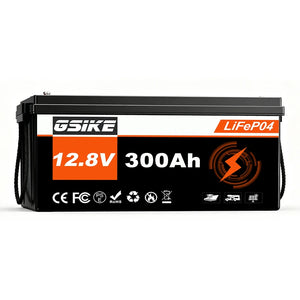


GSIKE 12.8V 300AH Lithium Energy Storage Battery for Solar Power System
Estimate delivery times: 2-7 Business days (European Union, United States).
Return within 30 days of purchase. Duties & taxes are non-refundable.
GSIKE 12.8V 300AH Lithium Energy Storage Battery for Solar Power System
Description
GSIKE 12.8V 300Ah LiFePO4 Battery — 4019.2Wh, 100A BMS, 6000 Cycles, 4P4S to 64.3kWh, IP65, for RV, Off-Grid & Home Storage, Free EU Shipping
The GSIKE 12.8V 300Ah LiFePO4 battery stores 4019.2Wh of deep-cycle energy in a 26kg IP65 ABS case — 314Ah engineering cells (a ~3840Wh "300Ah" nameplate), a 100A BMS capped at 1280W continuous, 6000 cycles at 80% depth of discharge, a 14.4V CC/CV charge profile and expansion to a 16-unit / 64.3kWh bank, sold across Europe at €369.99 with free delivery and a 30-day return.
4019.2 Wh 314 Ah (300Ah class) 100A BMS 1280W ceiling 6000 cycles 400A pulse / 1s 14.4V CC/CV IP65 M8 terminals up to 64.3 kWh bank

Manual specifications
| Parameter | Value |
|---|---|
| Chemistry / nominal voltage | LiFePO4 (LFP), 12.8 V nominal (4 cells in series) |
| Rated capacity / energy | 314 Ah / 4019.2 Wh (12.8V × 314Ah engineering cells); "300Ah" tier nameplate ≈ 3840 Wh |
| Continuous current | 100 A charge / 100 A discharge (max continuous power 1280 W) |
| Pulse / peak | 400 A for 1 second only (startup inrush; not continuous) |
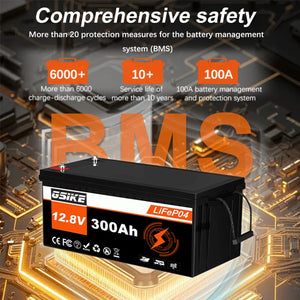
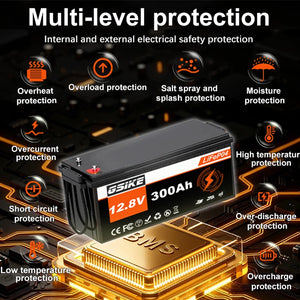
| BMS | 100 A BMS — over-charge, over-discharge, over-current, over-temperature and short-circuit protection (OEM-supplied module) |
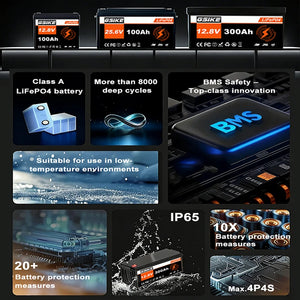
| Cycle life | 6000 cycles at 80% DoD (about 5000+ at full 100% DoD) |
| Charge settings | CC/CV; charge voltage 14.4 V ±0.2 V; recommended charge current 40 A |
| Discharge cut-off | 10 V end-of-discharge |
| Internal resistance | ≤20 mΩ |
| Expansion | 4P4S = 16 units = 64.3 kWh (4S = 51.2 V, 4P = 1256 Ah) |
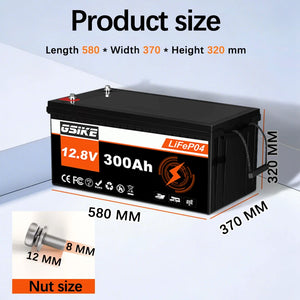
| Terminals | M8 bolt terminals (8 mm bolt / 12 mm nut) |
| Housing / ingress | ABS housing, IP65; CE, RoHS, UN38.3 certified |
| Weight / size | Net 26 kg (gross 27 kg); 540 × 283 × 275 mm (L×W×H) |
| Self-discharge | Less than 3% per month |
| Warranty / design life | 3-year warranty; ~10-year design life |
| Price / stock | €369.99 EUR · In stock, new condition |
| Delivery / returns | Free shipping to European countries (1–3 days handling + 2–7 days transit) · 30-day returns |
Pick the right GSIKE capacity — 300Ah vs 100Ah vs 25.6V-100Ah sibling
Same GSIKE line, three SKUs. This page sells the 12.8V 300Ah; the table below helps you compare it against the smaller 12.8V 100Ah sibling and the 25.6V 100Ah (8S) variant. Energy numbers use the engineering-cell figures; the 300Ah gives ~3.1× the run-time of the 100Ah at the same 1280W ceiling.
| Parameter | GSIKE 12.8V 300Ah (this page) | GSIKE 12.8V 100Ah sibling | GSIKE 25.6V 100Ah sibling |
|---|---|---|---|
| Nominal voltage | 12.8 V | 12.8 V | 25.6 V (8S string) |
| Rated capacity | 314 Ah (300Ah class) | 100 Ah | 100 Ah |
| Energy | 4019.2 Wh (~3.84 kWh nameplate) | ~1.28 kWh | ~2.56 kWh |
| Continuous power | 1280 W (100 A) | 1280 W (100 A) | ~2.56 kW (100 A at 25.6 V) |
| Run-time at a fixed 12V load | ~3.1× the 100Ah | baseline | ~2× the 100Ah |
| Net weight | 26 kg | 9.8 kg | larger 8S pack |
| Price (EUR, 14 Oct 2026) | €369.99 | €159.99 | own-line SKU |
| Best for | multi-day RV, off-grid cabin, home solar storage, trolling | weekend camping, single-vehicle leisure | mid-voltage 24V-class systems |
Lead-acid replacement — about six 12V 100Ah batteries, in parallel
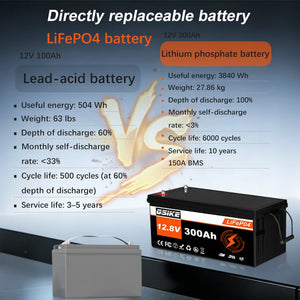
Because LiFePO4 safely delivers close to its full capacity while flooded lead-acid is limited to about 42% depth of discharge, one GSIKE 300Ah replaces roughly six 12V 100Ah lead-acid batteries wired IN PARALLEL on the same 12V bus. Never wire them in series to make 24V — that is a different system.
| Metric | One GSIKE 12.8V 300Ah LiFePO4 | Six 12V 100Ah flooded lead-acid (parallel) |
|---|---|---|
| Nominal energy | 4019.2 Wh | ~7200 Wh nameplate (6 × 1200 Wh) |
| Usable energy (DoD) | ~3818–4019 Wh (~95–100% usable) | ~3024 Wh (~42% DoD for longevity) |
| Cycle life | 6000 cycles @80% DoD | ~500 cycles |
| Weight | 26 kg net | ~150–180 kg |
| Maintenance | None (no watering, no equalisation) | Watering / venting / equalisation |
| Replacement ratio | 1 GSIKE 300Ah ≈ six 12V 100Ah lead-acid IN PARALLEL for the same usable Wh at 12V | |
Expected run-time by load (3840 Wh nameplate ÷ load)
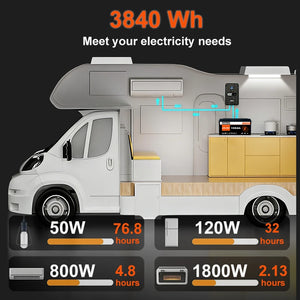
Ideal DC runtimes at the 3840Wh 300Ah nameplate, before derating. Keep every continuous load at or below the 1280W ceiling; if you pull the full 1280W, the bank lasts ~3.0–3.14h. When running through a separate 12V inverter, derate by about 90–95% efficiency and leave depth-of-discharge headroom.
| Load | Example use | Runtime (3840 Wh nameplate) |
|---|---|---|
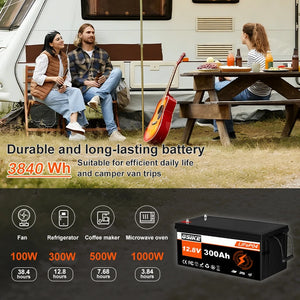
| 100 W | Laptop + lights + fan | 38.4 h |
| 300 W | Compressor fridge | 12.8 h |
| 500 W | Fridge + TV + fan | 7.68 h |
| 800 W | Fridge + small kitchen loads | 4.8 h |
| 1000 W | Higher DC / inverter load | 3.84 h |
Charge settings & operating temperatures
| Item | Specification |
|---|---|
| Charge method | CC/CV (constant current, constant voltage) |
| Charge voltage | 14.4 V ±0.2 V |
| Recommended charge current | 40 A; the BMS allows up to 100 A continuous charge |
| Discharge cut-off | 10 V end-of-discharge cut-off |
| Internal resistance | ≤20 mΩ |
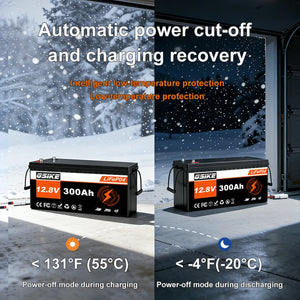
| Charge temperature | 0 °C to 50 °C; do not charge below 0 °C (no self-heating) |
| Discharge temperature | −20 °C to 60 °C |
| Storage temperature | −10 °C to 50 °C; store at ~50% charge, self-discharge <3%/month |
Expansion — 4P4S up to 64.3 kWh
The battery supports parallel and series building. 4P4S = four in parallel × four in series: 16 units total = 64.3 kWh. 4S raises the voltage to 51.2 V; 4P raises the capacity to 1256 Ah (51.2 V × 1256 Ah = 64,307 Wh).
| Configuration | Voltage | Capacity | Energy | Units |
|---|---|---|---|---|
| 1P1S (single) | 12.8 V | 314 Ah | ~4.0 kWh | 1 |
| 2P1S | 12.8 V | 628 Ah | ~8.0 kWh | 2 |
| 4P1S | 12.8 V | 1256 Ah | ~16.1 kWh | 4 |
| 4P4S (max) | 51.2 V | 1256 Ah | 64.3 kWh | 16 |
Pros & cons
Pros
- 4019.2 Wh at ~100% usable DoD with a 100A BMS and 6000 cycles @80% DoD — one unit replaces about six 12V 100Ah lead-acid batteries in parallel.
- Cheaper per Wh than the 100Ah sibling: €0.092/Wh vs €0.125/Wh — about 26% less per watt-hour for larger off-grid and home loads.
- Expandable to 64.3 kWh (4P4S, 16 units, 51.2 V / 1256 Ah) so one starter unit can grow into a whole home-storage bank.
- €369.99 undercuts the branded EU 300Ah field — LiTime (€579.99), Renogy Core self-heating (€599.99), Redodo (€599.99) and Power Queen (€539.99) — with free EU shipping and 30-day returns.
- IP65 ABS case, M8 terminals, CE/RoHS/UN38.3, 26 kg net — far lighter and smaller than the ~150–180 kg lead-acid equivalent.
- Real buyer rating 4.9 / 5 from 18 reviews, praising multi-day camper run-time, home solar self-consumption and trolling-motor endurance.
Cons
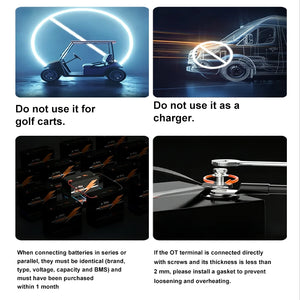
- Same 100A BMS / 1280W ceiling despite 3× capacity. You get ~3.1× the run-time, not ~3.1× the power. Parallel units add current; a single 300Ah does not raise the 1280W continuous ceiling, and several rivals ship a 200A BMS.
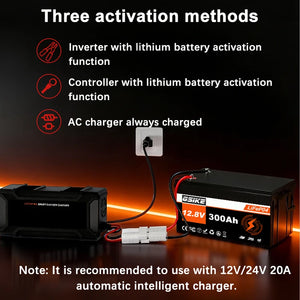
- Needs a 14.4V lithium charger. A legacy lead-acid charger that only floats at 13.5–13.8V without a LiFePO4 profile will not fully charge it.
- 26 kg is heavy — plan a two-person lift into a motorhome locker or boat compartment.
- Match identical units within ~1 month of production / charge history for series or parallel; never mix new and worn cells in one bank.
- Not for golf carts — this is a 12V leisure / deep-cycle pack, not a traction battery for golf-cart drive current.
- No cold charging below 0°C (charge window 0–50°C; discharge works down to −20°C). Bare EU-warehouse strips (e.g. DATOUBOSS at €355.68) are slightly cheaper and ship a 200A BMS; GSIKE's edge is the storefront, 30-day return, 3-year warranty and the verified review set.
Where this battery fits — real European use cases
Camper van
On a bench shelf it runs the fridge, water pump, heater and chargers for several days off-grid — exactly what multi-day travellers want.
Motorhome locker
Strapped into the under-seat bay, the 54 cm case fills an existing battery compartment and powers extended trips away from hook-ups.
Forest log cabin
A remote cabin relies on it for warm light and phone power after the panels stop generating at dusk, across several cloudy days.
Home solar storage
Mounted on a rack beside the switchgear, it stores daytime solar and covers the evening self-consumption load, expandable later.
Fishing boat / trolling motor
The steady 100A discharge gives a trolling motor smooth thrust without sag — buyers report a full day of fishing on one charge.
Parallel battery bank
Add matched units in parallel to grow the run-time (current adds) — the path toward a 16-unit / 64.3 kWh system.
Off-grid garden shed
On a shed shelf it cycles daily from a small solar array; the IP65 case shrugs off damp workshop air.
Workshop charging
On a workbench it charges from the 14.4V source and supplies bench lighting, pumps and chargers — the 10V cut-off protects the cells.
Shipping & returns
| Policy point | Detail |
|---|---|
| Price | €369.99 EUR · In stock, new condition |
| Free delivery to | European countries) |
| Handling / transit | Handling 1–3 days + transit 2–7 days, shipping rate EUR 0 |
| Returns | 30-day return window from delivery, by post, in original condition and packaging |
| Return cost | Return shipping is handled by the merchant; original import duties and taxes are non-refundable |
Frequently asked questions
How much energy does this battery really hold — 300Ah or 314Ah?
The engineering cells are 314Ah / 4019.2Wh (12.8V × 314Ah). The "300Ah" tier name × 12.8V = ~3840Wh, the figure printed on marketing and runtime graphics. Both describe the same pack. Spec tables on this page use the conservative manual 314Ah / 4019.2Wh and the 3840Wh nameplate for run-time; we never conflate this 4kWh pack with the smaller 100Ah sibling.
What is the largest continuous load I can run — can I pull more than 1280W?
The conservative manual ceiling is 1280W continuous (12.8V × 100A charge and discharge), with a 400A one-second pulse for startup inrush. Plan every steady load at or below 1280W. GSIKE's marketing graphics for this pack show a higher BMS rating and a larger appliance; treat 1280W as your planning number and confirm the true BMS rating with the merchant before wiring anything above it (see the specification note). Parallel batteries add current — a single 300Ah does not raise the 1280W ceiling.
Does one 300Ah battery really replace six lead-acid batteries?
Roughly, on the same 12V bus. One GSIKE 300Ah delivers ~3818–4019 usable Wh at ~95–100% depth of discharge, whereas a 12V 100Ah flooded lead-acid gives only ~504 usable Wh at ~42% DoD. So one GSIKE replaces about six 12V 100Ah lead-acid batteries wired IN PARALLEL on the 12V bus. Never wire them in series to make 24V — that is a different system.
Why does the 300Ah still cap at 1280W even though it holds about 3× the energy of the 100Ah?
Because energy (Wh) and power (W) are two different things. This 12V GSIKE family uses the same 100A BMS whether the pack holds 100Ah or 314Ah, so at 12.8V the continuous ceiling is 100A × 12.8V = 1280W on every single unit. The extra cells only lengthen run-time (4019.2Wh vs ~1.28kWh) — they do not raise the one-pack power ceiling. To pull more watts continuously, wire matched units in parallel (current adds while the voltage stays 12.8V) or build a higher-voltage series bank; until then, never plan a steady load above 1280W on a single 300Ah.
How long will it run my fridge, lights and appliances?
At the 3840Wh nameplate divided by the load: 100W → 38.4h, 300W → 12.8h, 500W → 7.68h, 800W → 4.8h and 1000W → 3.84h. Keep every continuous load at or below the 1280W ceiling; at the full ceiling the bank lasts ~3.0–3.14h. When running through a separate 12V inverter, derate by about 90–95% efficiency and leave depth-of-discharge headroom.
How do I expand the bank — series or parallel, and how far?
The maximum configuration is 4P4S: four in parallel times four in series = 16 units, giving 51.2V and 1256Ah for 64.3kWh. When building a bank, use units that are identical in model and matched within about one month of production / charge history; do not mix new and heavily-used units, and keep the whole bank on the 14.4V charge profile with the 10V cut-off.
The box reads 300Ah but the manual lists 314Ah / 4019.2Wh — which rating should I trust?
Both, for different jobs. The inside cells are engineering-rated 314Ah (12.8V × 314Ah = 4019.2Wh); GSIKE sells this in the conservative "300Ah" tier, whose nameplate is 12.8V × 300Ah ≈ 3840Wh — the figure on the marketing and runtime graphics. Use 314Ah / 4019.2Wh for spec comparisons and the 3840Wh nameplate to estimate run-time. The ~180Wh gap is tier rounding, not a second battery, and it does not change the 100A BMS, the 1280W ceiling or the 6000-cycle rating.
How heavy is the 300Ah and how should I move or mount it?
It weighs 26kg net (27kg gross) — genuinely heavy, so plan a two-person lift and use the integrated handles when tilting it into a motorhome locker or boat compartment. Bolt it down through the base with the M8 terminals using the supplied hardware, keep it upright, leave ventilation around the ABS case and run the thick 12V cables short. Because the charge window is 0°C to 50°C, mount it where the space stays above freezing in winter; do not charge below 0°C even though discharge works down to −20°C.
Will it work for a golf cart or a trolling motor?
Not for a golf cart — this is a 12V leisure / deep-cycle pack, not a traction battery for the high continuous drive current of a golf-cart system. It is well suited to an electric trolling motor on a boat (several buyers report a full day on one charge), as well as campervans, motorhomes, off-grid cabins, home solar storage and camping.
What about the weight, warranty, shipping and returns?
The pack weighs 26kg net (27kg gross) — plan a two-person lift. The price is €369.99 EUR, in stock and new. Shipping is free to 15 European countries (1–3 days handling plus 2–7 days transit), with 30-day returns by post. The warranty is 3 years against a ~10-year design life, so the covered period is shorter than the expected service life at light use.
Guides & comparisons
Go deeper before you buy:
12v 300ah lifepo4 battery,300ah lithium battery,12.8v 300ah lifepo4 battery,4kwh lithium battery 12v,large 12v lithium battery,300ah leisure battery,4019wh lifepo4 battery,buy 12v 300ah lifepo4 battery europe,12v 300ah lifepo4 battery under 370 eur,12v 300ah lifepo4 eu warehouse,gsike 12.8v 300ah battery price,4kwh 12v lithium battery price comparison europe
buy 12v 300ah lifepo4 battery europe, 12v 300ah lifepo4 battery under 370 eur, 12v 300ah lifepo4 eu warehouse, 300ah lithium battery for rv camper, 300ah lifepo4 for off grid cabin solar, gsike 12.8v 300ah battery price, 12v 300ah lithium battery free shipping europe, 300ah leisure battery uk europe, 12v 300ah solar battery for home energy storage, 12v 300ah lifepo4 30 day returns warranty, 12v 300ah lifepo4 in stock europe delivery 2-7 days, 4kwh 12v lithium battery price comparison europe
100ah vs 300ah lithium battery, how many kwh is a 300ah battery, how many days autonomy will a 300ah battery give, how long will a 300ah lifepo4 battery run appliances, what size batteryfor offgridhome solar, 12vlifepo4batteriesseriesvsparallel, 4p4s lifepo4 battery bank 64kwh, how much does a 300ah lifepo4 battery weigh, how to charge a 300ah lifepo4 battery, 300ah vs 200ah lifepo4 which doi need, how many lead acid batteries does a 300ah lifepo4 replace, 12v 300ah battery runtime calculator
best 12v 300ah lifepo4 battery europe 2026, gsike vs litime 12v 300ah lifepo4, gsike vs renogy 12v 300ah lifepo4, redodo12v300ah lifepo4 vs gsike, power queen 12v 300ah lifepo4 review, eco-worthy 12v 300ah lifepo4 vs gsike, easun 12v 300ah lifepo4 vs gsike, datouboss 12v 300ah lifepo4 review, gsike 100ah vs 300ah which battery to choose, litime 300ah vs renogy core 300ah lifepo4, cheap 12v 300ah lifepo4 battery europe, 12v 300ah lifepo4 under 400 eur europe

